

Finding the best axolotl bloodworms is something almost every axolotl keeper encounters early in their journey — bloodworms are one of the most enthusiastically accepted foods by axolotls, making them an invaluable tool for encouraging feeding in picky eaters and providing diet variety alongside pellets and nightcrawlers. But bloodworms have real limitations as an axolotl food that are not always clearly explained, and feeding them incorrectly — too frequently, in the wrong format, or without understanding what they can and cannot provide nutritionally — leads to problems over time. This guide covers everything: what bloodworms actually are, their correct role in an axolotl diet, the differences between frozen and freeze-dried formats, and our top verified Amazon picks. Read this alongside our best axolotl food guide and our best axolotl pellets article for the full picture on axolotl nutrition.
What Are Bloodworms and Why Do Axolotls Love Them?
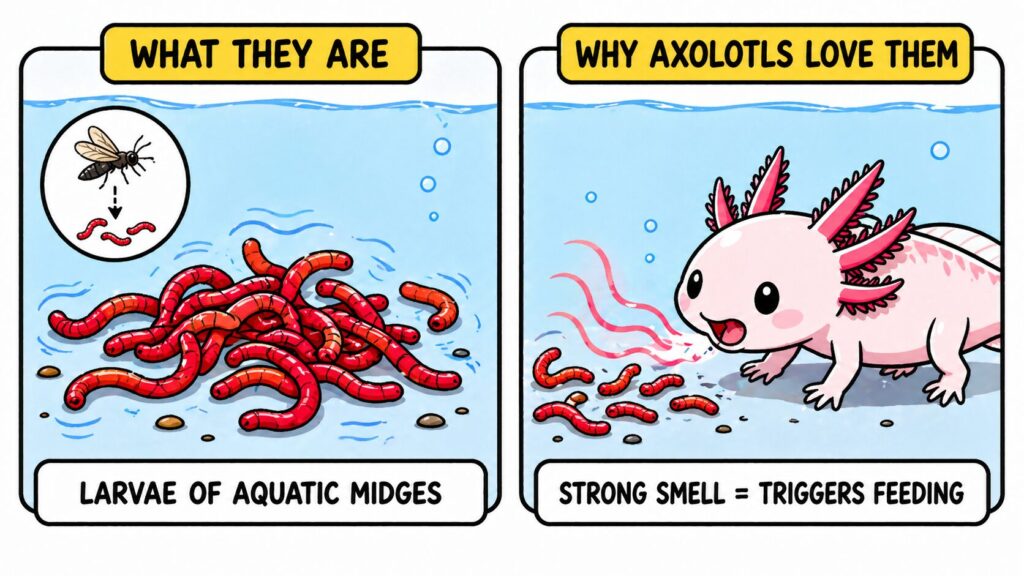
Bloodworms are the larvae of non-biting midges of the genus Chironomus — aquatic insects that spend their larval stage in freshwater sediments before emerging as the small flying insects commonly seen near lakes and ponds in summer. The name comes from the haemoglobin that gives them their characteristic bright red colour — the same molecule that makes human blood red, which allows these larvae to absorb oxygen efficiently in the low-oxygen sediment environments they inhabit.
Axolotls are drawn to bloodworms for straightforward reasons: they are red, move when live or thawed, and have a scent profile that triggers the axolotl’s instinctive feeding response powerfully. Because axolotls are carnivorous animals that hunt primarily by scent and vibration rather than vision, the strong smell of bloodworms makes them almost irresistible even to axolotls that have ignored other foods. This is precisely what makes bloodworms so useful for keepers dealing with fussy eaters or newly arrived axolotls that refuse pellets — and it is also why they should be used strategically rather than as an everyday staple.
Wild axolotls (Ambystoma mexicanum) do consume aquatic invertebrate larvae in their natural habitat in Xochimilco, Mexico City, so bloodworms represent a nutritionally familiar food type. However, the wild axolotl’s diet is highly varied — small crustaceans, worms, molluscs, and small vertebrates all feature alongside larval invertebrates. The wild population is critically endangered, which reinforces the importance of understanding their natural nutritional needs when caring for captive animals.
The Nutritional Reality of Bloodworms for Axolotls
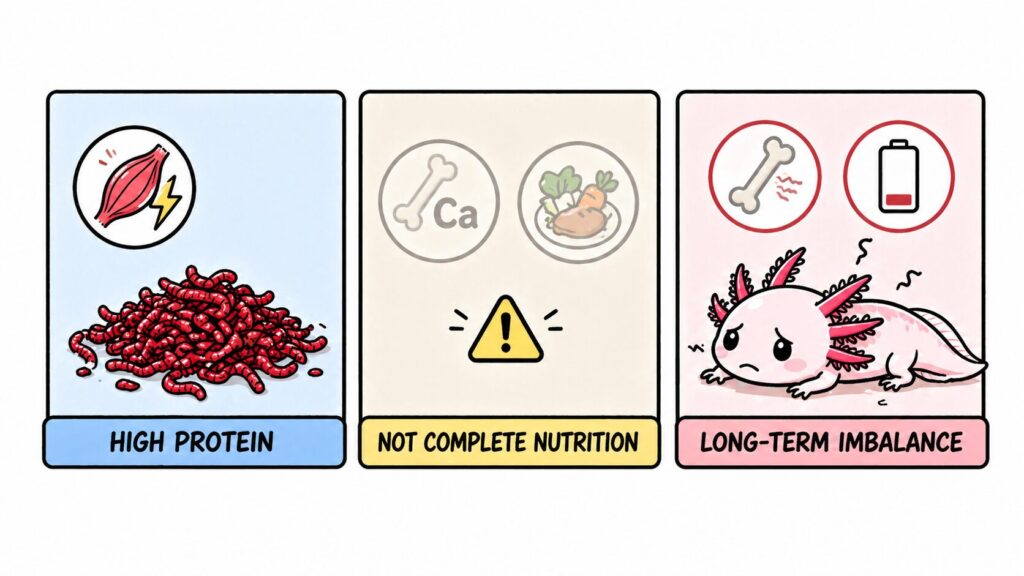
Bloodworms are genuinely nutritious — but not in a balanced, complete way. Understanding their nutritional profile explains both why they are valuable and why they should not be the primary food source.
Bloodworms have a crude protein content of approximately 50–60% on a dry weight basis, which is high and genuinely useful for a carnivore like an axolotl. They are also high in iron due to their haemoglobin content, which can support blood health. However, their fat profile is relatively limited compared to nightcrawlers, and they are deficient in several essential amino acids and minerals — particularly calcium — that axolotls need for bone development, gill health, and long-term metabolic function. According to research published in Aquaculture, dietary deficiencies in aquatic salamanders kept on limited prey variety develop over months rather than immediately, which is why bloodworm-only diets can seem to work well initially before problems emerge.
Axolotls fed exclusively or primarily on bloodworms long-term often develop nutritional imbalances that manifest as skeletal abnormalities, reduced regenerative capacity, immune weakness, and reproductive problems. The correct role for bloodworms is as a supplement and treat — 2–3 times per week maximum, alongside a quality sinking pellet as the daily staple and nightcrawlers for complete nutritional variety. Our complete best axolotl food guide covers the full dietary picture for axolotls at every life stage.
Frozen vs Freeze-Dried Bloodworms — Which Is Better for Axolotls?
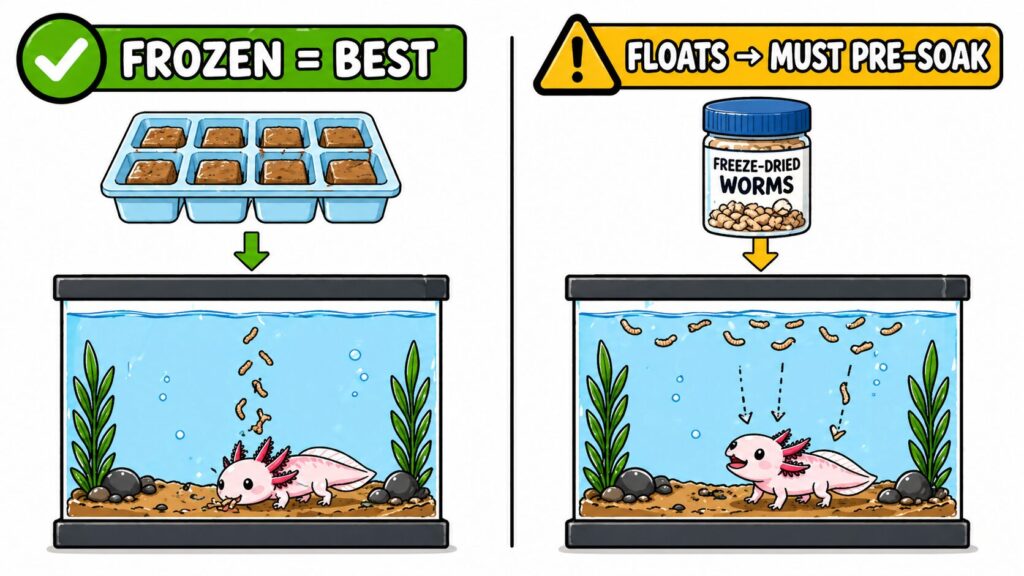
There are two main formats of bloodworm available for axolotl feeding: frozen and freeze-dried. Each has advantages and limitations, and the right choice depends on your feeding routine and storage preferences.
Frozen bloodworms are bloodworms that have been harvested, cleaned, and flash-frozen — typically packaged in flat sheets that can be broken into cubes or pieces for each feeding. Freezing kills most parasites and bacteria while preserving the worm’s natural moisture, texture, and much of its nutritional content. Frozen bloodworms most closely replicate the behaviour and appearance of live bloodworms when thawed — they are soft, move slightly as they settle in the current, and have the strong scent that triggers axolotl feeding responses. Most experienced axolotl keepers prefer frozen bloodworms over freeze-dried for these reasons, particularly for encouraging feeding in reluctant animals. The main drawback is storage — frozen bloodworms must be kept in a freezer and thawed before each feeding, which is less convenient than freeze-dried.
Freeze-dried bloodworms have had their moisture removed through a vacuum drying process, producing a lightweight, shelf-stable product that can be stored at room temperature for months. Freeze-drying kills parasites and preserves much of the nutritional content, though some water-soluble nutrients are reduced in the process compared to frozen. Freeze-dried bloodworms are more convenient for keepers who want a product that needs no refrigeration and can be stored in the tank cabinet alongside other supplies. The texture is different from frozen — they are dry and buoyant when first added to the tank, floating initially before absorbing water and sinking. This can be a drawback since axolotls feed at the bottom, and floating freeze-dried bloodworms may be ignored. Pressing freeze-dried bloodworms briefly between wet fingers before dropping them in the tank allows them to absorb water and sink more quickly, making them more accessible to a bottom-feeding axolotl. Some keepers pre-soak freeze-dried bloodworms in a small cup of tank water for 1–2 minutes before feeding for the same effect.
For axolotl use, frozen bloodworms are generally the better choice for primary bloodworm feeding — better texture, better acceptance, and more natural presentation. Freeze-dried are a useful backup and are perfectly adequate for treat feeding, especially when managed correctly to ensure they sink.
What to Look for in Axolotl Bloodworms
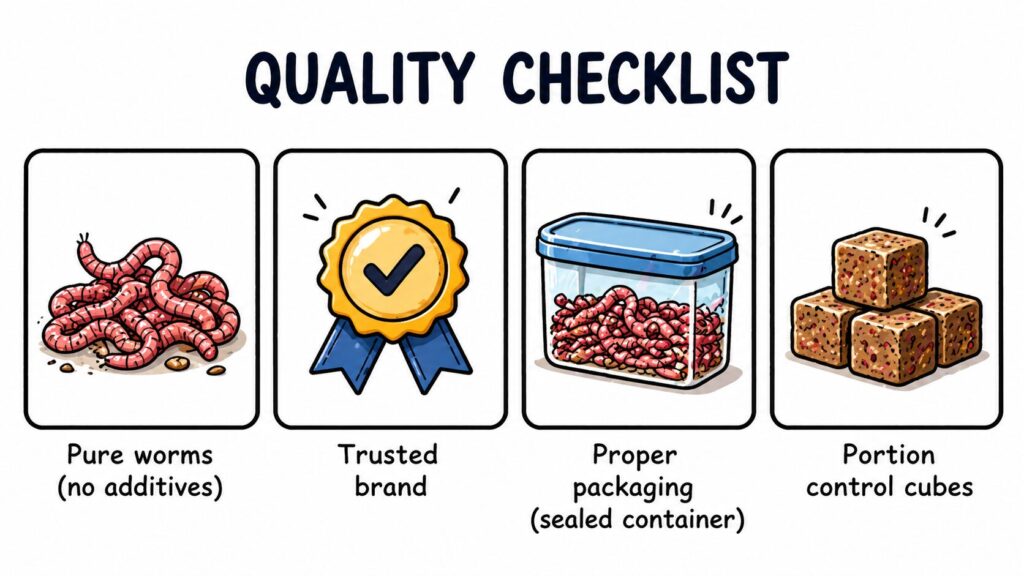
No artificial preservatives or additives. Both frozen and freeze-dried bloodworms should contain only bloodworms — no binding agents, colour enhancers, or chemical preservatives. Bloodworms naturally don’t need any additives.
Reputable brand with quality sourcing. Bloodworms can contain environmental contaminants depending on the water source from which they are harvested. Reputable aquarium food brands test their products and source from controlled harvesting environments. San Francisco Bay Brand, Hikari, and Omega One are the most trusted names in aquarium bloodworms.
Appropriate packaging size. Frozen bloodworms are typically available in flat foil packs that contain multiple individually breakable cubes. A single cube is often more than enough for one axolotl feeding session — many experienced keepers break a cube into quarters and use one piece per feeding. Consider how quickly you will use the product and choose a size accordingly. Frozen bloodworms should not be repeatedly thawed and refrozen.
Freeze-dried in an airtight, resealable container. Freeze-dried bloodworms absorb moisture from the air if not stored correctly, which causes them to clump and degrade. Always choose products in properly sealed containers and reseal immediately after each use.
Our Top Axolotl Bloodworm Picks
Best Overall Freeze-Dried: San Francisco Bay Brand Freeze-Dried Bloodworms (1.13oz)
The San Francisco Bay Brand Freeze-Dried Bloodworms (1.13oz) are our top freeze-dried bloodworm recommendation for axolotl keepers — consistent with our recommendation in the best axolotl food article. San Francisco Bay Brand is one of the oldest and most respected names in aquarium food production, and their freeze-dried bloodworms contain 54.6% crude protein with no artificial preservatives or additives. The product is explicitly listed as suitable for freshwater fish and aquatic amphibians. The 1.13oz (32g) resealable container provides a generous supply for treat feeding, lasting many months at the recommended 2–3 times per week schedule for an adult axolotl. Pre-soak a small pinch briefly in tank water before feeding to encourage sinking and faster axolotl discovery.
Best Budget Freeze-Dried Option: San Francisco Bay Brand Freeze-Dried Bloodworms (0.5oz)
For keepers who want to try freeze-dried bloodworms before committing to a larger quantity, or for those who feed only one axolotl and want the freshest possible product by using smaller amounts more quickly, the San Francisco Bay Brand Freeze-Dried Bloodworms (0.5oz) is the same trusted formulation in a smaller, more accessible format. The shorter time between opening and emptying reduces the risk of the product absorbing ambient humidity before it is fully used.
Best Freeze-Dried for Large Bloodworm Users: San Francisco Bay Brand Freeze-Dried Bloodworms (1.75oz)
For keepers with multiple axolotls, those who use bloodworms more frequently as part of a varied diet protocol, or those transitioning axolotls to pellets who need a reliable treat food in quantity, the San Francisco Bay Brand Freeze-Dried Bloodworms (1.75oz) provides the largest standard retail size at a better cost-per-gram ratio. Store in a cool, dry location and keep the lid tightly sealed between uses.
Best Frozen Bloodworm Option: Hikari Bio-Pure Frozen Bloodworms (3.5oz)
For keepers who prefer frozen bloodworms for their superior texture and acceptance — particularly useful for encouraging a reluctant axolotl to feed or for stimulating appetite in a recently arrived animal — Hikari Bio-Pure Frozen Bloodworms are the most widely trusted frozen bloodworm product in the hobby. Hikari’s Bio-Pure process involves a multi-stage cleaning and quality control procedure before flash-freezing that significantly reduces the bacterial and parasite load compared to unprocessed frozen bloodworms. According to Hikari’s product documentation, the Bio-Pure process eliminates harmful organisms while preserving the natural nutrients and attractant compounds that trigger axolotl feeding responses. The flat-pack format allows you to break off small portions rather than thawing the entire pack.
To feed: break off a small piece (approximately a quarter of a cube is typically sufficient for a single adult axolotl feeding), place in a small container of tank water to thaw for 5–10 minutes, then use feeding tongs to offer the thawed bloodworms directly to your axolotl at tank floor level. Pour off the thaw water rather than adding it to the tank — it contains juices from the bloodworms that can add to the organic load and should be discarded.
How to Feed Bloodworms to Axolotls Correctly
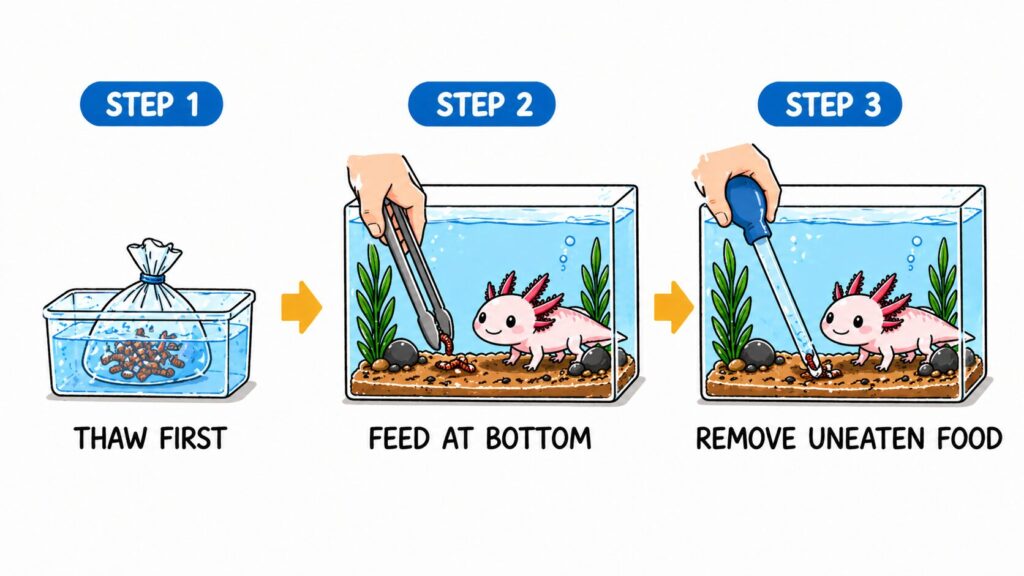
Use feeding tongs for precision. Offering bloodworms using feeding tongs allows you to deliver them precisely at tank floor level where your axolotl can smell and locate them. For freeze-dried bloodworms, a small pinch can be lowered to the substrate surface on the tongs. For frozen, a small cluster of thawed worms can be held gently and positioned in front of your axolotl’s nose.
Remove uneaten bloodworms promptly. Bloodworms break down rapidly in tank water and create a significant organic load. Any bloodworms not consumed within 15–30 minutes should be removed with a turkey baster. This is particularly important for freeze-dried bloodworms that have absorbed water and settled into substrate crevices. Uneaten bloodworms left overnight are a major driver of ammonia spikes — monitor your water test kit readings closely if you feed bloodworms frequently. Our guides on how to clean an axolotl tank and how often to clean an axolotl tank cover the maintenance routine that keeps waste under control.
Offer as a supplement, not a staple. Feed bloodworms 2–3 times per week maximum for adult axolotls. On other feeding days, offer a quality sinking pellet — our best axolotl pellets guide covers the best options — or a piece of nightcrawler, covered in our best axolotl nightcrawlers guide. Variety is the key to a nutritionally complete axolotl diet.
Use bloodworms strategically for picky eaters. If your axolotl is refusing pellets during a diet transition, offer a pellet first at each feeding and only provide bloodworms if the pellet goes uneaten. This trains the axolotl to try the pellet before it receives its preferred food. Most axolotls will transition to pellets within 2–4 weeks of this approach.
Thaw frozen bloodworms properly. Never add frozen bloodworm cubes directly to the axolotl tank. The ice cold water released during thawing can cause a localised temperature drop that stresses your axolotl. Always thaw in a separate small container of tank water first. Keep temperature stable at 60–68°F as detailed in our guide on what temperature axolotls need.
Do not overfeed. It is easy to overfeed bloodworms because axolotls are so eager for them. A small pinch of freeze-dried or a quarter-cube of frozen bloodworms is the right amount per adult feeding session. More than this contributes to water quality problems and the nutritional imbalance that comes from over-reliance on a single food source. Overfeeding is one of the most common contributors to the health issues discussed in our article on whether axolotls can get fat.
Bloodworms and Axolotl Health
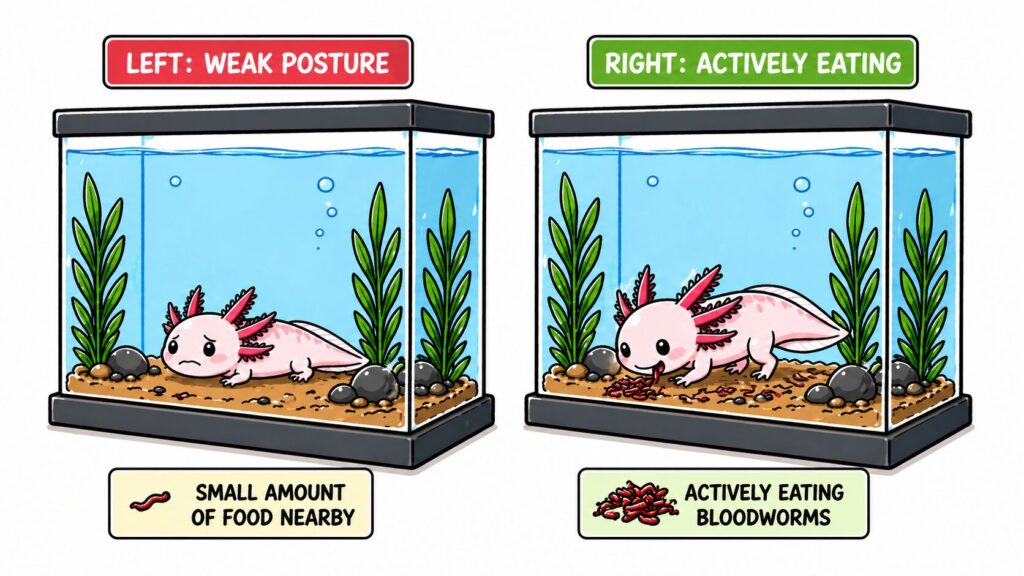
Bloodworms play a genuinely useful role in axolotl health care beyond nutrition. Their strong scent and irresistible palatability make them one of the best tools for encouraging a sick or recovering axolotl to start eating again. When an axolotl has been through illness, treatment in a quarantine tub, or significant environmental stress, its appetite may be suppressed for days or weeks. Offering a small amount of freeze-dried or thawed frozen bloodworms is often the best way to reignite the feeding response and get nutrition back into a recovering animal before transitioning back to its normal diet.
Similarly, during axolotl breeding conditioning — the process of preparing breeding pairs through enriched feeding before attempting to induce spawning — bloodworms can be used as part of an increased feeding regime to bring both axolotls to peak condition. The higher protein intake during conditioning supports egg development in females and reproductive readiness in males. Our articles on whether axolotls mate and how axolotls mate cover the full breeding context.
Frequently Asked Questions
Can I feed my axolotl bloodworms every day? No. Daily bloodworm feeding leads to nutritional imbalances over time and also contributes to water quality problems from uneaten worms. Feed bloodworms 2–3 times per week maximum alongside a varied diet of quality pellets and occasional nightcrawlers.
Are freeze-dried bloodworms as good as frozen for axolotls? Frozen bloodworms are generally preferred — they have better texture, sink more naturally, and are accepted more readily. Freeze-dried are a good convenience alternative with adequate nutritional value, but require pre-soaking to sink properly.
How much bloodworm should I feed per session? A small pinch of freeze-dried (approximately 5–10 individual worms) or a quarter-cube of frozen is appropriate for a single adult axolotl feeding session. Less is better — axolotls are smaller animals than many keepers realise, and overfeeding bloodworms causes both nutritional and water quality problems.
Do bloodworms carry parasites? Wild-harvested live bloodworms carry parasite risk. Frozen and freeze-dried bloodworms from reputable brands like San Francisco Bay Brand and Hikari have undergone processing that kills most parasites and pathogens. Never feed wild-collected live bloodworms without understanding the parasite risk involved.
Can juvenile axolotls eat bloodworms? Yes, with care. Small juveniles can be fed individual bloodworms of appropriate size — bloodworms are typically 1–2cm long and manageable for most juveniles above 2 inches. For very tiny juveniles under 1.5 inches, live microworms or baby brine shrimp are more appropriate before transitioning to bloodworms and then pellets.
Why is my axolotl refusing bloodworms? An axolotl that has previously accepted bloodworms and suddenly refuses them is almost certainly experiencing water quality or temperature stress. Check your water test kit and thermometer immediately. Appetite suppression is one of the earliest and most consistent indicators of environmental problems.
The Perfect Treat for the Perfect Pet
Bloodworms earn their place in every axolotl keeper’s supply cabinet — not as a daily staple, but as the irresistible treat that gets a fussy axolotl eating, adds variety to an established diet, and brings a little excitement to feeding time. Used correctly, they are a safe and genuinely valuable part of your axolotl’s nutritional life. For trusted recommendations on every product your axolotl needs — from the tank and filter to every food type, health supply, and piece of equipment — Best Axolotl Products is your complete keeper-tested guide to the very best in axolotl care.