
Choosing the best axolotl tank light is a decision that matters more than most new keepers initially realise — but for the opposite reason to what you might expect. With tropical fish tanks, the goal is often maximum brightness for plant growth and vivid colours. With axolotls, the goal is controlled, dimmable, low-intensity lighting that allows you to observe your animal clearly without stressing it. Axolotls are highly sensitive to bright light, and a tank light that is too intense causes them to hide constantly, disrupts their natural behaviour, and contributes to chronic low-level stress over time. Get the lighting right, however, and you get an axolotl that is comfortable in the open, actively engaging with its environment, and displayed beautifully against a well-lit aquascape. This guide covers everything: why light sensitivity matters for axolotls, what features the best axolotl tank light must have, and our top verified Amazon picks for every tank size. Pair this with our full axolotl care guide and our guides on best axolotl tank plants, best axolotl tank decor, and the best axolotl tank for the complete aquascape picture.
Why Axolotls Need Special Lighting Consideration

Axolotls (Ambystoma mexicanum) are native to the high-altitude lake system of Xochimilco in Mexico City — a naturally murky, turbid freshwater environment with heavy aquatic vegetation, sediment, and limited light penetration. According to the IUCN Red List documentation of Ambystoma mexicanum, the natural habitat of the wild axolotl is characterised by shallow, turbid water with dense aquatic plant cover — conditions that provide natural shade and significantly reduce light intensity at the lakebed where axolotls spend their lives.
The wild axolotl is critically endangered, and understanding its natural habitat informs how we create appropriate captive conditions. Three biological characteristics make axolotls particularly sensitive to bright light:
They lack eyelids. Unlike most terrestrial vertebrates, axolotls cannot close their eyes to block out light. Their eyes are always open and always exposed. This means bright light is a continuous stimulus they cannot escape or reduce through a natural eye closure response. According to research on axolotl visual physiology published in Comparative Biochemistry and Physiology, axolotls have eyes adapted for low-light conditions and their photoreceptor sensitivity is optimised for dim, murky water environments rather than well-illuminated aquariums.
They are naturally crepuscular/nocturnal. Axolotls are most active at dawn and dusk, with significant activity during night hours. Bright, continuous overhead light disrupts this natural activity rhythm, causing axolotls to become more reclusive and less behaviourally active during hours when they would otherwise be exploring, foraging, and interacting with their environment. Our article on whether axolotls sleep discusses their rest and activity patterns in more detail.
Bright light causes chronic stress. When an axolotl in a brightly lit tank has nowhere to hide from the light, it experiences ongoing low-level stress that suppresses immune function over time. Chronic stress in aquatic salamanders is documented in research published in Aquaculture as a significant contributor to susceptibility to fungal and bacterial infections — the same conditions that make methylene blue and aquarium salt treatments necessary.
None of this means axolotls must be kept in total darkness — they do not, and good lighting that replicates the dim, filtered light conditions of their natural habitat benefits both the axolotl’s comfort and the keeper’s ability to observe and enjoy the animal. The key is dimming capability and appropriate intensity control.
What Makes the Best Axolotl Tank Light?

Dimming capability — the most important feature. For an axolotl tank, the ability to reduce lighting intensity is more important than maximum brightness. A light that can be dimmed to 10–30% of its maximum output is far more useful than a powerful light that only operates at full intensity. Full-spectrum LED lights with adjustable brightness are the ideal format.
Built-in timer with gradual sunrise/sunset function. A programmable timer that allows you to set consistent light-on and light-off times automates the day/night cycle without you having to remember to switch the light manually. More importantly, a gradual sunrise and sunset function — where the light slowly ramps from off to on over 15–30 minutes and back down at night — prevents the sudden on/off shock that startles axolotls and disrupts their behaviour. Gentle transitions also replicate the natural dawn and dusk conditions of Xochimilco much more accurately than an abrupt switch.
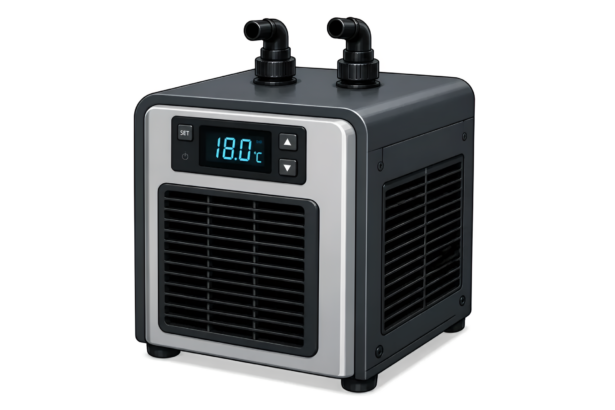
Low heat output. Axolotls need cold water — between 60–68°F (16–20°C) as detailed in our guide on what temperature axolotls need. A light that generates significant heat above the tank can raise surface water temperature over a full day of operation, working against your water chiller or cooling fan. LED lights are significantly cooler than fluorescent or incandescent alternatives, and thin LED fixtures mounted on an aluminium heat-sink body dissipate the minimal heat they generate away from the tank efficiently.
Full spectrum with adjustable colour spectrum. A light with full-spectrum output — covering the range from red through blue wavelengths — provides appropriate light for any live plants in the tank. Plants like Java fern, Anubias, and Hornwort (covered in our best axolotl tank plants guide) need some light for photosynthesis, but they are low-light plants that do not need intense illumination. A full-spectrum LED at 20–40% brightness provides enough light for these plants while keeping conditions comfortable for the axolotl.
Appropriate size for your tank footprint. The Aqueon 40-gallon breeder — our recommended tank in the best axolotl tank article — has a 36-inch length. A light sized for 30–36 inches covers this tank appropriately. Most extendable bracket LED lights fit this footprint and adjust to accommodate both the 30-gallon and 40-gallon breeder formats.
IP65 or higher water resistance rating. Any light mounted above an axolotl tank will occasionally be exposed to water splash from siphoning, water changes, or the axolotl itself. A water-resistant rating of at least IP65 ensures the light can handle this without damage.
How Bright Should an Axolotl Tank Light Be?
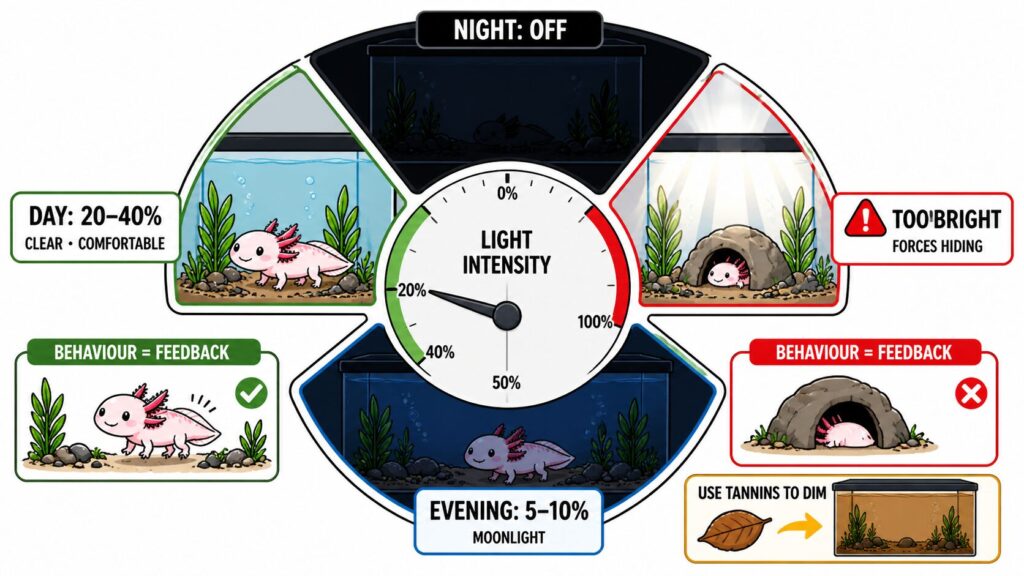
A practical target for axolotl tank lighting is the equivalent of a shaded outdoor environment — bright enough to clearly see all areas of the tank and support low-light plant growth, but not so intense that the axolotl squints (as much as an eyeless animal can) and retreats to the darkest corner. In practical terms, this means running a full-spectrum LED light at approximately 20–40% of its maximum output during daylight hours, dropping to a very dim moonlight blue (5–10%) in the evening, and fully off during the night.
If your axolotl is spending the majority of the day hidden inside its hides or caves and only emerges at night or when the light is off, your lighting is almost certainly too bright. Dimming the light — or using tannin-darkening Indian almond leaves to naturally reduce light penetration — should bring your axolotl into the open more comfortably.
Our Top Axolotl Tank Light Picks
Best Overall: hygger Auto On Off LED Aquarium Light (30–36 Inch, 7 Colors, Dimmable with Built-In Timer)
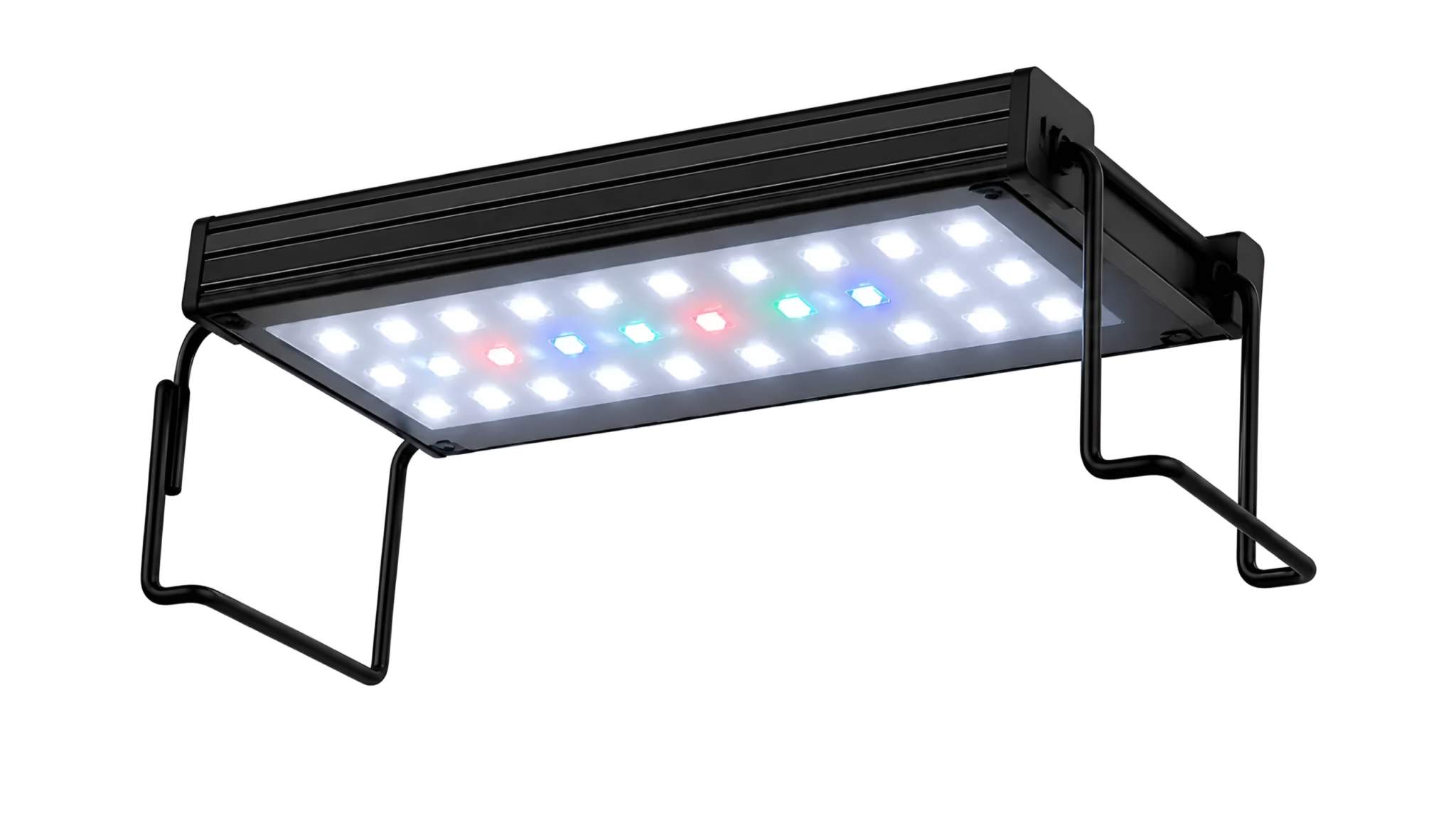
The hygger Auto On Off LED Aquarium Light for 30–36 Inch Tanks is our top overall recommendation for the Aqueon 40-gallon breeder — the same tank we recommend in our best axolotl tank article. It covers everything an axolotl tank light needs: a built-in programmable timer with 15-minute sunrise and sunset ramp functions, 10 levels of brightness adjustability (10%–100%) allowing precise dimming to axolotl-safe low intensities, and 7 colour options including a dim blue moonlight mode for evening hours. The IP68 water-resistant LED coating protects against splash, the aluminium heat-sink body minimises heat transfer to the water, and the extendable brackets fit the 36-inch width of the 40-gallon breeder tank perfectly. Set the timer to bring the light on at 10–20% brightness in the morning and off at night, and your axolotl has a gentle, consistent lighting cycle that suits its natural rhythms without stressing it.
Best Premium Option with Maximum Programmability: Finnex Planted+ 24/7 ALC LED Light (30-Inch)
The Finnex Planted+ 24/7 ALC LED Light (30-Inch) is the premium choice for keepers who want the most sophisticated programmable lighting control available and who are also growing live plants. The 24/7 ALC series — according to Finnex’s own product documentation — offers true 24/7 automated sunrise-to-sunset cycling with full colour and intensity customisation via remote control. For an axolotl tank, you programme the light to run at low intensity during daytime hours, shift to an even dimmer warm tone in the evening, and cycle off fully at night. The true 660nm red LEDs are excellent for promoting growth in low-light plants like Java fern and Anubias. The aluminium body keeps heat production minimal. This is the light for keepers who want precise, beautiful control over their tank’s lighting environment and are willing to invest in that capability.
Best for 40-Gallon Breeder Width (30–36 Inch): hygger 957 Programmable LED Light with LCD Display (30–36 Inch)
The hygger 957 Aquarium Programmable LED Light with LCD Setting Display (30–36 Inch) is an excellent alternative to the standard hygger Auto On Off model for keepers who want a physical LCD display showing all current settings — current mode, brightness level, and timer status — rather than cycling through button presses on a small controller. The LCD display makes it much easier to confirm your settings at a glance, which is particularly useful when you are adjusting the dimming level to find the right intensity for your specific axolotl. Same programmable sunrise and sunset functions, same 10-level dimming, same IP68 water resistance, and the same 30–36 inch extendable bracket fit for the Aqueon 40-gallon breeder.
Best for 55-Gallon Two-Axolotl Setups: hygger Auto On Off LED Aquarium Light (36–42 Inch)
For keepers running a 55-gallon tank for two axolotls — as we recommended in our best axolotl tank article — the hygger Auto On Off LED Aquarium Light for 36–42 Inch Tanks scales the same trusted hygger formula up to the 48-inch length of a standard 55-gallon tank. All the same features apply — programmable timer, 10-level dimming, 7 colour modes, IP68 coating, and sunrise/sunset gradient — in a format sized for the longer tank footprint. Before housing two axolotls together, always read our guides on whether axolotls are cannibalistic and whether axolotls can have tank mates.
Best Budget Option: hygger Adjustable Dimmable Aquarium Light (30–36 Inch, 20W, External Dimmer Controller)
For keepers who want a reliable dimmable light at the lowest possible price point, the hygger Adjustable Dimmable Aquarium Light (30–36 Inch, 20W) is a well-built, no-frills option. It does not have programmable timer functions or multiple colour modes — but it does have an external dimmer controller that allows you to set brightness anywhere from 10% to 100%, which is the most important feature for axolotl use. Pair it with a basic timer plug (available inexpensively on Amazon) to automate the on/off cycle, and you have everything you need at a very accessible price.
How to Set Up Axolotl Tank Lighting Correctly
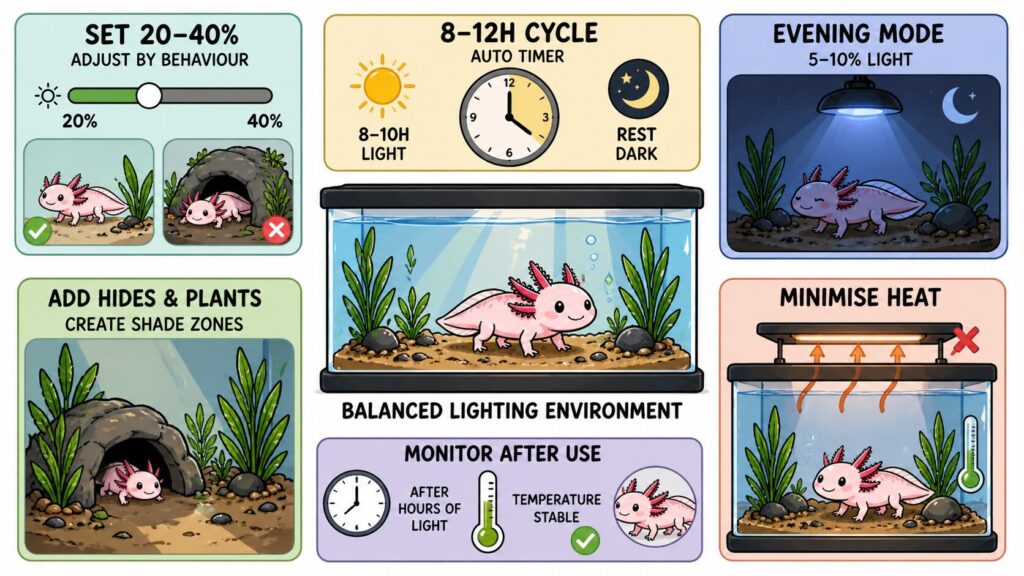
Set maximum daytime brightness to 20–40%. Start at 20% and observe your axolotl’s behaviour over several days. If it remains in its hide continuously even during feeding time, reduce further. If it moves comfortably around the tank, grazes and explores during daylight hours, and only retreats to its hide for rest (not to escape the light), your intensity is appropriate. Most axolotls settle comfortably at 20–30% brightness on a hygger-style dimmable LED.
Programme a consistent 8–12 hour light cycle. Axolotls benefit from a consistent day/night cycle that supports their natural crepuscular rhythms. A cycle of 8–10 hours of dim daylight followed by 14–16 hours of dark is appropriate for most axolotl setups. Use the built-in timer to automate this so it does not depend on you remembering to switch the light.
Use the moonlight mode in the evening. Many axolotls are most active in the hour or two before the light fully turns off in the evening. A very dim blue moonlight mode (5–10% intensity) in the 1–2 hours before the light goes off simulates natural dusk conditions and allows you to observe your axolotl’s evening activity — which is often when they are most engaging to watch.
Position the light to allow shaded areas. Even with a dimmed light, having shaded areas in the tank where light intensity is lower — created by overhanging plants, caves, and decor — gives your axolotl the ability to self-regulate how much light it is exposed to. This reduces stress even further and mimics the naturally varied light environment of the vegetated lake edges of Xochimilco.
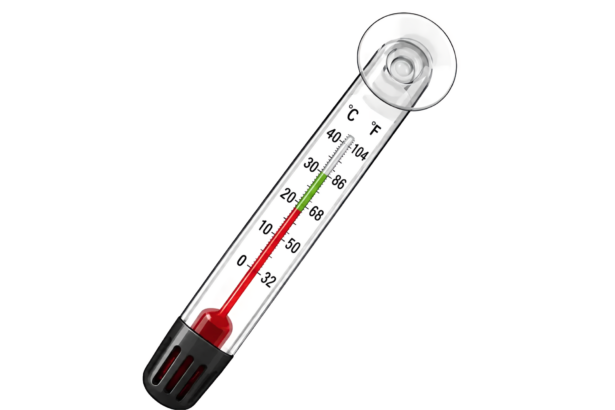
Keep the light from contributing to heat. Position the light on top of the tank lid rather than over an open area of the water surface if possible, so any residual heat from the fixture is absorbed by the lid rather than entering the water. Monitor tank temperature with your thermometer after the light has been running for several hours to confirm it is not causing temperature creep.
Does an Axolotl Tank Need a Light?
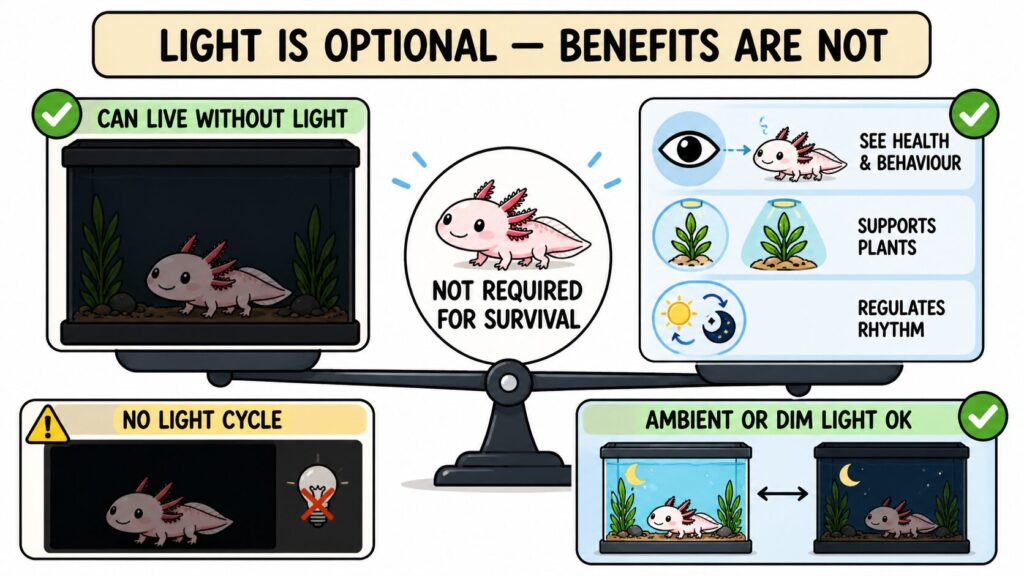
The answer is nuanced. Axolotls themselves do not require light — they would be perfectly healthy in a tank with no lighting at all from a biological standpoint. However, a light provides several meaningful benefits for the keeper: it allows proper observation of your axolotl’s health, colour, and behaviour; it supports the growth of live plants that improve water quality; it makes the tank an attractive feature of your home rather than a dark box; and it provides the consistent day/night cycle that helps regulate your axolotl’s natural activity rhythms.
If you choose not to use a tank light, ensure the room has ambient light that provides some day/night rhythm for your axolotl. A completely dark room with no light variation at all is less desirable than even ambient room lighting that naturally varies through the day.
Frequently Asked Questions
How many hours of light does an axolotl tank need per day? An 8–10 hour light cycle per day at appropriately low intensity is sufficient. Some keepers run as few as 6 hours without any negative effect on axolotl behaviour. Consistency matters more than exact duration — the same schedule every day supports natural rhythms better than a variable one.
Can you use a standard fish tank light for axolotls? Only if it has dimming capability. Standard fish tank lights designed for tropical tanks often operate at intensities too bright for comfortable axolotl keeping. A dimmable LED with 10-level brightness control is essential.
Do axolotl tank lights cause algae growth? At the low intensities appropriate for axolotl keeping, light-driven algae growth is minimal. Bright, uncontrolled lighting is a major driver of nuisance algae in freshwater tanks — another reason that keeping your light dim is beneficial beyond just axolotl welfare.
Does a tank light affect my axolotl’s sleep? Axolotls do not sleep in the same way mammals do, but they do have periods of rest and reduced activity — particularly during bright daylight. A consistent dark period at night supports these rest patterns. Our article on whether axolotls sleep explores this in more detail.
Will a tank light affect my axolotl’s colour? Lighting affects how we perceive an axolotl’s colour more than how the colour actually is. Low-iron glass tanks — like the Landen 60P we recommended in our best axolotl tank article — combined with a warm-toned low-intensity LED bring out the pinks, golds, and whites of pale axolotl morphs beautifully. A dark substrate like CaribSea Moonlight sand creates high contrast that makes colours pop even more.
Light It Right, See More of Your Axolotl
An axolotl in a well-lit but dim tank — one where the light replicates the filtered, murky daylight of Xochimilco rather than a hospital fluorescent — is an axolotl you will actually see. It will explore, forage, walk across the tank floor, and rest in the open with a calm confidence that bright-tank axolotls never show. Getting the lighting right costs nothing extra if you choose a dimmable light from the start — it is simply a matter of dialling back the brightness and letting your axolotl do the rest. For the complete, keeper-tested guide to every product your axolotl depends on, from the tank itself to food, filtration, health supplies, and enrichment, Best Axolotl Products is your one-stop resource for the best gear in every category of axolotl care.