
Finding the best axolotl caves is a decision that directly affects your axolotl’s daily quality of life. Caves are the most instinctively sought-after shelter type for axolotls — fully enclosed, dark, and floor-level — and a well-chosen cave is one of the most effective welfare improvements you can make to any axolotl tank. Without proper cave shelter, axolotls experience chronic stress from constant light exposure and a sense of vulnerability, which suppresses immune function and contributes to the gill and skin health problems that make treatments like methylene blue and aquarium salt necessary. With the right cave in the right position, you will see your axolotl use it consistently throughout the day and emerge more confidently in the evenings — the hallmark behaviour of a relaxed, healthy animal. This guide covers everything: why caves matter for axolotl welfare, exactly what to look for, what to avoid, and our top Amazon picks for every setup. Read this alongside our best axolotl hides guide for full shelter coverage, and our best axolotl tank decor article for the complete tank enrichment picture. Our full axolotl care guide covers everything beyond decor.
Why Caves Are the Most Important Enrichment Item in an Axolotl Tank
Axolotls (Ambystoma mexicanum) are secretive, shelter-seeking animals by nature. In their native Xochimilco lake system in Mexico City — a shallow, murky, heavily vegetated freshwater environment — wild axolotls spend the majority of their active lives beneath or within cover: submerged vegetation, rocks, organic debris, and natural cavities in the lakebed substrate. The wild axolotl is critically endangered, and their natural biology gives us direct guidance on what captive environments should provide.
In a tank without any cave or enclosed shelter, an axolotl has nowhere to achieve the genuine darkness and enclosure that its instincts drive it to seek. This creates a state of ongoing low-level stress that compounds over time. Research published in Aquaculture has documented that captive aquatic salamanders without structural enrichment — including cave-type shelter — show elevated stress hormone levels, reduced feeding responses, and impaired immune function compared to animals with appropriate shelter. The Ambystoma Genetic Stock Center at the University of Kentucky, which maintains the world’s most significant captive axolotl colony for research purposes, lists appropriate shelter as a fundamental component of axolotl welfare protocols.
A cave that provides genuine enclosure — a dark interior, an opening sized correctly for the animal’s body, and solid walls that block light from multiple directions — addresses the shelter-seeking instinct completely. An axolotl with a proper cave rests inside it during daylight hours, emerges in the evening to forage and explore, and shows the calm, unhurried behaviour that indicates a relaxed animal in a secure environment.
What Makes the Best Axolotl Cave?
Genuinely enclosed with a dark interior. The cave must provide actual darkness inside — not just partial shade, but a meaningfully enclosed space that reduces light exposure to the sheltering axolotl. Caves with solid top surfaces, solid side walls, and an entrance opening sized to minimise light penetration provide far more effective shelter than open-topped structures or caves with multiple large openings in the roof.
Opening sized correctly for adult axolotls. An adult axolotl can reach 9–12 inches in length with a body width of 2–3 inches at the widest point behind the head. The cave opening must be large enough to allow comfortable entry and — critically — a comfortable reverse exit. Axolotls cannot turn around in tight spaces, so any cave with only one opening must be wide enough that the animal can back out without squeezing or becoming stuck. Two-opening tunnels (open at both ends) eliminate this risk entirely. Never buy a cave purely based on appearance without verifying opening dimensions against your axolotl’s body measurements.
Smooth interior surfaces with polished edges. Axolotls brush their skin and gill plumes against cave surfaces every time they enter, rest, and exit. Any roughness, sharp edge, moulded protrusion, or abrasive texture on interior surfaces will cause microabrasions and gill plume damage. Run your fingers over every interior surface and edge of any cave before putting it in your tank. Smooth, polished resin or unglazed ceramic surfaces are the gold standard.
Aquarium-safe, inert materials. Caves must be made from BPA-free resin, unglazed ceramic, or natural inert stone — materials that will not leach chemicals into the water, alter pH or hardness, or degrade in cold freshwater over years of use. Glazed ceramics may contain heavy metals. Calcareous rocks like limestone and marble raise water pH and must be avoided. Always verify material specifications before purchasing.
Weighted to stay stable on the substrate. A cave that floats, tips, or is easily displaced by filter flow or water changes creates a fall risk for a resting axolotl and a general maintenance problem. Dense resin caves that sink and sit flat on the substrate immediately are strongly preferred over lightweight options.
Sized to fit without consuming all available floor space. A cave appropriate for a 40-gallon breeder tank should occupy a corner or side position without dominating the whole tank floor. Leave open walking space for your axolotl to move freely around the tank. Our guide to the best tank size for axolotls covers how much floor space an adult axolotl needs.
Cave Materials: Which Are Safe?
BPA-free aquarium resin is the most common and most convenient cave material. Quality resin caves from reputable aquarium brands are chemically inert in freshwater, smooth, durable, available in realistic stone and natural aesthetics, and easy to clean. Look for products explicitly described as BPA-free and pH-neutral.
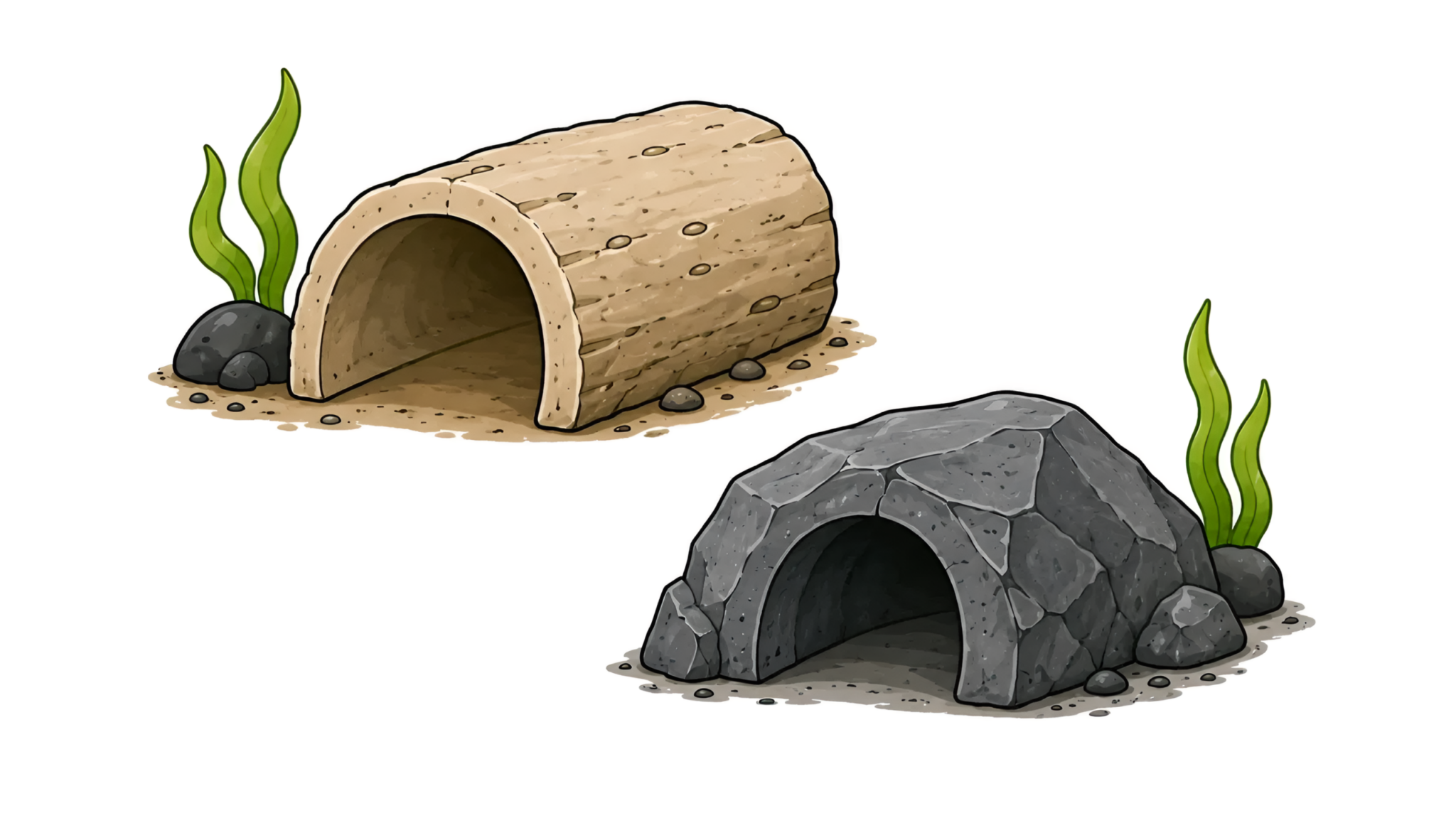
Unglazed ceramic is an excellent natural material for axolotl caves. Unglazed (not glazed) terracotta or stoneware is inert, porous enough to colonise with beneficial bacteria, and completely safe in freshwater. The smooth interior of an unglazed ceramic cave is gentle on gill plumes. Many keepers use unglazed terracotta flower pots with the drainage hole enlarged as an inexpensive and effective DIY cave.
Natural inert stone (slate, granite, smooth river stone) can be stacked to create natural-looking cave structures. Flat pieces of slate arranged as roof and sides create a low-profile cave that is entirely natural in aesthetic and completely inert in chemistry. This approach takes more setup effort but produces one of the most naturalistic and attractive cave options available. See our best axolotl tank tiles guide for the best slate products to use in this configuration.
What to avoid: Glazed ceramics (may contain heavy metals), calcareous rocks including limestone, marble, and seashells (raise pH), lava rock (extremely abrasive surface dangerous to gill plumes), rough volcanic stone (same abrasion issue), and any painted or coated decoration with an unstable finish that may chip or flake.
Our Top Axolotl Cave Picks
Best Overall Cave: PENN-PLAX Reptology Shale Scape Step Ledge and Cave Hideout (Medium)
The PENN-PLAX Reptology Shale Scape Step Ledge and Cave Hideout (Medium) is the most consistently recommended axolotl cave structure in the hobby, and it has maintained that reputation across years of keeper experience. Made from PENN-PLAX’s proprietary safe resin with a realistic layered shale texture, the base opening provides a genuine cave space with a dark enclosed interior where an axolotl can shelter fully. The stepped ledge design above the cave creates additional resting surfaces, and the weighted base keeps it firmly in position on the tank floor. According to PENN-PLAX’s product specifications, the Reptology series is confirmed safe for fully submerged freshwater aquarium use. The realistic grey shale aesthetic pairs beautifully with natural slate tank tiles and fine sand substrate. This is the cave we recommend to most axolotl keepers as the primary shelter option — the opening is large enough for most medium to large adults, the interior is appropriately dark, and the surfaces are smooth enough to be safe for gill plumes.
Best Tunnel Cave for Guaranteed Exit Safety: Axolotl Hide Corner Fish Tunnel (Natural Colourway)
The Axolotl Hide Corner Fish Tunnel is a purpose-designed axolotl cave tunnel that is open at both ends, completely eliminating any entrapment risk. For keepers who are concerned about their axolotl becoming stuck in a single-opening cave — a genuine consideration for larger adults or unusually wide animals — the open-ended tunnel design provides the enclosure and darkness that axolotls seek while ensuring they can always exit from either end without reversing in a tight space. The corner design fits neatly against any tank wall corner, and the aquarium-safe materials are confirmed appropriate for axolotl use. Available in natural, black, and white colourways.
Best Cave with Viewing Window: Aquarium Corner Cave Hide for Axolotl with Viewing Window
The Aquarium Corner Cave Hide for Axolotl with Viewing Window is a purpose-built axolotl cave that includes a small transparent viewing window in one wall. This is a genuinely useful feature — being able to observe your axolotl’s gill condition, body posture, and breathing rate while it is at rest inside the cave without disturbing it is directly relevant to health monitoring. Changes in gill plume appearance, abnormal body curvature, or laboured breathing are all easier to catch early when you can see the resting animal. The corner configuration minimises floor footprint, the cave interior is appropriately dark with the viewing window providing only a small amount of ambient light, and the aquarium-safe resin materials are confirmed for axolotl use. This is the best option for keepers who prioritise health observation alongside welfare.
Best for Large Adult Axolotls: PENN-PLAX Reptology Shale Scape Hideout (Large)
For axolotls at the larger end of the adult size range — 10–12 inches — the PENN-PLAX Reptology Shale Scape Step Ledge and Cave Hideout (Large) is the appropriate step up. The large version provides a proportionally larger base cave opening that accommodates bigger bodies with genuine comfort and no squeezing. It is the same trusted design and material as the medium version, simply scaled up. If you have noticed your medium-size axolotl beginning to fill its cave opening tightly or hesitating at entry, the large is the straightforward upgrade.
Best Natural Stone Cave: Stacked Slate Pieces (8–10 Inch Natural Slate, USA Sourced)
For keepers who want the most naturalistic cave aesthetic possible — one that closely resembles the rocky submerged formations of wild axolotl habitat — building a cave from the Natural Slate Stone Aquarium Decorations (8–10 Inch Pieces) provides a completely inert, gorgeous result. Arrange two or three flat slate pieces to create a low-profile cave with a generous opening and a dark interior — a large flat piece as the roof, smaller flat pieces as side walls, and open front and rear. This creates a naturally horizontal cave structure that closely mimics the submerged rock formations wild axolotls shelter beneath. The slate is fully inert, pH-neutral, and verified aquarium-safe. Pair this with fine sand substrate for one of the most naturalistic and beautiful axolotl aquascape configurations possible.
Best Decorative Cave for Display Tanks: Uniclife Aquarium Decorations Resin Coral Rock Mountain Cave
The Uniclife Aquarium Decorations Resin Coral Rock Mountain Cave is a highly detailed resin cave structure designed for aquarium display use, with a rock-mountain aesthetic and multiple cave openings at different heights. For keepers who want an eye-catching centrepiece that also provides functional shelter, this is one of the most visually impressive cave options available. The resin is confirmed aquarium-safe and pH-neutral, the larger lower openings are sized appropriately for adult axolotls, and the detail work creates a genuinely striking focal point in a planted tank setup. Verify the specific lower cave opening dimensions against your axolotl’s measurements before purchasing to confirm fit.
Cave Placement and Setup Tips
Position caves in low-light areas. Place your cave in a back corner or along the rear wall of the tank, away from the direct overhead beam of your tank light. The further the cave is from the primary light source, the darker its interior will be and the more effectively it will function as a stress-reducing shelter.
Orient the opening toward open tank floor. The cave entrance should face inward toward the open tank floor, giving your axolotl a clear, unobstructed path from its resting and foraging areas to the cave opening. An entrance facing a tank wall or filter intake is poorly positioned.
Add one cave per axolotl. Every axolotl in a tank should have access to its own dedicated cave without competition. For two-axolotl setups — which require careful reading of our articles on axolotl cannibalism and tank mate compatibility first — provide two caves positioned on opposite sides of the tank to establish separate territories.
Surround caves with plants and leaves for additional cover. Placing silk or live plants and Indian almond leaves around the cave entrance creates a more naturally sheltered zone that further reduces the axolotl’s sense of exposure when approaching and exiting the cave. This particularly benefits newly arrived axolotls still settling into their environment.
Clean caves regularly. Caves accumulate algae, biofilm, and waste on all surfaces. Remove and rinse thoroughly under plain running water with a clean brush every 2–4 weeks, and use a turkey baster to spot-clean the area around the cave entrance during weekly water changes with your tank siphon. Maintaining clean cave surroundings keeps waste from building up in the sheltered area where your axolotl spends the most time.
Cave and Breeding Behaviour
Axolotl caves take on an additional significance for breeding setups. During axolotl mating, females seek sheltered surfaces on which to deposit their fertilised eggs — and a cave or hide with appropriate interior surfaces is often used as an egg-laying site. If you are attempting breeding after reading our articles on whether axolotls mate and axolotl breeding, providing a cave with a smooth interior floor and walls gives the female an appropriate substrate for egg deposition during the spawning process.
Frequently Asked Questions
How often will my axolotl use its cave? A healthy, settled axolotl typically retreats to its cave or hide during the daylight portion of its activity cycle and emerges in the evening and at night to explore and forage. This is normal crepuscular behaviour as detailed in our article on whether axolotls sleep. If your axolotl never emerges at all, check water quality and temperature — prolonged hiding combined with loss of appetite often indicates a water quality problem.
My axolotl keeps trying to squeeze behind the filter rather than using its cave — why? This is a sign that the provided cave does not feel secure enough — typically because the opening is too large, the interior is not dark enough, or the cave is positioned in too exposed a location. Try a cave with a more enclosed interior, reposition it to a darker corner, and add plants around the entrance to reduce the open exposure.
Can I use a PVC pipe as an axolotl cave? Yes — food-grade PVC pipe without plasticisers is considered safe for aquarium use by experienced keepers. The smooth interior is gentle on gill plumes, and a section cut to appropriate length with openings at both ends functions as an effective tunnel cave. Use thick-walled, smooth-bore PVC and verify it is food-grade and free of plasticiser additives before use.
Do axolotl caves affect water flow in the tank? A solid-walled cave reduces water circulation in the immediate vicinity of the cave interior, which means organic waste in the cave can accumulate slightly faster than in the open tank. Clean cave interiors regularly and ensure your filter’s flow is sufficient to circulate water reasonably throughout the tank.
Should the cave opening face up or sideways? Sideways — the entrance should be at floor level, oriented toward the open tank floor. Axolotls enter caves at ground level and rest horizontally inside. A cave oriented with the opening facing upward is not appropriate for axolotl use.
A Secure Cave, A Thriving Axolotl
The right cave transforms how your axolotl experiences its tank — from a place of constant exposure to a home where it has genuine refuge. The confidence that comes from having a secure shelter to retreat to makes your axolotl more active, more visible, and more behaviorally natural during its waking hours. It is one of the simplest and most impactful improvements you can make to a captive axolotl’s life. For the complete, keeper-tested guide to every product your axolotl depends on — from filtration and temperature management to food, health supplies, and every aspect of tank enrichment — Best Axolotl Products is your comprehensive resource for the best gear in every category of axolotl care.