
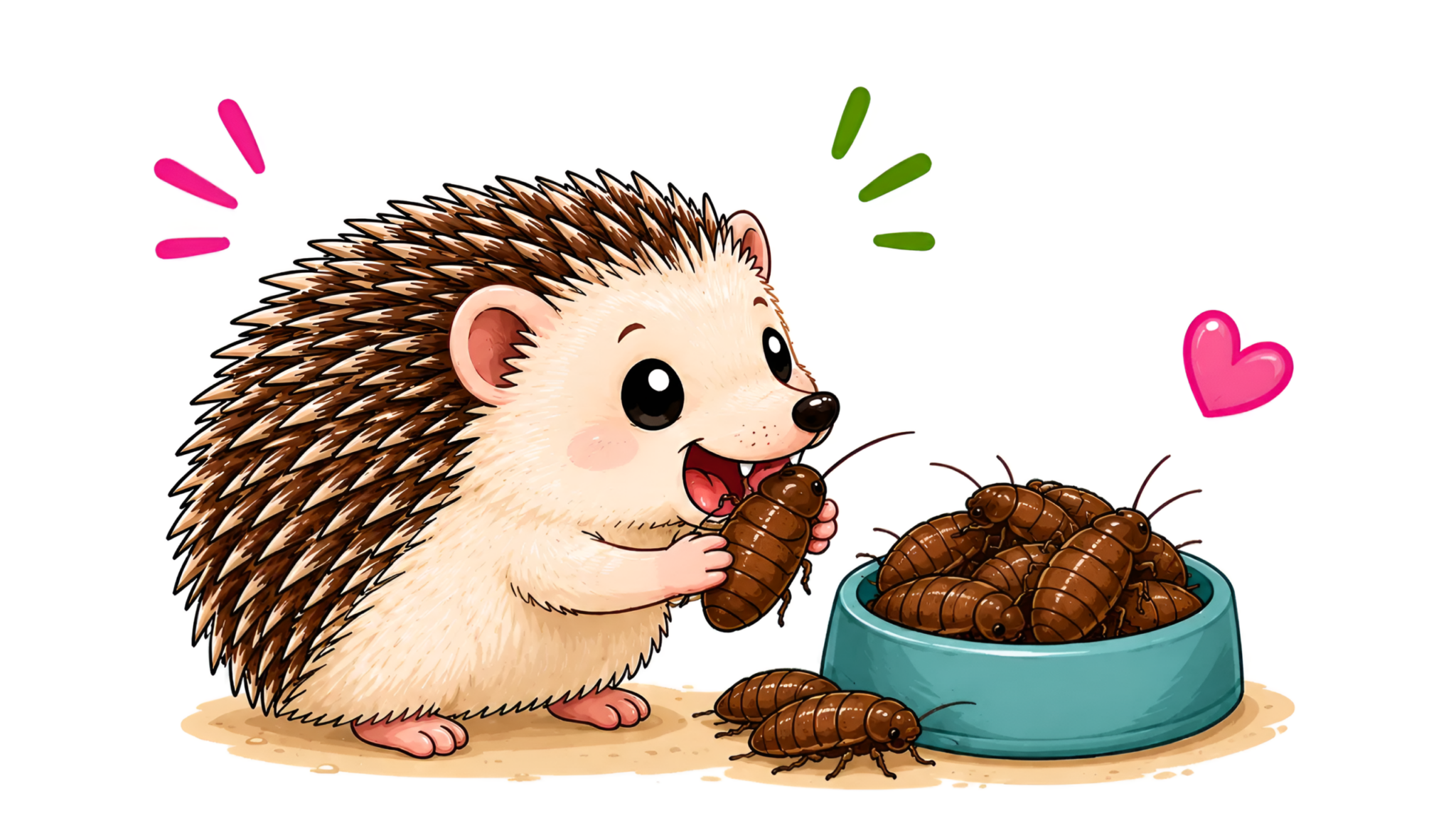
Say “cockroach” to most people and you’ll get a very specific reaction. But say “dubia roach” to anyone who keeps insectivorous pets, and the reaction is completely different — a lot of enthusiasm, actually. Dubia roaches have built a strong reputation in the exotic pet community as one of the best feeder insects available, and for good reason. Hedgehogs can absolutely eat dubia roaches, and once you understand what makes them stand out from other feeder options, you might find yourself reaching for them more often than anything else in the rotation.
What Makes Dubia Roaches Different From Regular Cockroaches
The first thing worth getting out of the way: dubia roaches (scientific name Blaptica dubia, also known as the orange-spotted roach or Argentinian spotted roach) bear very little resemblance to the cockroaches most people are trying to get rid of. They’re clean when properly kept, slow-moving, unable to climb smooth surfaces, and don’t make any noise — which puts them a long way ahead of crickets on the convenience front. They’re bred specifically as feeder insects and are raised in controlled conditions, meaning none of the parasite risk that comes with anything caught in the wild. As Hedgehog Planet notes, the key distinction is that dubia roaches are clean, captive-raised insects — a world apart from the wild cockroaches you’d find behind a skirting board.
The Nutritional Case for Dubia Roaches
Here’s where things get genuinely interesting. Dubia roaches aren’t just safe for hedgehogs — they’re arguably one of the most nutritionally complete feeder insects you can offer.
Mealworms are the most commonly used hedgehog supplement, and they’re a solid choice, but they come with a significant fat content — roughly twice the fat of dubia roaches, according to Dubia.com’s comparative feeder guide. Dubia roaches sit at around 23% protein and 7% fat, which is a lean, well-balanced profile that suits hedgehogs well given their tendency toward obesity. They also contain meaningful amounts of calcium — providing nearly five times more calcium than mealworms according to The Critter Depot’s nutritional comparison — which is a significant practical advantage.
Dubia roaches also have less chitin than many other feeder insects. Chitin is the fibrous material in insect exoskeletons, and while hedgehogs do need it as a dietary fiber source, excessive amounts can be harder to digest. The softer exoskeleton of dubia roaches makes them easier on the digestive system than harder-shelled insects, which is worth knowing if you have a younger or older hedgehog. For more on why insect-based nutrition matters so much to hedgehogs, our guide on what hedgehogs eat covers the full picture.
Gut-Loading Still Matters
Even with dubia roaches’ strong base nutritional profile, gut-loading before feeding is still recommended and makes a meaningful difference. Research cited in a Louisiana State University study on dubia roach nutrition found that a 24-hour gut-loading period using a calcium-rich diet significantly improved the calcium-to-phosphorus ratio of the roaches — moving it from an unfavourable 0.2:1 to a much healthier 1.4:1 to 2.1:1, depending on the diet used.
In practice, gut-loading dubia roaches is straightforward. Offer them leafy greens, carrots, apple slices, oats, or a commercial gut-load diet for 24 hours before feeding them to your hedgehog. Whatever the roaches eat, your hedgehog effectively eats too — so it pays to make those final 24 hours count. For more on the gut-loading process and why it matters for feeder insects generally, our crickets article goes into the concept in more detail.
How to Source and Store Them
Dubia roaches are widely available from specialist feeder insect suppliers online, and from many pet shops that cater to reptile keepers. When buying, look for suppliers who gut-load their roaches before shipping and who can confirm the insects are healthy and well-maintained.
Storing dubia roaches at home is simpler than most people expect. A smooth-sided plastic container — a large Kritter Keeper from a pet shop works well for small quantities — with a ventilated lid is all you need. Because dubia roaches cannot climb smooth vertical surfaces, there’s little risk of escape as long as the container has smooth plastic or glass walls. Add a few pieces of egg carton for the roaches to shelter in, provide a small amount of fresh food every couple of days, and they’ll stay healthy and nutritious until feeding time. The Dubia Roach Depot’s storage guide recommends 18-gallon plastic totes for larger quantities, with mesh screen ventilation cut into the lid.
One practical bonus: unlike crickets, dubia roaches don’t chirp, don’t escape easily, and don’t smell. If the noise and chaos of keeping live crickets has ever put you off, dubia roaches are a considerably calmer alternative.
Sizing and Feeding
Match the size of the roach to the size of your hedgehog. Dubia roaches are available in a range of sizes from nymphs up to adult, and the general rule — as with all feeder insects — is that nothing should be wider than the gap between your hedgehog’s eyes. Medium nymphs are a safe bet for most adult hedgehogs.
A few roaches two to three times a week is a sensible frequency, offered alongside rather than instead of the main diet. Many experienced owners enjoy placing hedgehog and roaches together in a bathtub or high-sided plastic bin for feeding sessions — the smooth walls keep the roaches contained while giving the hedgehog room to hunt properly, which is half the point. That hunting behaviour is genuinely valuable: it engages a hedgehog’s natural instincts and provides enrichment that a bowl of kibble simply cannot replicate. If you want to read more about hedgehog behaviour and what drives it, our article on are hedgehogs nocturnal has useful context.
As always, remove any uneaten roaches from the enclosure after a feeding session. Dubia roaches left loose overnight could potentially nibble on a sleeping hedgehog, and stray feeders hiding in the bedding defeats the purpose of a tidy cage. Speaking of which, our guide on how to clean a hedgehog cage is worth bookmarking.
One Important Legality Note
Before ordering dubia roaches, it’s worth checking whether they’re legal where you live. Due to concerns about the species becoming invasive in warm climates, dubia roaches are banned in Florida, Hawaii, and Canada, according to Dubia Roach Depot’s legal information page. In those locations, discoid roaches are a widely recommended alternative with a very similar nutritional profile. In the rest of the continental United States and most other countries, dubia roaches are legal and freely available. If you’re unsure, a quick check with your local agricultural authority is the safest first step.
Conclusion
Dubia roaches are one of the strongest feeder insect options available to hedgehog owners — nutritionally well-rounded, low in fat compared to mealworms, rich in calcium, easy to digest, and remarkably straightforward to store and maintain. They’re not an exotic luxury; they’re a practical, species-appropriate food that more hedgehog owners should have in their rotation. Gut-load them for 24 hours before feeding, match the size to your hedgehog, and offer them a few times a week as a supplement to a quality protein-based diet, and you’ll have a feeding routine your hedgehog will genuinely look forward to.
For the full range of products to support your hedgehog’s care — from feeding bowls and food options to housing and enrichment — our best hedgehog products page has everything you need to keep your prickly companion in great shape.