
Origin And Natural Habitat
French Guiana and adjacent northern Brazil are the confirmed native range of Amazonius germani, placing it squarely in the Guiana Shield rainforest — the same ancient, biodiverse territory that hosts the Para Mongo Zebra (Acanthoscurria simoensi) and several other species rarely encountered outside of specialist collections. The type locality documented in the 2022 formal description by Cifuentes and Bertani is Montsinery-Tonnegrande in French Guiana, a commune in the coastal lowland forest zone where equatorial conditions prevail year-round — consistently warm temperatures between 22 and 28°C, high rainfall, and the persistent canopy humidity of dense tropical rainforest.
As a strictly arboreal species, A. germani occupies the tree layer rather than the forest floor, constructing silk tube retreats inside bark crevices, hollow branches, and the structural cavities of living trees in the mid to lower canopy. This elevated lifestyle is reflected in every aspect of its care requirements, from the tall enclosure orientation to the cross-ventilated humidity management that keeps conditions appropriately moist without becoming stagnant. The species has been photographed in the wild in French Guiana by Rick C. West, whose images appear in the original Zootaxa description and confirm the vivid orange adult colouration visible in captive specimens.
Scientific Classification
The taxonomic history of this species is one of the more colourful in recent hobby memory. For decades it was kept and sold under the name Tapinauchenius gigas, a misidentification first published by Günter Schmidt in 1994 that persisted in the literature and hobby through subsequent arachnologists who followed Schmidt’s identification without revisiting the original material. The spider was then placed in Pseudoclamoris gigas when Hüsser’s 2018 phylogenetic analysis established that genus, still under the incorrect species identification. The 2022 revision by Cifuentes and Bertani — published in Zootaxa 5101(1) as part of a comprehensive cladistic analysis of Tapinauchenius, Psalmopoeus, and the newly erected Amazonius — formally corrected the identification, described A. germani as a new species within the new genus, and synonymised all the previous misidentified names. Keepers who purchased this species as Tapinauchenius gigas or Pseudoclamoris gigas hold specimens now correctly identified as A. germani. The World Spider Catalog entry confirms the current valid name. Full classification: Kingdom Animalia, Phylum Arthropoda, Class Arachnida, Order Araneae, Infraorder Mygalomorphae, Family Theraphosidae, Subfamily Psalmopoeinae, Genus Amazonius Cifuentes & Bertani, 2022, Species A. germani Cifuentes & Bertani, 2022.
Species Overview
Within the hobby, Amazonius germani has earned a specific and well-defined reputation as the ideal bridge species for keepers transitioning from New World to Old World tarantulas. The reasoning is precise: it is a New World species that lacks urticating hairs — the defining New World defensive tool — relying instead on speed and occasional biting as its only active defences. This gives it the behavioural profile of an Old World arboreal without the medically significant venom that makes true Old World arboreals high-stakes animals. As one keeper-focused care source puts it, the combination of extreme speed, absence of urticating hairs, and weak venom makes it an ideal bridge for those aspiring to more demanding Old World species. For keepers at the intermediate level who want to experience Old World-style speed and defensive behaviour before committing to species with genuinely dangerous venom, this is the most logical stepping stone available.
Appearance And Size
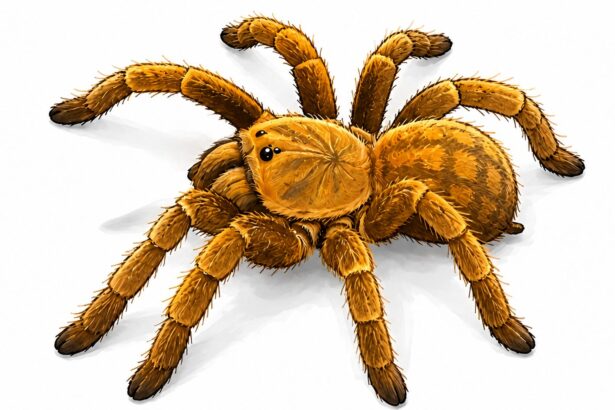
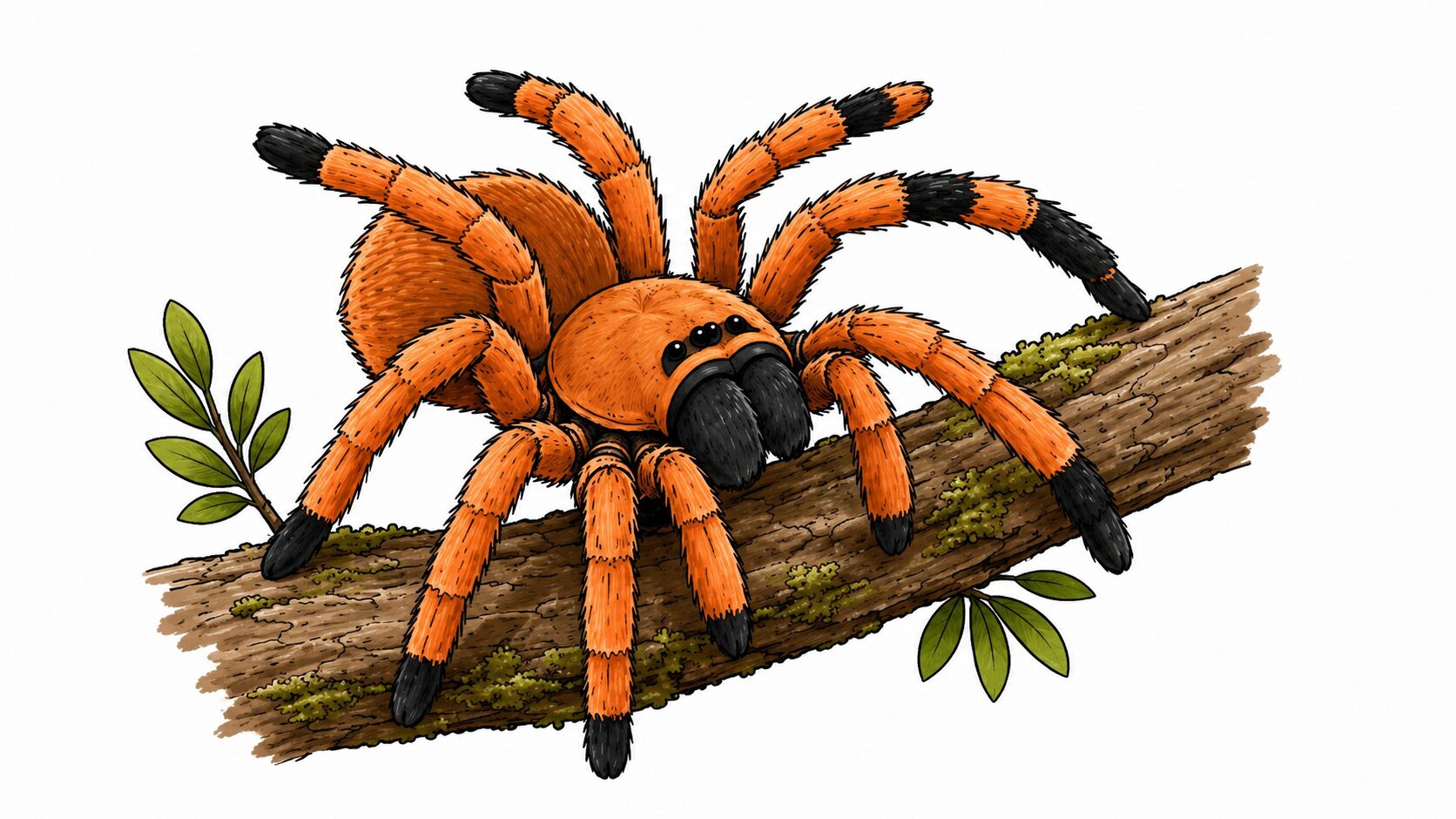
The orange colouration is what the common name promises and what the spider delivers. Adults display a warm, vibrant orange across the body and legs — described by keepers as resembling the colour of an orangutan — with a slightly greenish-grey carapace creating a subtle two-tone contrast. Long, similarly coloured setae on the legs and abdomen give the spider a softly furred appearance that photographs exceptionally well against the dark silk of its retreat. Juveniles show interesting abdominal striping that shifts progressively toward the adult orange through moults, making the growth journey visually engaging to document. The colouration is brightest immediately after a moult before the setae accumulate debris and settle into a slightly more muted everyday tone.
Adult females reach a legspan of 5 to 6 inches. Males are smaller and die within 3 to 4 years of sexual maturity, while females are estimated at 12 to 15 years in captivity. Growth rate is described as medium to fast — keepers raising from slings reach appreciable adult size within a couple of years under consistent feeding.
Housing
Tall, front-opening, and cross-ventilated. The enclosure requirements mirror those of any fast-moving arboreal species, with a minimum of 20 by 20 by 35 centimetres for adults — height being the critical dimension for a spider that never touches the substrate voluntarily. The enclosure must latch securely. The speed of this species is genuinely extreme — keeper accounts describe it as able to “teleport” across an enclosure — and a top-opening lid over an alert A. germani at the enclosure top is a genuine escape opportunity. Front-opening access is the only practical configuration for safe maintenance. Cross-ventilation between lower side openings and the top prevents the stagnant humid air that stresses arboreal species of this subfamily. Our best tarantula enclosure guide covers tall arboreal formats with appropriate cross-ventilation and front-access security.
Enclosure’s Decorations
A cork bark tube positioned vertically in the upper third of the enclosure, with its open end near the lid, provides the primary retreat and webbing anchor. A. germani webs extensively from this structure, building a dense silk tube retreat that expands outward to incorporate surrounding decoration. Broad-leafed fake plants positioned at height give additional attachment points. A shallow water dish at substrate level is essential — arboreal species do descend occasionally for water, and the dish provides passive humidity contribution through evaporation as well. Our best tarantula cork bark and best tarantula fake plants guides cover appropriate shapes for upper-enclosure arboreal configurations in a species that webs as actively as this one.
Substrate
Two to three inches of coconut coir or a coconut coir and peat moss blend, kept lightly damp at the lower portion, serves primarily as an evaporation layer for humidity management rather than a burrowing medium. A. germani does not touch the substrate as part of normal behaviour once past the earliest juvenile stage. The substrate moisture contributes to ambient humidity without requiring daily misting, and the enclosure ventilation allows that humidity to remain stable rather than accumulating into stagnant dampness. Our best tarantula substrate guide covers lightly moisture-retaining blends suited to arboreal enclosures where humidity management is the primary function.
Water And Humidity
A shallow water dish at substrate level should always be filled and refreshed every two to three days. Ambient humidity of 70 to 80 percent is appropriate for the French Guiana rainforest origin of this species, maintained through the lightly damp substrate, the water dish, and periodic light misting of the enclosure walls and webbing. The critical counterpoint to humidity is always ventilation — moist air moving through the enclosure is healthy; moist air sitting still in the enclosure is not. A hygrometer confirms actual ambient conditions, and a fine-mist misting bottle delivers targeted moisture without drenching the webbing. Arboreal species in the Psalmopoeinae subfamily drink from droplets on the enclosure walls and webbing after misting, so a light spray at feeding time serves double duty.
Heating And Temperature
French Guiana’s equatorial climate maintains temperatures consistently in the 22 to 28°C range year-round with minimal seasonal variation. This range — roughly 72 to 82°F — is the appropriate captive target. Most keepers in temperate climates maintain A. germani at room temperature without supplemental heat for most of the year. A low-wattage heat mat applied to the side of the enclosure and controlled by a thermostat provides background warmth when ambient temperatures drop below 68°F. A thermometer at enclosure level rather than room level gives accurate data on conditions at the spider’s actual position.
Diet And Nutrition
A reliable and enthusiastic feeder with a fast, committed strike response. Adults take crickets, roaches, and other appropriately sized invertebrates every seven to fourteen days. Juveniles every five to seven days, with prey sized carefully to the small abdomen during the sling stage. Food should be offered near or at the retreat entrance in the evening when the spider is most active — dropping prey onto the substrate where the spider must descend to retrieve it is less effective than placing it within reach of the webbing. Remove uneaten prey within 24 hours. Our best tarantula food guide covers feeder insect options and gut loading relevant to a moderately sized, fast-metabolising arboreal species.
Compatibility
Solitary only. For breeding, the female must be well-fed and the introduction supervised — the speed and defensive alertness of both sexes makes unsupervised introductions risky. Captive breeding has been documented successfully, and the species is available from captive breeders in both Europe and North America.
Behavior And Temperament
Speed is the defining characteristic and cannot be overstated. The “teleport” description from keeper accounts reflects genuine experience — this spider moves between positions in an enclosure faster than the eye can comfortably track, and the absence of urticating hairs means the only defensive escalation above rapid retreat is a bite. Most individuals prefer to bolt for their retreat rather than standing their ground, making the threat display less common than for some other fast arboreals, but the biting threshold is lower than for New World species that would kick hairs first. Venom is considered medically insignificant to healthy humans, and bites produce pain comparable to a bee sting. The Psalmopoeinae subfamily context positions this species as a relative of Psalmopoeus and Tapinauchenius, both genera known for the same speed-first defensive profile. Our how do tarantulas protect themselves article covers the full defensive biology of species that rely on speed over chemical or physical deterrents.
Handling
Not recommended. The extreme speed and willingness to bite without extended warning make handling a genuinely risky proposition regardless of the venom’s low medical significance — a bite from any tarantula large enough to break skin causes pain and potential secondary infection, and the speed of this species makes a controlled handling session very difficult to execute safely. Franksbuggin661’s product description correctly notes it as a bridge toward Old World species, not a handleable display animal. Observation through the enclosure is where the relationship with this species is best built.
Health And Lifespan
Females live 12 to 15 years in captivity. Males survive 3 to 4 years after sexual maturity. The species is considered hardy within appropriately ventilated, humidity-managed conditions. The primary health risk shared with all Psalmopoeinae arboreals is poor ventilation combined with humidity — the combination that causes stress and unexplained decline. A spider that becomes lethargic or descends to the substrate and stays there is a signal to review airflow conditions immediately. Pre-moult retreat sealing and cessation of feeding should be left undisturbed. Our tarantula dehydration article covers the signs and recovery for dehydration-related health concerns in arboreal species.
Price
Reasonably accessible in both European and North American markets following the establishment of captive breeding programmes that pre-date the 2022 formal description — keepers were breeding the animal successfully under the old names long before the taxonomy was corrected. Slings typically sell for $30 to $60 USD. Juveniles range from $55 to $100. Confirmed adult females command $100 to $180 depending on size and source. Fear Not Tarantulas and Exotics Unlimited are among the US vendors stocking this species intermittently. Source captive-bred specimens only. Everything needed to provide appropriate arboreal conditions for this species is on our best tarantula products page.