
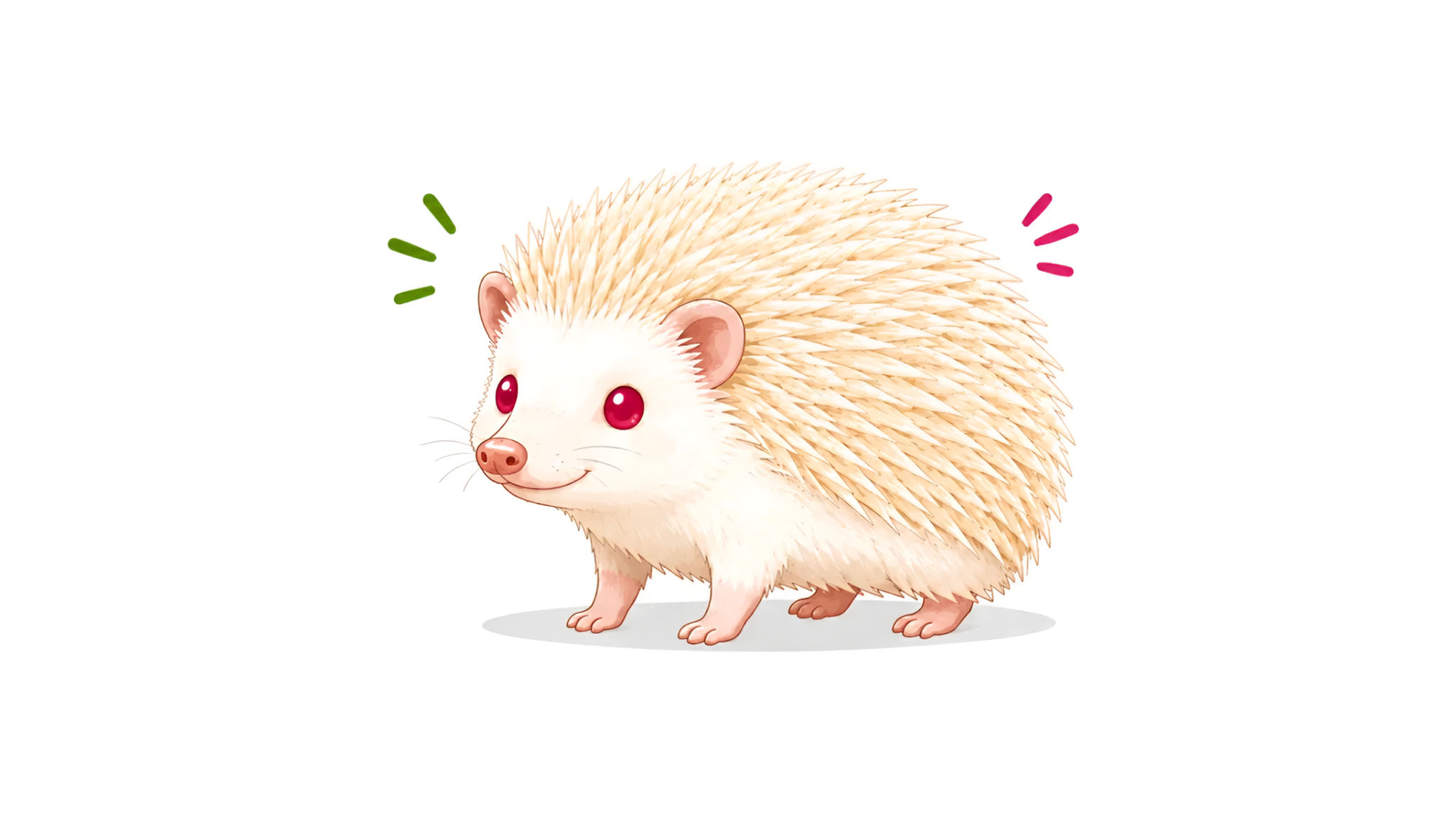
Spotting a white hedgehog with glowing pink eyes is the kind of thing that stops you in your tracks. They look almost otherworldly — pale quills, rosy skin, and those unmistakable red-tinted eyes staring back at you. But what exactly makes a hedgehog albino, why are they so incredibly rare, and what does life actually look like for one of these animals? There’s a lot more to the story than most people realize, and it’s worth understanding before you consider bringing one home.
What Albinism Actually Is
Albinism is a genetic condition caused by the complete absence of melanin — the pigment responsible for color in skin, fur, and eyes across virtually all mammals. It’s not a disease in the traditional sense, but rather an inherited trait that affects how an animal produces pigment from birth. When melanin is entirely absent, the result is white or near-white fur, pale skin, and eyes that appear pink or red because the underlying blood vessels show through.
One thing worth clearing up straight away: not every white hedgehog is an albino. Leucistic hedgehogs also exist and look strikingly similar on the surface, but there’s one key difference. Leucism results in reduced pigmentation but does not affect eye color — a leucistic hedgehog will have white or pale quills and skin, but its eyes will stay their normal color. Albinism, conversely, always results in red or pink eyes. That’s the quickest way to tell them apart. It’s also worth knowing that albino hedgehogs are not a separate breed or species — they’re the same animals as any other hedgehog. You can read more about hedgehog varieties on our hedgehog breeds page.
The Genetics Behind It
Albinism is driven by recessive gene mutations that disrupt melanin production. In hedgehogs, two copies of the mutated gene must be inherited for albinism to show up at all. If only one copy is inherited, the hedgehog will carry the gene without ever expressing the trait.
This is where things get particularly interesting. Both parents must carry the gene mutation for the offspring to have any chance of being albino — even if the parents themselves look completely normal. Two standard-looking hedgehogs can produce an albino offspring if they both happen to carry the recessive gene, and neither of them would give anything away by their appearance alone.
Even when both parents are carriers, there’s no guarantee. If a breeder paired two albino hedgehogs together, they would typically produce around 50% albino offspring, 25% non-albino carriers, and 25% non-albino animals without the gene at all.
Why They’re So Hard To Find
All of the above explains why albino hedgehogs are exceptionally rare. The gene itself is uncommon, it’s recessive, and both parents need to carry it for there to even be a chance. Only one in 100,000 hedgehogs is born albino. Those are staggering odds, and they go a long way toward explaining why most people will go their entire lives without encountering one — in the wild or even in a pet store.
Your best chance of finding one is through a specialist breeder, though availability is still unpredictable. This rarity is also one of the main reasons albino hedgehogs tend to cost more than standard hedgehogs, which we’ll get to shortly.
The Challenges Albinism Creates
Albinism looks striking, but it does come with real consequences for the animals that have it — particularly around vision and sun exposure.
Eyesight And Light Sensitivity
Hedgehogs already have fairly poor eyesight to begin with, relying far more on their sense of smell and hearing than on vision to navigate the world. Albinism adds another layer to the eye issue. The lack of melanin not only affects appearance but can also lead to increased sensitivity to sunlight and potential vision problems, since melanin plays a structural role in how the eye develops and functions.
That said, hedgehogs are so well-adapted to navigating by smell and sound that even a visually impaired animal can often get around with remarkable confidence. Their hearing range alone — capable of detecting sounds between 250 Hz and 45,000 Hz, well beyond human perception — more than compensates for weaker eyesight.
For captive albino hedgehogs specifically, it’s crucial to keep their environment shaded and provide plenty of hiding spots. Bright light isn’t just uncomfortable — UV exposure can cause genuine skin damage over time. Never place their cage in direct sunlight, and always make sure shaded retreat areas are available. A look at the best hedgehog bedding options can help you create a comfortable, appropriately dark resting space for them.
Camouflage And Predators
In the wild, an albino hedgehog’s white coloring is a real liability. Their striking white appearance makes them significantly more visible to predators compared to their darker, better-camouflaged relatives. Standard hedgehogs blend into undergrowth and soil fairly well, especially at night. An albino animal doesn’t have that advantage.
Fortunately, hedgehogs are nocturnal and tend to stick to dense, bushy cover during daylight hours, which helps offset the visibility problem to some degree. It’s worth noting that very few albino hedgehogs have ever been documented surviving in the wild long-term, so the ones you’re most likely to encounter are captive-bred.
How To Tell If Your Hedgehog Is Truly Albino
The eyes are your clearest indicator. Albino animals have pink or red eyes because, without melanin, the underlying blood vessels show through. A hedgehog with ruby-colored eyes is actually not a true albino — ruby eyes tend to be a deeper red that appears darker than genuine albino eyes, and they indicate diluted pigmentation rather than a complete absence of it.
Beyond the eyes, look at the quills and skin. A true albino will have completely white quills and pale pink or white skin with zero dark pigmentation anywhere. Any dark spotting, dark eyes, or cream-colored rather than white quills points toward leucism or another color variation.
One more thing: a hedgehog cannot be partially albino. Albinism is a binary trait — either the animal has the genetic mutation preventing melanin production, or it doesn’t.
How Much Do Albino Hedgehogs Cost?
Our how much do hedgehogs cost page covers general hedgehog pricing in full, but for albinos specifically, you can typically expect to pay between $250 and $350, with prices potentially climbing higher for particularly sought-after animals from reputable breeders. Unusual or rare color varieties can sometimes exceed $500.
Your best bet is a reputable breeder rather than a pet store, since albino hedgehogs are rarely stocked by general retailers. Take the time to verify their health practices and breeding standards before committing. A responsibly bred hedgehog — albino or otherwise — is going to be far healthier and better socialized than one bred purely for color.
Caring For An Albino Hedgehog
The good news is that caring for an albino hedgehog is largely the same as caring for any other hedgehog. Their diet, handling requirements, and general care don’t change because of their coloring. You can find a full breakdown of what hedgehogs eat and everything you need to know about hedgehog quills and safe handling on their respective pages.
The main extras for albino care come down to light sensitivity. Keep their enclosure away from direct sunlight, ensure shaded retreat areas are always available, and avoid exposing them to harsh bright light unnecessarily. Regular vet checkups are worth prioritizing too, since albino animals can be more prone to skin-related issues over time.
Everything else — the exercise wheel, temperature regulation, regular bathing, and general hygiene — follows the same routine as any healthy hedgehog.
Conclusion
Albino hedgehogs are one of nature’s more unusual results — a perfect storm of recessive genetics producing an animal that looks unlike anything most people expect from a hedgehog. The white quills, the pink eyes, the pale skin: it all comes down to a single missing ingredient: melanin. Understanding why they’re rare, what challenges their condition creates, and how to care for them properly means you’ll be genuinely equipped to give one a wonderful life if you’re lucky enough to find one. And when you’re ready to kit out their home, our best hedgehog products page has everything you’ll need to make sure your albino hedgehog has a safe, comfortable, and well-equipped space from day one.