
Choosing the best axolotl tank substrate is one of those decisions that seems minor until you understand the real risks involved. Axolotls are indiscriminate feeders that regularly pick things up from the floor of their tank during feeding, and the wrong substrate can cause fatal intestinal impaction. At the same time, the right substrate choice can create a natural, enriched environment that genuinely improves your axolotl’s quality of life. This guide covers everything you need to know about axolotl tank substrate — which types are safe, which are dangerous, and our top Amazon picks for each safe option. Pair this with our in-depth articles on whether axolotls need substrate and the best substrate for axolotls for the full picture, and read our axolotl care guide for comprehensive guidance on setting up a complete, healthy tank.
Why Substrate Choice Matters So Much for Axolotls

Axolotls are bottom-dwelling aquatic salamanders that spend virtually all of their time at floor level — walking, resting, foraging, and exploring along the substrate surface. Their relationship with whatever is on the floor of their tank is constant and close, which makes substrate choice far more consequential than it would be for a mid-water swimming fish.
The most serious risk is gastrointestinal impaction. Axolotls feed using suction — they strike at prey and inhale it along with surrounding water. In a tank with loose substrate, this means substrate particles enter the mouth regularly, and anything small enough to swallow will be swallowed. Particles that can pass through the digestive tract cause no harm, but particles that cannot pass create dangerous or fatal blockages. According to research published in Aquaculture, gastrointestinal foreign body ingestion is among the most common preventable causes of mortality in captive aquatic salamanders. Standard aquarium gravel — with particles typically in the 3–8mm range — sits in exactly the danger zone: small enough for an axolotl to ingest, too large to pass safely.
Beyond safety, substrate also affects your axolotl’s behaviour and comfort. Axolotls on fine sand engage in natural sifting and foraging behaviours they are unable to perform on bare glass. Appropriate substrate gives their feet proper traction for walking — something that matters for animals that walk everywhere rather than swim. It also provides surface area for the beneficial bacteria that support your tank’s nitrogen cycle, as covered in our best axolotl filter guide.
The wild axolotl (Ambystoma mexicanum) is critically endangered, native to the high-altitude lake system of Xochimilco in Mexico City where the natural lakebed is composed of fine silt, mud, and organic debris. Fine aquarium sand most closely mimics this natural environment.
The Three Safe Options for Axolotl Tank Substrate

There are exactly three substrate approaches that are genuinely safe for axolotls. Everything else — including popular choices like pea gravel, aquarium gravel, decorative pebbles, and coloured substrate — carries real impaction risk.
Fine sand (particles 1mm or smaller). This is the most popular choice among experienced axolotl keepers and the one we recommend as the best overall axolotl tank substrate. Fine sand particles are small enough that even if swallowed — which will happen occasionally — they pass harmlessly through the digestive system and are excreted without issue. Sand provides excellent traction for axolotl feet, closely mimics the natural substrate of Xochimilco, allows natural foraging behaviour, and provides ample surface area for beneficial bacteria colonisation. It looks beautiful, and most axolotl morphs show up spectacularly well against a pale sand backdrop. For dedicated sand coverage, see our guide to the best axolotl tank sand.
Large flat tiles (slate, ceramic, or stone). Flat tiles laid across the tank floor are a completely safe substrate option because they present no swallowable particles. They provide a smooth, non-abrasive surface, are extremely easy to clean — waste sits on top and is easily siphoned rather than hiding between grains — and give your axolotl reasonable traction. The tradeoff compared to sand is that they offer no foraging enrichment and less natural aesthetics. Our dedicated guide to the best axolotl tank tiles covers the best products and configurations. Tiles also work well as a hybrid approach — covering most of the tank floor in sand with a tiled area in the feeding corner reduces the chance of sand ingestion during mealtimes.
Bare bottom (no substrate at all). The third option is simply not using any substrate — running a bare-bottom tank on the aquarium glass. This is popular among breeders and keepers who prioritise ease of cleaning over aesthetics. Bare-bottom tanks show waste clearly on the glass floor, making spot-cleaning with a turkey baster or tank siphon straightforward and effective. The primary downside is poor traction — axolotls can slip and struggle for grip on smooth aquarium glass, which causes stress and unnatural posture over time. If you run a bare-bottom setup, adding a few flat tiles in resting areas significantly improves your axolotl’s ability to walk comfortably.
What to Absolutely Avoid

Aquarium gravel of any size is the most dangerous common substrate for axolotls. Standard fish gravel particles (3–10mm) are exactly the size range most likely to be swallowed and most likely to cause impaction. This includes coloured gravel, natural pebble gravel, pea gravel, and all decorative stone mixes. No matter how appealing they look, they are not safe for axolotls.
Large decorative pebbles are safe from an impaction standpoint if they are large enough to be impossible to swallow, but they create an uneven, difficult-to-navigate surface that is poor for traction and terrible for cleaning. Waste and uneaten food collect in the gaps between large pebbles and is very difficult to remove with routine siphoning. If you want a rocky aesthetic, use a few large decorative stones as accent pieces over a fine sand base rather than as the primary substrate.
Crushed coral and aragonite substrate can alter water chemistry by raising pH and hardness, which is fine for marine or African cichlid tanks but unnecessary and potentially harmful for axolotls. Axolotls do best in neutral to slightly alkaline freshwater, and crushed coral introduces chemistry variables you do not need.
Sharp volcanic rock or lava rock substrate risks abrasion injuries to axolotl skin and feet — their skin is permeable and delicate, making them vulnerable to surface injuries from rough substrate.
What Depth of Substrate Is Right?

For fine sand, a depth of 1–2 inches is ideal. This is enough for your axolotl to sift through naturally but not so deep that anaerobic (oxygen-free) pockets form in the deeper layers. Anaerobic zones can produce hydrogen sulphide gas, which is toxic to aquatic life. Keeping the sand layer at 1–2 inches and gently disturbing the surface during weekly water changes prevents these pockets from forming.
For tiles, depth is not a consideration — lay them flat across the entire tank floor, fitting them to cover the glass with minimal gaps between tiles.
Our Top Axolotl Tank Substrate Picks
Best Overall Fine Sand: CaribSea Super Naturals Torpedo Beach Aquarium Sand (20lb)
The CaribSea Super Naturals Torpedo Beach Aquarium Sand is our top overall recommendation for axolotl tank substrate. Its fine, smooth grain size is safe for axolotls to ingest and mimics the soft, silty lakebeds of natural axolotl habitat beautifully. CaribSea manufactures it with no artificial dyes, paints, or coatings, and it is pH neutral — it will not alter your water chemistry. The warm, natural tan colour makes the typical colouration of most axolotl morphs stand out clearly, creating a visually stunning display. It provides excellent traction for axolotl feet and ample surface area for beneficial bacteria colonisation. The 20lb bag is sufficient for a 1–1.5 inch layer in a standard 20-gallon long tank; for the Aqueon 40-gallon breeder we recommended in our best axolotl tank article, two 20lb bags or one larger bag gives you the appropriate depth. This sand is also favoured for its relatively low dust content compared to cheaper alternatives, meaning less cloudiness when first added to the tank.
Best Fine Sand for Black Aesthetics: CaribSea Super Naturals Moonlight Sand (20lb)
For keepers who want a darker substrate aesthetic — particularly those keeping leucistic or golden albino axolotls, whose pale colouration is shown off dramatically against dark substrate — the CaribSea Super Naturals Moonlight Sand is an excellent choice. It uses the same fine grain structure and dye-free construction as the Torpedo Beach but in a rich, deep charcoal colour. It is pH neutral, safe for all aquariums, and made in the USA. The fine particle size makes it fully safe for axolotl ingestion, and the dark background creates a high-contrast look that shows off both the axolotl itself and any live or silk plants beautifully.
Best Budget Sand: CaribSea Super Naturals Crystal River Sand (5lb — for Small or Budget Setups)
For keepers starting with a smaller juvenile tank or working with a tighter budget, the CaribSea Super Naturals Crystal River Sand in the 5lb format provides the same fine grain, dye-free, pH-neutral quality as the larger bags in a more accessible quantity and price. The Crystal River colour is a clean, natural sandy white that works beautifully in any aquascape. For a full 40-gallon breeder you would need multiple bags, so this format is best for smaller setups or for topping up an existing substrate layer.
Best Pool Filter Sand Alternative: FairmountSantrol AquaQuartz Pool Filter Sand (50lb)
For keepers who want a large quantity of safe fine sand at the lowest possible cost per pound, pool filter sand is a well-established axolotl keeper’s choice. The FairmountSantrol AquaQuartz-50 Pool Filter Sand is a 50-pound bag of natural silica sand in the 20-grade filter size, which provides a fine, smooth particle that is safe for axolotl use. At 50 pounds for a very accessible price, it is one of the most cost-effective ways to substrate a large axolotl tank fully. The natural white colour is clean and attractive. The only important note is that pool filter sand must be rinsed very thoroughly before use — multiple rinse cycles until the water runs completely clear — as it contains significant fine dust straight from the bag. With thorough rinsing, it is a safe and popular choice in the axolotl community. Note that some pool filter sands use slightly angular particles; round, smooth particle varieties are preferable, so verify particle shape on the specific product page.
Best Tile Option: Natural Slate Stone Aquarium Tiles (USA Sourced, 8–10 inch pieces)
For keepers who prefer the tile approach — particularly those with bare-bottom setups who want to give their axolotl better traction in resting areas — the Natural Slate Stone Aquarium Pieces (8–10 inches, USA Sourced) are large enough to be completely impossible for an axolotl to ingest, smooth enough to avoid abrasion, and fully aquarium-safe. Slate is an inert rock that does not leach any substances into the water. These pieces lay flat naturally due to slate’s characteristic layered structure, covering significant floor area and giving your axolotl firm, non-slip footing. They also look genuinely beautiful as a tank floor and pair well with caves, hides, and live plants to create a natural, enriched environment. For full tile coverage, you can also source unglazed natural slate floor tiles from a hardware store, which is often more economical for covering a full 40-gallon breeder floor. For a full breakdown of tile options, see our guide to the best axolotl tank tiles.
How to Prepare and Add Substrate to Your Axolotl Tank
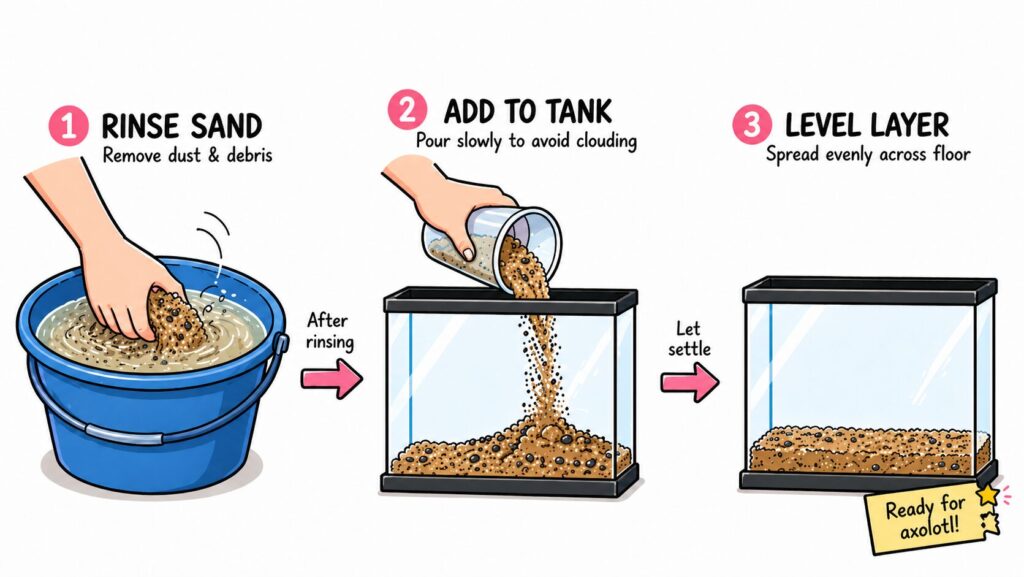
Rinse sand thoroughly before use. Even pre-washed aquarium sands like CaribSea require rinsing before they go into your tank. Place the sand in a clean bucket, fill with water, stir vigorously, and pour off the cloudy water. Repeat until the water runs completely clear. This typically takes 5–10 rinse cycles depending on the sand. Adding unrinsed sand to your tank creates days of cloudiness that stress your axolotl and clog your filter.
Add sand slowly. Pour rinsed sand into the tank slowly using a cup or scoop, distributing it evenly across the bottom in a 1–2 inch layer. Placing a plate on the substrate first and pouring over it helps avoid disturbing your tank layout as the sand settles.
Rinse tiles too. Even natural slate tiles should be rinsed under running water and scrubbed with a clean brush before use to remove loose debris and dust. Do not use soap or detergent.
Never use soap or cleaning products on substrate. Any residual chemical is harmful to your axolotl. Rinse with plain water only.
Maintain substrate regularly. For sand, use a tank siphon weekly to vacuum waste from the surface, hovering the siphon just above the sand without removing it. Use a turkey baster for daily spot-cleaning of visible waste and uneaten food. Our guides on how to clean an axolotl tank and how often to clean an axolotl tank cover the full maintenance schedule.
Frequently Asked Questions
Is gravel safe for axolotls? No. Standard aquarium gravel is not safe for axolotls. Gravel particles in the 3–10mm range are small enough to be swallowed during feeding but too large to pass through the digestive tract safely, causing impaction that can be fatal. Choose fine sand, flat tiles, or a bare-bottom setup instead.
Can axolotls ingest sand without harm? Fine sand with particles 1mm or smaller passes harmlessly through an axolotl’s digestive system when accidentally swallowed. This is what makes fine sand the safest loose substrate choice. Coarser sands with angular particles larger than 1mm begin to approach a safety grey area and are better avoided.
What is the best substrate for a bare-bottom axolotl tank? If you run a bare-bottom setup, add a few flat slate tiles or unglazed ceramic tiles in the areas where your axolotl spends the most time resting and walking. This gives them the traction they need without introducing any loose substrate.
How deep should the sand be in an axolotl tank? A depth of 1–2 inches is ideal. Deeper sand can develop anaerobic zones that produce toxic gases. Shallower sand can be disturbed and displaced easily. The 1–2 inch range gives your axolotl meaningful interaction with the substrate while remaining safe.
Does substrate affect water quality in an axolotl tank? Yes. Fine sand provides surface area for beneficial bacteria that process ammonia and nitrite as part of the nitrogen cycle, which improves water quality. On the other hand, waste accumulates in sand if not siphoned regularly, which can spike ammonia if cleaning is neglected. Pair good substrate maintenance with a reliable water test kit and water conditioner for stable water parameters.
Is coloured aquarium sand safe for axolotls? Only if it is a fine, smooth, dye-free formulation. Some coloured aquarium sands are made from naturally coloured fine sand and are safe. Others are coated or dyed, and those dyes can leach into the water over time. Stick to well-known brands like CaribSea that explicitly state no paints, dyes, or coatings are used.
Build the Perfect Environment From the Floor Up
Substrate is the foundation of your axolotl’s home — the surface they walk on, rest on, and forage across every hour of every day. Getting it right is one of the most meaningful things you can do for their long-term health and quality of life. If you want a complete, keeper-tested resource for every product your axolotl needs — from substrate and filtration to food, hides, and health supplies — head over to Best Axolotl Products and explore our full guide to the best gear in every category.