


Choosing the best axolotl tank siphon is one of those practical decisions that makes the difference between a maintenance routine you dread and one that takes ten minutes and is done. A good aquarium siphon is the tool you use every single week — for water changes, for vacuuming waste from the tank floor, and for keeping the substrate clean between water changes. For axolotl tanks specifically, siphon choice matters more than it does for many fish setups because axolotls are messy animals that produce significant waste, spend all their time at the bottom of the tank close to any substrate debris, and have delicate gill plumes that must not be disturbed or sucked into an overpowered vacuum. This guide covers everything: why a good siphon is essential, what makes one appropriate for an axolotl tank, and our top Amazon picks for every type of setup. Pair this guide with our articles on how to clean an axolotl tank, how often to clean an axolotl tank, and our full axolotl care guide.
Why a Good Tank Siphon Matters So Much for Axolotl Keepers

Axolotls are among the messiest animals in the aquarium hobby. They produce a significant volume of waste relative to their body size, they eat large food items like nightcrawlers and pellets that can leave residue on the tank floor, and they occasionally regurgitate food that then decomposes rapidly. All of this organic material — if left on the substrate — breaks down into ammonia, which is directly toxic to axolotls. According to research published in Aquaculture, even sub-lethal ammonia concentrations suppress immune function and gill health in aquatic salamanders significantly, and axolotls are particularly vulnerable because of their permeable skin and exposed external gill plumes.
The nitrogen cycle your filter establishes handles the dissolved ammonia in the water column, but physical waste sitting on the substrate or tank floor produces a concentrated local ammonia source that the filter cannot process fast enough on its own. Regular siphoning removes this physical waste before it fully breaks down — dramatically reducing the ammonia load your filter must process and keeping water quality genuinely stable rather than just nominally acceptable.
For sand-substrate tanks — which we recommend as the safest substrate option in our best axolotl tank sand and best axolotl tank substrate articles — siphon technique is particularly important. You need a siphon with enough suction to lift waste from the sand surface but not so much that it vacuums up the sand itself. This requires flow control — either through a valve or by technique — which distinguishes a good axolotl siphon from a generic aquarium vacuum.
Beyond waste management, siphoning is how you perform water changes — removing a portion of the tank water to take out accumulated nitrates and dissolved organic compounds. The U.S. Environmental Protection Agency notes that nitrate accumulation in closed water systems causes gradual water quality degradation that cannot be resolved without physical water replacement. A regular water change schedule using a good siphon is the most important maintenance practice in axolotl keeping. For tile or bare-bottom tanks — covered in our best axolotl tank tiles article — siphoning is even simpler since waste sits visibly on flat surfaces and is easily targeted.
What Makes the Best Axolotl Tank Siphon?

Appropriate tube diameter. Siphon tubes come in several diameters. For axolotl tanks, a tube diameter in the 1–1.5 inch range is ideal — wide enough to pick up larger waste pieces (including worm remnants and pellet fragments) without clogging, but not so large that it creates excessive flow that disturbs fine sand substrate or generates enough suction to catch a curious axolotl’s gill plumes. Very narrow siphons designed for small nano tanks are impractical for 40-gallon axolotl setups.
Controllable flow rate. For sand-substrate axolotl tanks, the ability to control the intensity of suction is essential. By hovering the tube opening just above the sand surface rather than pushing it into the sand, and by controlling your siphon height differential, you can skim waste from the surface without pulling sand up the tube. A flow control valve or squeeze mechanism makes this significantly easier.
Long enough tube for your tank depth. The Aqueon 40-gallon breeder — our recommended tank in the best axolotl tank article — has a 16-inch depth. Your siphon tube should be long enough to reach the tank floor comfortably from a hand position above the tank rim. Most standard aquarium siphon tubes are 10–24 inches, which works for the breeder format. For taller tanks, a longer tube is needed.
No-mouth starting mechanism. Traditional siphons are started by briefly sucking on the output end to initiate water flow — an unpleasant and unhygienic process that puts your mouth in contact with tank water containing axolotl waste. Modern siphons include squeeze bulb starters, self-start valves, or faucet-driven systems that eliminate mouth-starting entirely. This is a quality-of-life feature that makes weekly cleaning much more pleasant.
Enough hose length to reach a drain or bucket. The output hose needs to be long enough to reach from your tank to wherever you are draining the removed water — a bucket beside the tank, a laundry sink, or a bathtub. For faucet-connected systems like the Python No Spill Clean and Fill, hose length is especially important since the system connects directly to your tap and drains directly into the sink.
Axolotl-safe construction materials. Any tubing or plastic in contact with your axolotl’s water should be free of PVC plasticisers or other chemical additives that can leach into water over time. Python Products explicitly uses UV-stabilised, non-porous materials in their products to avoid chemical contamination.
Types of Axolotl Tank Siphons

Traditional hand siphon with gravel tube. The classic aquarium siphon — a clear plastic tube attached to a flexible hose — is the most widely used type in the hobby. Started by a squeeze bulb or brief priming, it siphons water by gravity into a bucket while you vacuum the tank floor. Simple, reliable, and inexpensive. The main limitations are that you need a bucket large enough to hold 20–25% of your tank volume, and you will need to carry that bucket to the drain. For a 40-gallon tank’s 25% water change, that means moving approximately 2.5 gallons at a time — manageable but not as effortless as the faucet-connected systems.
Faucet-connected water changer systems (Python-style). These systems connect directly to your household tap via an adapter and use the faucet’s water pressure to both drain (via venturi effect) and fill (via direct flow) your tank without a bucket. The Python No Spill Clean and Fill is the most famous example. You attach the device to your faucet, put the gravel tube in the tank, open the faucet, and water drains directly to your sink — no buckets, no carrying. When the drain is done, you flip a switch and the faucet water flows back into the tank to refill. This is the most convenient method for regular maintenance by a significant margin. The main consideration for axolotl keepers is that you must treat the refill water with dechlorinator — either by dosing the tank before refilling or by using a dechlorinator that can be added as you fill. Temperature of tap water also needs to match your tank’s cold-water temperature, which may require mixing cold and hot tap water to find the right level — always verify with your thermometer.
Electric-powered aquarium vacuums. Battery or USB-powered siphons use a small motor to generate suction rather than gravity. They are convenient for spot-cleaning and useful in setups where a gravity siphon is impractical, but the motorised pump generates a fixed flow rate that can be hard to control on a sand-substrate axolotl tank. For routine weekly water changes, traditional or faucet-connected gravity siphons generally outperform electric options.
Our Top Axolotl Tank Siphon Picks
Best Overall for Most Setups: Python No Spill Clean and Fill (25ft)
The Python No Spill Clean and Fill Aquarium Maintenance System (25ft) is the most widely recommended aquarium maintenance system in the freshwater hobby and the one that makes the biggest quality-of-life difference for axolotl keepers who dread weekly water changes. It connects to your household faucet via an included adapter, drains your tank directly to the sink via venturi effect, and refills from the tap — no buckets required. According to Python Products’ own documentation, the system uses UV-stabilised, non-porous tubing to prevent chemical contamination of aquarium water, which is an important safety consideration for sensitive animals like axolotls. The included 10-inch gravel tube is appropriate for reaching the floor of the Aqueon 40-gallon breeder (16-inch depth), and Python sells extended gravel tube attachments if needed. The 25-foot hose length is sufficient for tanks positioned within about 20 feet of a sink. Always treat the refill water with Seachem Prime as you fill — either dose the tank before filling, or use a vitamin C-based dechlorinator in the line.
Best with Flow Switch for Axolotl Tank Safety: Python No Spill Clean and Fill (50ft) with Flow Switch
For keepers whose tank is further from a sink, or who want the added convenience of a flow switch that allows them to pause and resume refilling without disconnecting from the faucet, the Python No Spill Clean and Fill (50ft) with Flow Switch is our recommended upgrade. The flow switch is particularly useful for axolotl keepers because it allows you to stop the fill flow momentarily while you check the temperature of incoming water with your thermometer — ensuring the cold axolotl tank is receiving appropriately cool refill water rather than a blast of warm tap water. The 50-foot hose provides comfortable reach from most tank positions in a typical home.
Best Traditional Bucket Siphon with Squeeze Start: Python Pro-Clean Gravel Washer with Squeeze Siphon Starter (Medium)
For keepers who prefer the control and simplicity of a traditional bucket-based siphon over the faucet-connected Python system, the Python Pro-Clean Gravel Washer and Siphon Kit with Squeeze Starter (Medium) is our top recommendation. The squeeze bulb starter eliminates mouth-starting by allowing you to squeeze the bulb to initiate siphon flow — much cleaner and more hygienic than traditional priming. The medium-size gravel tube is appropriate for the 40-gallon breeder tank and provides a flow rate that is controllable enough to hover above sand without pulling up the substrate. Drain into a bucket, carry to the drain, refill with treated water. This method gives you more control over exactly how much water you remove and lets you add Seachem Prime to each refill bucket before adding it to the tank.
Best Small Siphon for Spot-Cleaning and Quarantine Tubs: Python Pro-Clean Gravel Washer (Small)
For spot-cleaning between water changes, cleaning a quarantine tub, or performing water changes on smaller juvenile tanks, the Python Pro-Clean Gravel Washer (Small) is the right tool. The smaller tube diameter provides a more gentle, precise flow that is easier to control when working in smaller spaces. This is also an excellent secondary siphon to keep on hand for spot-cleaning the main tank between weekly maintenance sessions — use it to target visible waste without performing a full water change. A small siphon alongside your turkey baster gives you complete precision cleaning capability for daily maintenance.
Best for Larger Two-Axolotl Setups: Python No Spill Clean and Fill (50ft) with 30-Inch Gravel Tube
For keepers running a 55-gallon setup for two axolotls — as we recommended in our best axolotl tank article — the Python No Spill Clean and Fill (50ft) with 30-Inch Gravel Tube provides the extended gravel tube needed to comfortably reach the floor of a deeper tank, alongside the 50-foot hose for flexible positioning. Before housing two axolotls together, always review our guides on whether axolotls are cannibalistic and tank mate compatibility.
How to Siphon an Axolotl Tank Correctly

Siphon technique for sand-substrate tanks. Hold the gravel tube vertically and lower it to just above the sand surface — approximately 1–2cm above the substrate. Do not push the tube into the sand. Allow the suction to draw waste particles up from the sand surface without removing the sand itself. Move the tube slowly across different areas of the tank floor in a systematic pattern, covering the full footprint of the tank. Any area where you see visible waste, faeces, or food remnants should be targeted. If sand begins to travel up the tube, raise the siphon slightly higher above the surface.
Siphon technique for bare-bottom or tile tanks. On bare glass or flat tiles, waste sits visibly on the surface and is much easier to target precisely. Use the siphon to vacuum up any visible waste, moving methodically across the tank floor. Tiles also allow you to push the tube right up against the surface for thorough cleaning since there is no sand to disturb. For daily spot-cleaning of tiles or bare glass, a turkey baster is faster and more precise than a full siphon.
Where to position your axolotl during siphoning. Ideally, your axolotl will have retreated into a hide or cave during maintenance — most axolotls learn to do this as they become accustomed to the routine. If your axolotl is in an open area of the tank during siphoning, work around it carefully, keeping the siphon tube away from its gill plumes. Never direct the siphon flow toward an axolotl’s face or gills. The suction from a standard siphon can disturb gill plumes and cause stress if the tube comes too close.
Water change volume. For a 40-gallon axolotl tank, remove and replace 20–25% of the tank volume (8–10 gallons) per weekly water change. For tanks with heavy waste loads — particularly during summer when ammonia builds faster — or if nitrate testing shows levels above 20 ppm, increase to 30–40% per change rather than increasing frequency. Always treat replacement water with dechlorinator and verify temperature before adding. Track your nitrate levels with your water test kit weekly to confirm your water change volume and frequency is keeping up with the waste load.
Maintaining Your Siphon
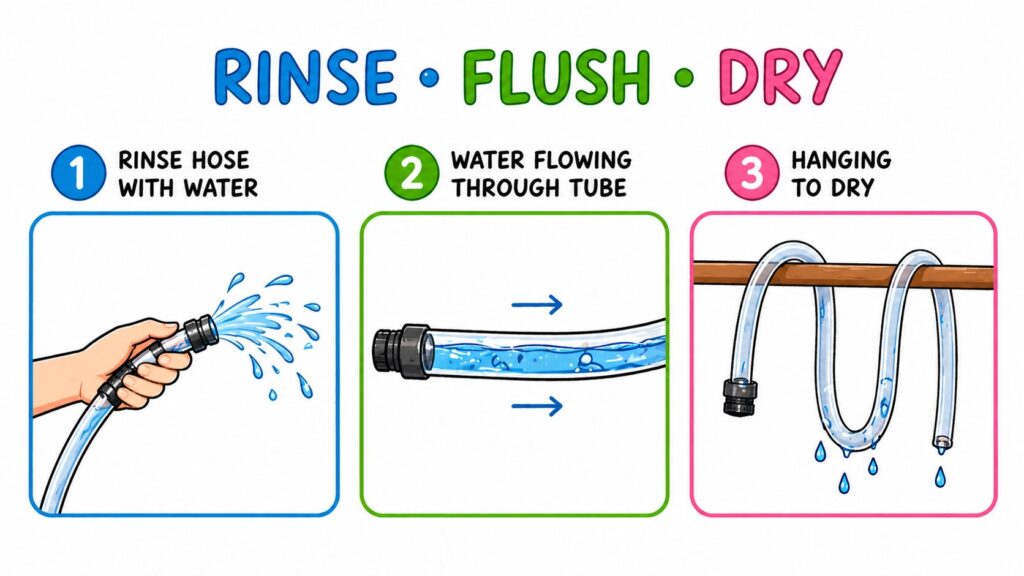
Aquarium siphons require minimal maintenance but should be rinsed thoroughly after every use. Tank water, organic debris, and residual dechlorinator in the hose can degrade over time if left sitting in a stored siphon. After each use, run clean tap water through the full length of the hose to flush it out, then allow to drain and air-dry before storing. Never use soap or cleaning products on any aquarium equipment — residual detergent introduced to your tank can kill your filter bacteria and harm your axolotl.
Replace hose tubing if it becomes discoloured, brittle, cracked, or develops a persistent musty smell. Plastic tubing has a finite life, and degraded tubing can become a contamination source. Python and similar brands sell replacement tubing that can be cut to your preferred length.
Frequently Asked Questions
Can I use any aquarium siphon for an axolotl tank? Most standard aquarium siphons work for axolotl tanks, but tube diameter and flow control matter more than for typical fish tanks. A siphon with a tube that is too narrow will clog on larger axolotl waste, and one with uncontrollable high flow will disturb fine sand substrate. Python Pro-Clean and No Spill Clean and Fill products are the most consistently recommended by experienced axolotl keepers.
How often should I siphon my axolotl tank? The substrate surface should be siphoned during every weekly water change. For spot-cleaning of visible waste between changes, a turkey baster is faster and more precise than a full siphon. Our guide on how often to clean an axolotl tank covers the full maintenance schedule.
Will siphoning disturb my fine sand substrate? Only if you push the tube into the sand. Hovering the siphon 1–2cm above the surface skims waste without pulling up sand. Start slow with a new siphon to calibrate the right height for your specific setup and flow rate.
Is the Python No Spill system safe to use with axolotl cold water? Yes, but you need to manage the tap water temperature carefully. Most households have cold tap water cold enough for axolotl tanks, but in summer the incoming water can be warmer than your tank. Mix cold and hot tap water to achieve the right temperature, or use a thermometer to check refill water temperature before allowing it into the tank.
Do I need to remove my axolotl from the tank to siphon? No — siphoning with the axolotl present is standard practice. Keep the siphon tube away from your axolotl’s face and gill plumes, work methodically around any areas where it is resting, and it will generally be undisturbed by the process.
The Weekly Habit That Keeps Everything Running
A great siphon turns the most important weekly maintenance task from a burden into a ten-minute routine. When water changes are easy, they actually get done consistently — and consistent water changes are what keep ammonia and nitrate in check, your filter healthy, and your axolotl thriving over the 10–15 years it can live with proper care. If you want the full, keeper-tested guide to every product that supports excellent axolotl care — from the tank and filtration to health supplies and enrichment — Best Axolotl Products has everything you need in one place.