
Do axolotls bite? Yes — but understanding why they bite, what it feels like, and when it happens completely changes how threatening that answer sounds. Axolotl biting is almost never aggressive in any meaningful sense. It is a feeding reflex, and it happens to fingers for the same reason it happens to worms — because something moved near their mouth and triggered an instinctual response. For most owners, an axolotl bite is a mild surprise rather than a genuine injury. This article covers everything you need to know about axolotl biting behavior, what causes it, whether it is dangerous, and how to handle and prevent it.
Why Do Axolotls Bite?
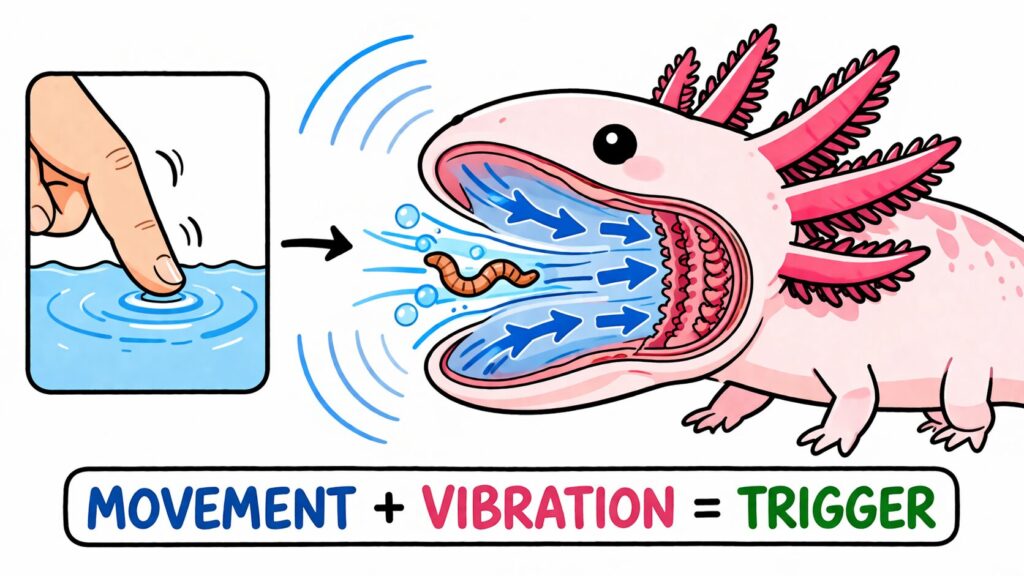
To understand why axolotls bite, you first need to understand how they feed. Axolotls are carnivores that use suction feeding — they open their wide mouths extremely rapidly, creating a powerful rush of water that pulls prey items inside. This feeding mechanism is triggered primarily by movement and water vibration rather than by visual identification of what the prey actually is. An axolotl does not look at a finger and decide it looks like food; it detects movement near its mouth and fires the feeding reflex automatically.
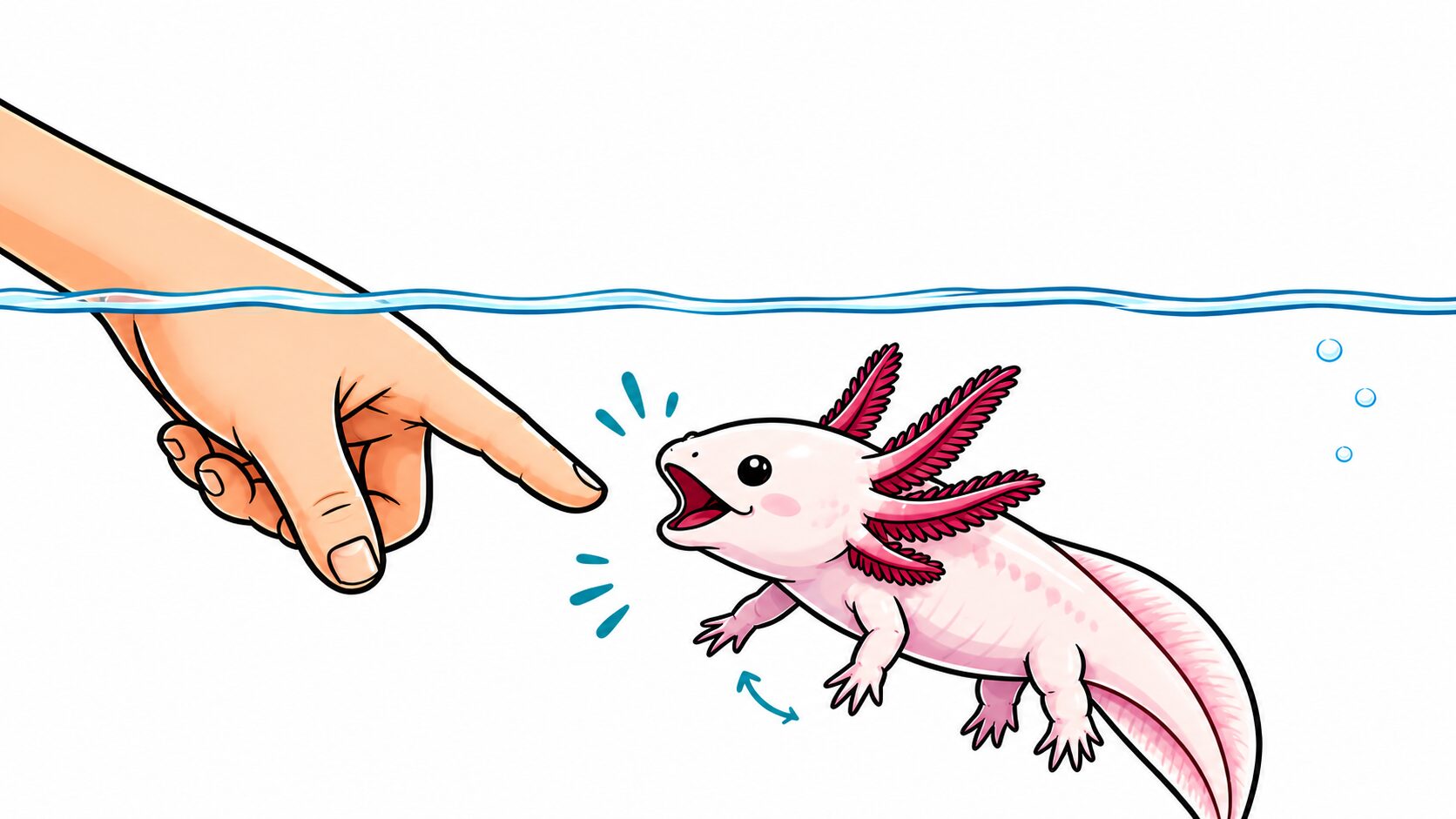
This means that axolotl bites on humans are virtually always cases of mistaken identity. A finger moved through the water near an axolotl’s face, a hand placed near a hungry axolotl during feeding time, or an attempt to handle an axolotl that has recently been fed can all trigger the same suction lunge that would be aimed at a nightcrawler. The axolotl is not being aggressive, territorial, or defensive — it is simply doing the thing its biology has programmed it to do when something moves within striking range.
According to research on amphibian feeding mechanics published through the National Center for Biotechnology Information, suction feeding in aquatic salamanders is one of the fastest vertebrate feeding behaviors observed, occurring in milliseconds. The speed of this reflex is part of why bites can catch owners off guard even when they are being careful.
Does an Axolotl Bite Hurt?
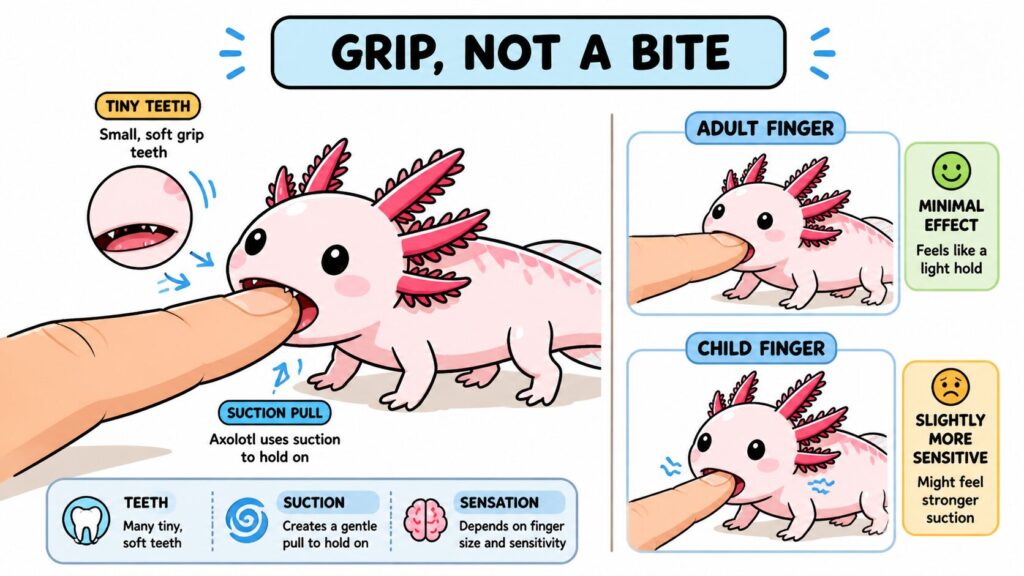
For the vast majority of adults, an axolotl bite does not hurt in any meaningful way. Axolotls have small, vestigial teeth — called pedicellate teeth — that are not designed for cutting, tearing, or crushing. They are designed for gripping soft prey items like worms and crustaceans and preventing them from escaping before swallowing. Against human skin, these teeth create a sensation that most owners describe as a gentle gripping or squeezing feeling, sometimes with a faint pinching quality. It is rarely painful and almost never breaks the skin on an adult.
Young children with thinner, more sensitive skin might find an axolotl bite slightly more uncomfortable, and in very rare cases involving fingers held in an axolotl’s mouth for an extended period, there may be some redness or minor irritation. But the idea of an axolotl bite being a painful or dangerous event is a significant overstatement for the vast majority of people in normal circumstances.
The suction itself is sometimes stronger than the teeth — owners occasionally report the grip of the suction being more noticeable than any sensation from the teeth. This is consistent with the mechanics of suction feeding, where the vacuum created is the primary capture mechanism and the teeth simply prevent escape.
When Are Axolotls Most Likely to Bite?
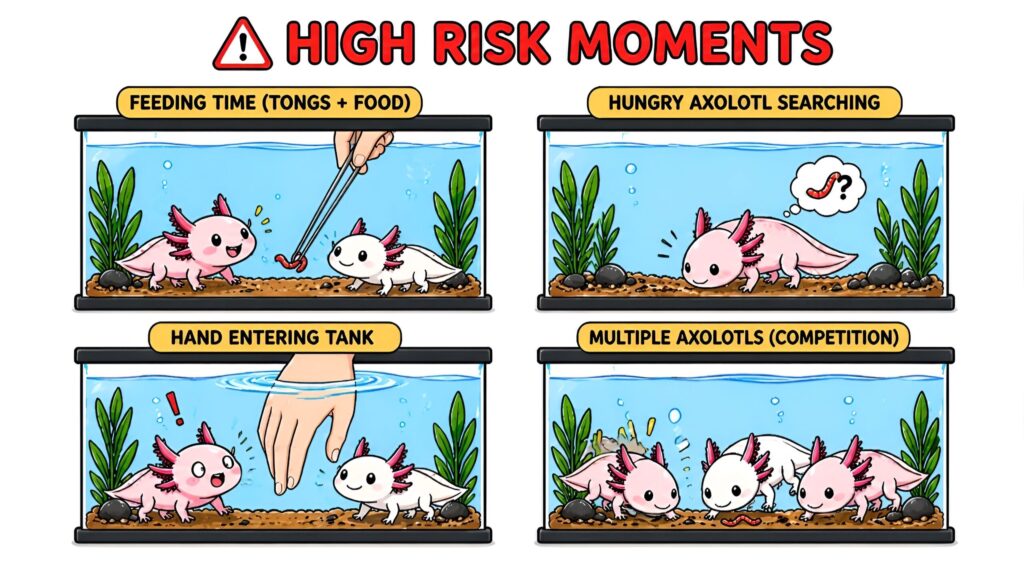
Understanding the circumstances that increase bite risk makes them easy to manage. Axolotls are most likely to bite in a handful of specific situations.
During feeding is the highest-risk moment. If you are target feeding with feeding tongs or dropping food into the tank, a finger that enters the water near a hungry axolotl is at real risk of triggering a feeding lunge. The axolotl is primed and actively searching for prey movement, making its feeding reflex even more hair-trigger than usual. Using feeding tongs rather than your fingers to deliver food is the single most effective way to eliminate this risk.
When the axolotl is hungry is closely related — an axolotl that has not been fed recently is in a heightened state of food-seeking behavior and will be more reactive to any movement in the water. Maintaining a consistent feeding schedule with quality food like nightcrawlers, bloodworms, or pellets keeps your axolotl well-fed and less reactive between feedings.
During handling is another common moment. Axolotls generally should not be handled frequently — their skin is delicate and permeable, and the stress of being taken out of water is real even for brief periods. But when handling is necessary, a hand moving through the water to pick up an axolotl can easily trigger a feeding response, particularly if the axolotl is hungry or if the movement is sudden.
In a tank with multiple axolotls, biting between tank mates is a significant concern that goes beyond the simple feeding reflex. Axolotls will bite each other’s gills, toes, and tails in what is effectively the same feeding lunge they would aim at prey. This is the cannibalistic behavior covered in our article on whether axolotls are cannibals, and it is a more serious management challenge than the occasional nip on an owner’s finger.
What Should You Do If an Axolotl Bites You?
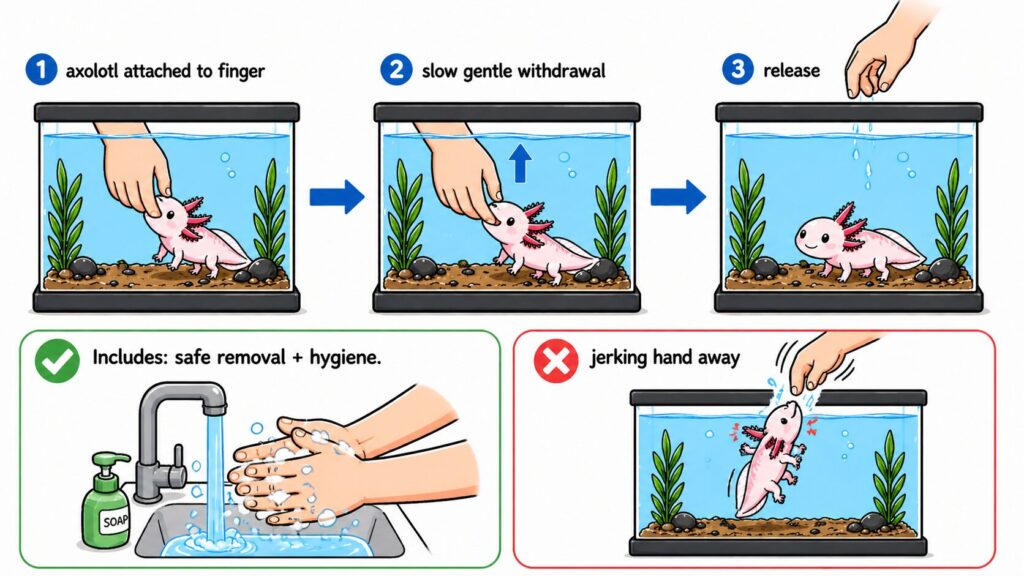
The first thing to do is stay calm and avoid jerking your hand away suddenly. A sudden, forceful pull can injure the axolotl — it may be holding on with its suction grip and teeth, and a sharp withdrawal can damage the animal’s mouth. Instead, gently and slowly withdraw your hand, allowing the axolotl to release naturally. Because axolotls swallow prey whole, they will fairly quickly recognize that your finger is not going anywhere and will release it without much resistance.
Once you have removed your hand, wash the area thoroughly with soap and water. While axolotl bites rarely break the skin, basic hygiene after any animal contact is sensible. Axolotls can carry certain bacteria — including species of Salmonella — as do many amphibians. The Centers for Disease Control and Prevention recommends handwashing after handling any amphibian or reptile, and their tank water, as a standard precaution. This applies whether or not a bite occurred.
If the skin is broken — which is rare but possible in people with more sensitive skin — clean the wound thoroughly, apply an antiseptic, and monitor for any signs of infection. A break in the skin from an aquatic animal’s bite is worth taking seriously hygienically even when the injury itself is minor. Our article on whether axolotls carry diseases covers the health considerations of axolotl ownership in more detail.
Do Axolotls Bite Each Other?
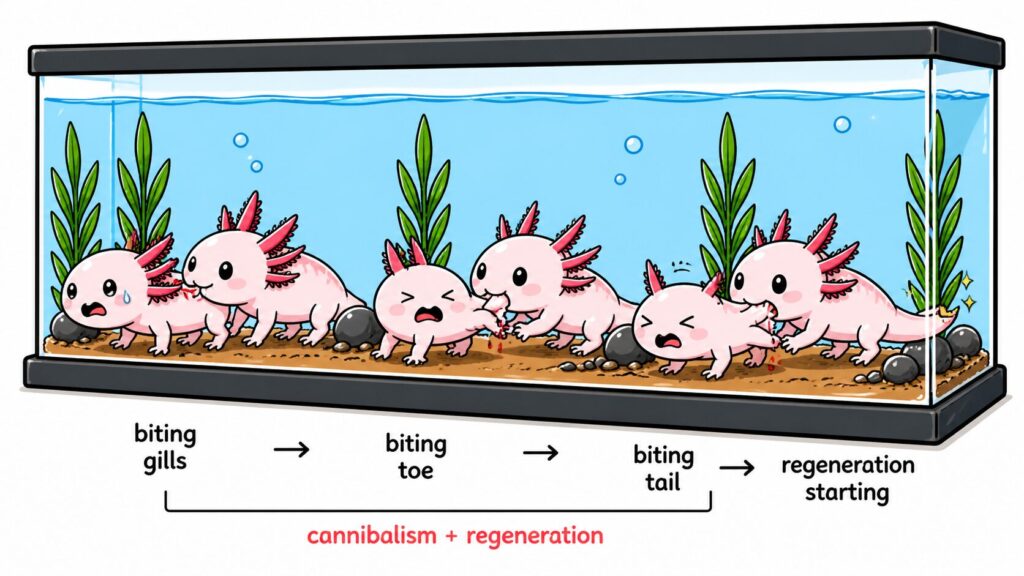
Yes, and this is actually a more practically significant issue than biting humans. When housed together, axolotls will bite each other in feeding lunges aimed at gills, toes, and tails — which are soft, worm-like structures that trigger the feeding reflex just as effectively as an actual worm. This behavior is not aggression; it is the same instinctual suction feeding response aimed at a tank mate instead of prey.
The consequences for the bitten axolotl can range from minor gill tip damage that regenerates quickly to serious injury requiring separation and treatment. Axolotls have remarkable regenerative abilities — they can regrow lost limbs, gill filaments, and other tissue — but repeated biting causes stress and increases the risk of infection at wound sites.
Preventing inter-axolotl biting requires adequate tank size, size-matched animals, proper feeding to reduce hunger-driven reactivity, and enough hides and caves to give each animal its own space. If biting persists despite these measures, separation is the right answer. Our guide on whether axolotls can have tank mates covers safe cohabitation in full detail.
How to Prevent Axolotl Bites
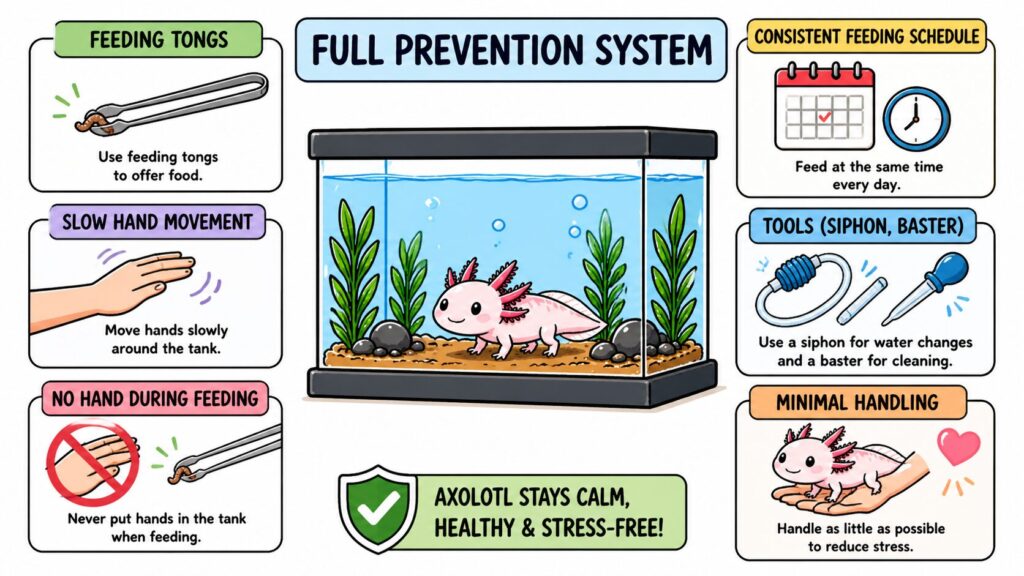
Preventing bites is largely a matter of understanding the feeding reflex and adjusting your behavior around it.
Always use feeding tongs rather than your fingers to deliver food. This keeps your hands entirely out of the equation during the highest-risk moment of the axolotl’s day. Long-handled tongs give you safe distance and precise placement of food items. A turkey baster is equally useful for spot cleaning after feeding without putting your hands in the water.
Minimize handling generally. Axolotls are aquatic animals that experience genuine stress when removed from water, and frequent handling is not good for them regardless of the bite risk. When you do need to interact with the tank — for maintenance, water changes, rearranging décor — move slowly and deliberately rather than making fast movements that might trigger the feeding reflex. Our guide on how to clean an axolotl tank covers tank maintenance techniques that keep your hands out of the water as much as possible.
Avoid putting your hands in the tank when your axolotl has recently been fed or when it is visibly actively searching for food along the tank floor. If you need to do maintenance immediately after a feeding, use a siphon and tools rather than your hands where possible.
Feed on a consistent schedule. A well-fed axolotl on a predictable routine is less likely to be in a heightened food-seeking state at unpredictable times. Our full axolotl food guide can help you establish a feeding routine that keeps your axolotl satisfied.
Are Axolotl Bites Dangerous to Humans?
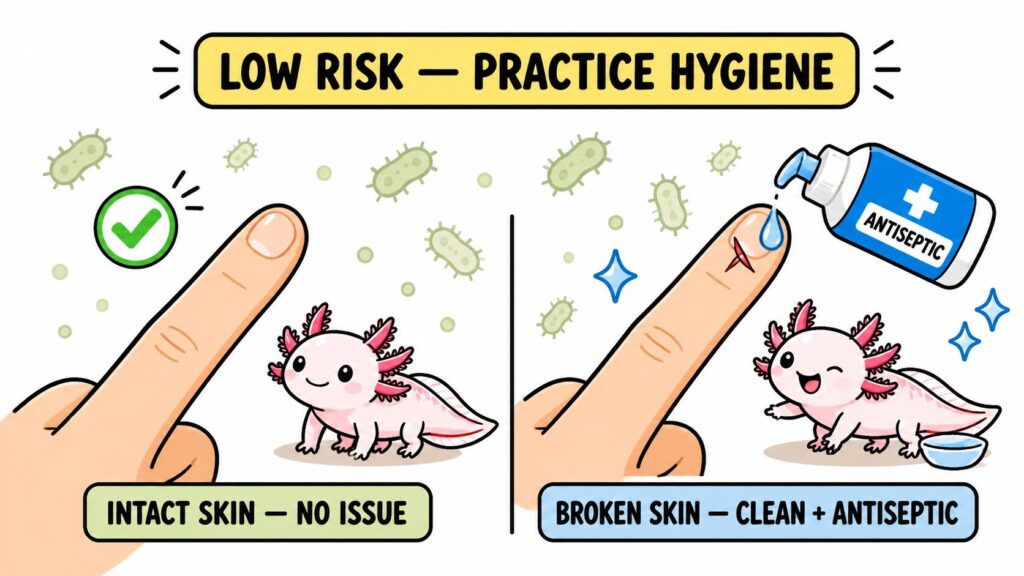
In terms of physical injury, axolotl bites are not dangerous to most people. The teeth are too small and blunt to cause meaningful wounds, and the suction grip, while firm, does not have the force to cause bruising or tissue damage. The main consideration after a bite is hygiene — washing hands thoroughly, and paying attention to any break in the skin given the aquatic environment involved.
The Association of Reptilian and Amphibian Veterinarians advises standard hygiene precautions after contact with amphibians and their water, but does not classify axolotl bites as medically significant events for healthy adults. People with compromised immune systems, young children, or pregnant women may want to take extra precautions around any amphibian and its tank water as a matter of general practice — not specifically because of biting.
It is worth noting that axolotls should never be placed in the mouth, and their tank water should never be consumed. These are basic precautions that apply to any aquarium animal.
Does Bite Behavior Mean My Axolotl Is Unhealthy or Unhappy?
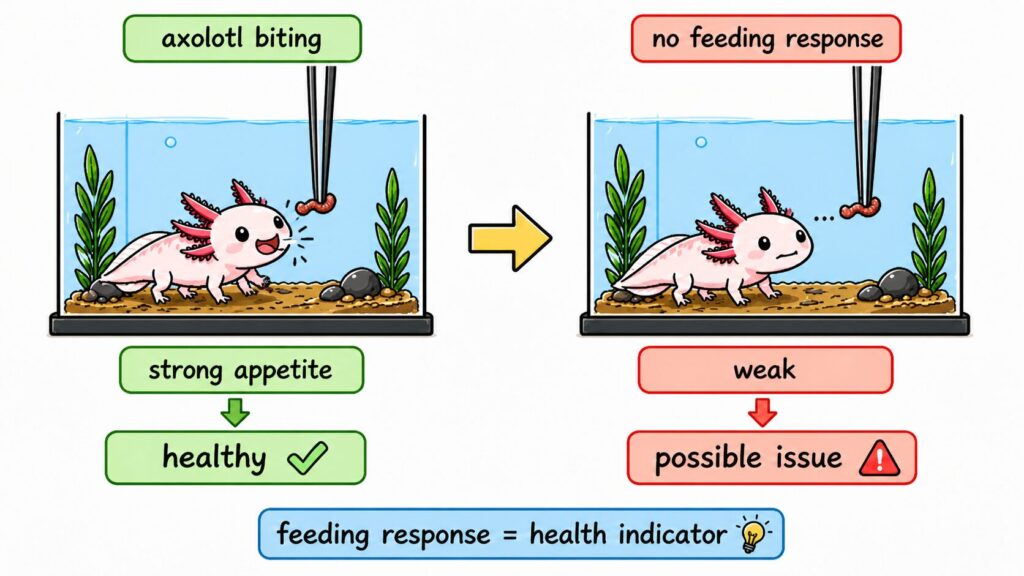
No. Biting is a normal expression of normal feeding behavior in a carnivore that relies on suction feeding. An axolotl that bites your finger during feeding time is not stressed, unhappy, or ill — it is doing exactly what its biology has equipped it to do. The bite tells you something useful: your axolotl has a strong feeding response and good appetite, both of which are positive health indicators.
An axolotl that bites a tank mate repeatedly is a different concern — not because the biting itself indicates a health problem, but because it suggests the tank setup is not adequately preventing the conditions that lead to it. Size differences between tank mates, insufficient hiding spots, inadequate feeding, or an undersized tank are the most common causes. Addressing those environmental factors is the solution, not treating the axolotl as though something is wrong with it.
If your axolotl has stopped responding to food and is no longer showing a feeding response, that is more likely to indicate a health issue worth investigating — check temperature first, as described in our guide on what temperature axolotls need, followed by water quality with a reliable water test kit.
Frequently Asked Questions
Can an axolotl bite break the skin? Rarely, and only in people with thinner or more sensitive skin. Axolotl teeth are very small and not designed to cut. Most bites produce a gripping sensation with no skin damage at all.
Should I be worried about infection after an axolotl bite? Only if the skin was broken. In that case, wash the area thoroughly, apply antiseptic, and monitor for redness or swelling. Standard wound hygiene applies. Axolotls, like all amphibians, can carry Salmonella, so hand washing after any contact with the animal or its tank water is always recommended.
My axolotl bit me during a water change — is this normal? Very normal. Moving your hand through the water during maintenance triggers the same movement-detection that triggers feeding. Move more slowly during maintenance, and consider using a siphon and tools to minimize how often your hands need to enter the water.
Will my axolotl become less bitey over time? The feeding reflex does not diminish with age — it is hardwired. However, experienced owners simply learn to avoid the situations that trigger it, which has the same practical effect. Using feeding tongs consistently and moving deliberately in the tank eliminates the vast majority of accidental bites.
Is it safe for children to be around axolotls? Yes, with supervision and hygiene precautions. Children should be taught to wash hands before and after any contact with the tank, not to put their hands in the tank during feeding, and to understand that axolotls are not handling pets. A child who respects those boundaries is at minimal risk from biting.
Final Thoughts on Whether Axolotls Bite
Do axolotls bite? They do — but it is a feeding reflex, not aggression, and with basic awareness and the right tools it is almost entirely preventable. An axolotl that bites enthusiastically is an axolotl with a strong appetite and a healthy feeding response, which is ultimately a good sign. Respect the feeding reflex, use tongs, move slowly in the tank, and the occasional accidental nip becomes a rarity rather than a routine.
Every part of keeping an axolotl well — from feeding safely to maintaining a clean, correctly set up tank — comes back to having the right tools and knowledge. Find everything you need at the Herdurbia Best Axolotl Products hub, where the right gear makes every part of axolotl ownership easier and safer.