
Do axolotls sleep? It is a question that new keepers often find themselves wondering — particularly when they see their axolotl sitting motionless on the tank floor for long stretches, or when they notice it is more active at certain times of day than others. The answer is yes, axolotls do sleep — but sleep in an axolotl is quite different from what we experience as humans, and understanding how axolotl rest works helps you interpret your animal’s behaviour correctly, distinguish normal resting from signs of illness, and set up an environment that supports healthy natural activity patterns. This guide covers everything you need to know about axolotl sleep. Pair it with our full axolotl care guide for the complete picture on understanding and caring for these extraordinary animals.
How Do Axolotls Sleep? The Science Behind Axolotl Rest
Axolotl sleep is fundamentally different from mammalian sleep in several important ways. To understand how axolotls sleep, it helps to understand what sleep actually is at a biological level.
In mammals — including humans — sleep involves distinct, cyclically alternating brain states characterised by changes in neural activity, reduced responsiveness to external stimuli, consolidation of memory, hormonal regulation, and tissue repair. The two most recognised mammalian sleep states are rapid eye movement (REM) sleep, associated with dreaming and memory processing, and non-REM slow-wave sleep, associated with physical restoration. Mammals cycle through these states multiple times during a sleep period.
Do axolotls experience sleep of this kind? Research on this question has produced genuinely interesting findings. A study published in Science — one of the most prestigious scientific journals in the world — examined sleep in larval zebrafish and found evidence of both REM-like and slow-wave-like sleep states in vertebrates far more primitive than mammals, suggesting that the evolutionary origins of these sleep stages are ancient. Research specifically on salamander sleep is more limited, but related studies on primitive vertebrates suggest that some form of consolidated rest state exists across a wide range of aquatic vertebrate groups.
The Ambystoma Genetic Stock Center at the University of Kentucky, which maintains the world’s largest research colony of axolotls, has documented that axolotls show characteristic periods of significantly reduced activity with reduced responsiveness to stimuli — consistent with a rest state that functions analogously to sleep even if the underlying neural mechanisms may differ from mammalian sleep.
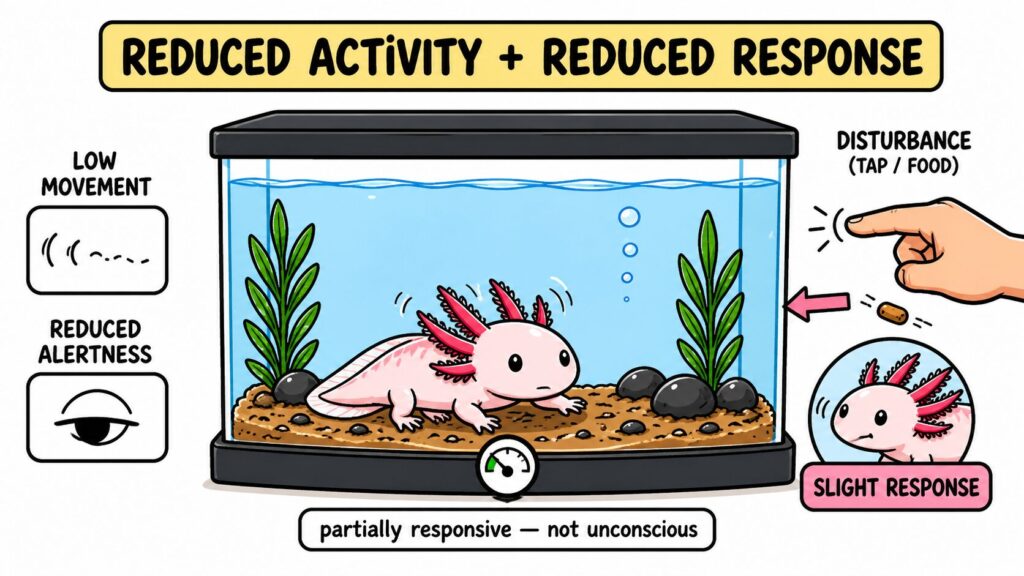
In practical terms: axolotls enter periods of rest characterised by stillness, reduced responsiveness, and typically seeking out a sheltered position on the tank floor or inside a hide. During these rest periods they are not fully unresponsive — they can be aroused by significant disturbance — but they show markedly reduced reactivity compared to their active periods. This is what axolotl sleep looks like from the keeper’s perspective.
When Do Axolotls Sleep? Axolotl Activity Patterns

Axolotls are naturally crepuscular and nocturnal — they are most active at dawn and dusk, with significant activity also occurring at night. During daylight hours, axolotls typically rest inside their hides, beneath plants, or in shaded areas of the tank. This resting during the day is their primary “sleep” period.
In their native Xochimilco lake system in Mexico City — where the wild axolotl population is critically endangered — the murky, vegetated lakebed provides natural cover that allows axolotls to rest concealed from potential threats during the day. Their crepuscular and nocturnal activity pattern evolved in an environment where daytime resting was the norm.
In captivity, this pattern is heavily influenced by the light cycle in the tank. Axolotls in tanks with no light cycle — either constant light or constant dark — often develop irregular and apparently random activity patterns that may be less healthy than those with a consistent day/night cycle. Providing a consistent light cycle — approximately 8–10 hours of dim light followed by 14–16 hours of darkness — supports the axolotl’s natural crepuscular rhythm and produces the most naturalistic behaviour, including clear rest periods during the light phase and more active foraging behaviour in the evening.
This is one of the reasons that appropriate, dimmable lighting is important in an axolotl tank — not just to observe the animal, but because the light cycle itself regulates the axolotl’s biological rhythms including its rest and activity patterns. Our guide to the best axolotl tank light covers how to set up the right light cycle with appropriate intensity and timer functions.
What Does a Resting Axolotl Look Like?
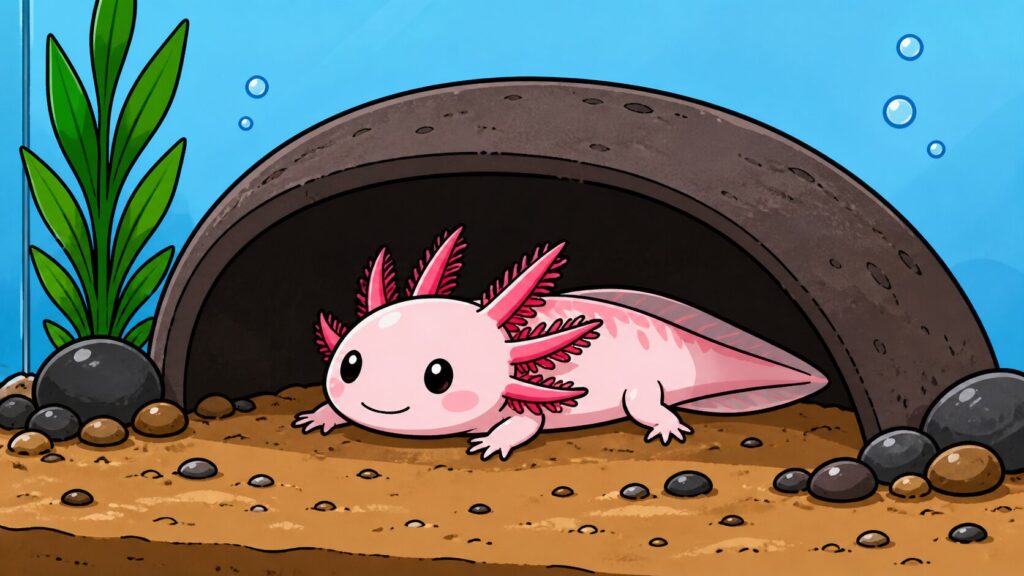
New keepers sometimes worry when they see their axolotl motionless for extended periods, particularly during daylight hours. Understanding what normal resting looks like helps distinguish healthy sleep from concerning symptoms.
Normal resting behaviour:
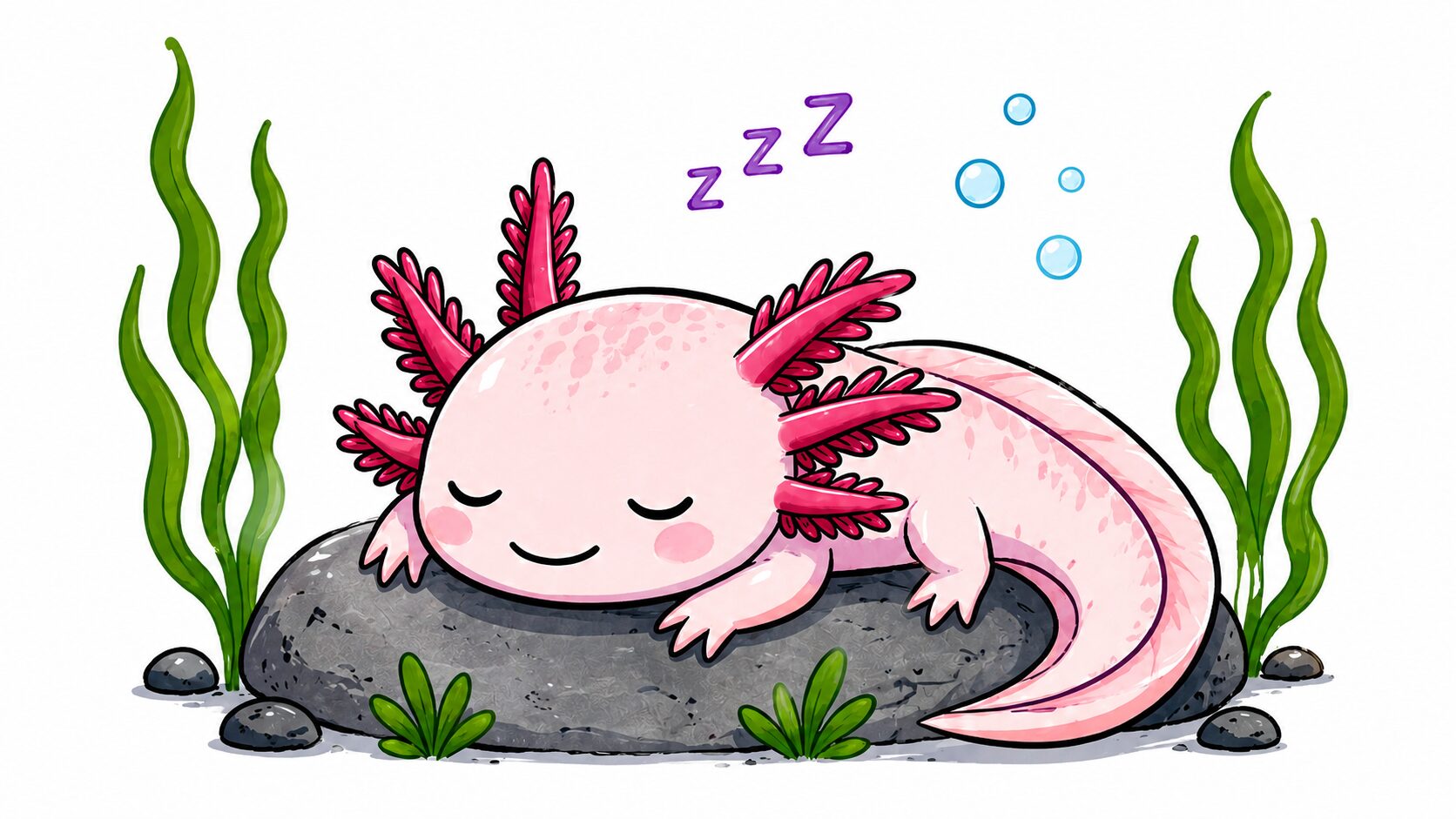
A resting axolotl will typically be found inside its hide, in a shaded corner, beneath a plant, or on a flat piece of slate or substrate in a low-light area of the tank. It sits with its legs slightly spread, resting on the tank floor, with its gill plumes relaxed and fanned outward or gently floating. The body is in a relaxed, natural posture — not curled, not tilted, not compressed. Breathing is apparent through gentle gill plume movement. The axolotl responds to gentle stimulation — a light tap on the glass or the motion of feeding tongs — by opening its eyes more fully and potentially shifting position, but it may settle back into rest after a few moments without a food stimulus.
A resting axolotl in a well-maintained tank will typically remain still for hours at a stretch during the day, emerging more actively in the late afternoon, evening, and night hours. This is entirely normal and healthy behaviour. An axolotl that rests all day and becomes noticeably more active and alert around dusk is displaying exactly the crepuscular pattern that is appropriate for the species.
Behaviour that looks like sleep but may indicate a problem:
The challenge for new keepers is distinguishing normal deep rest from illness-related lethargy. Several differences help:
A resting healthy axolotl has correct gill colour — pink to red gills with good, full plumes that fan naturally. An ill axolotl may have gill plumes that are curled forward toward the face, sparse, discoloured, or show white fluffy growth. A resting healthy axolotl maintains a natural body position — right side up, legs supporting its weight on the substrate. An ill axolotl may be tilted, floating at the surface, or curled in an unnatural C-shape. A resting healthy axolotl responds to feeding stimulus within a few seconds when food is presented. An axolotl that consistently ignores food when its normal feeding response should be present is likely experiencing illness, stress, or water quality problems rather than simply resting.
Any time you are uncertain whether resting behaviour is normal, test your water immediately with your water test kit and check temperature with your tank thermometer. The two most common causes of abnormal lethargy — elevated ammonia and elevated temperature — are immediately measurable and actionable.
Do Axolotls Sleep With Their Eyes Open?

Yes — axolotls always appear to sleep with their eyes open, because they have no eyelids. Axolotls cannot close their eyes. This is one of the reasons that appropriate lighting is important — unlike animals that can close their eyes to block out light, axolotls are always light-exposed when the tank light is on. Bright, uncontrolled lighting causes chronic low-level stress in axolotls because they cannot escape it. A well-chosen dim light, set to an appropriate 8–10 hour daily cycle and then fully off during the rest period, allows axolotls to experience genuine darkness during their primary rest phase. Our guide on the best axolotl tank light covers this in full detail.
The lack of eyelids is also why adequate hides and caves matter so much — they provide the darkness and enclosure that axolotls seek for resting, compensating for their inability to block light by moving into a shaded, enclosed space. An axolotl with a good hide will use it consistently for daytime resting, which is a sign of a secure, comfortable animal.
Do Axolotls Dream?
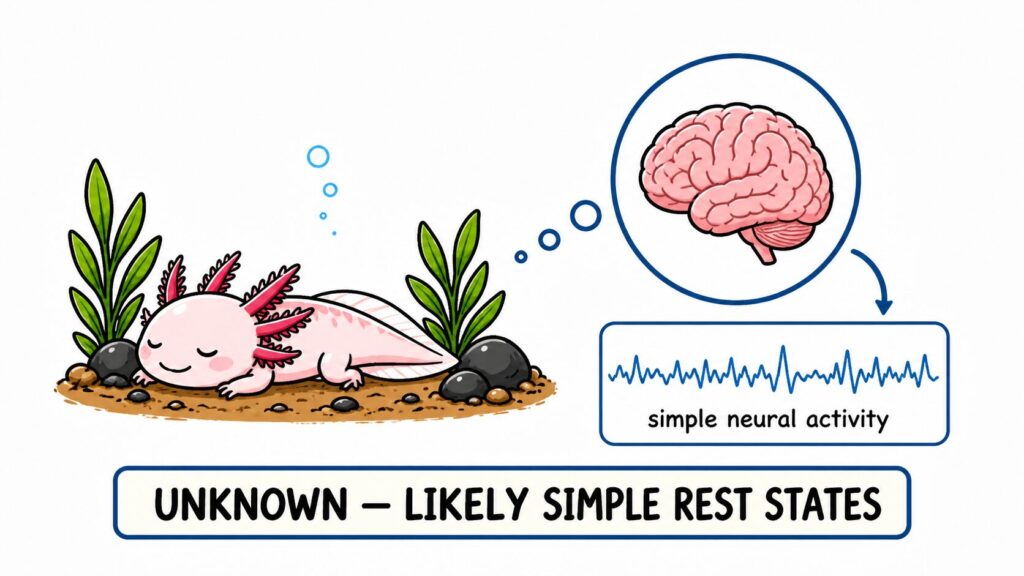
Whether axolotls dream is genuinely uncertain and remains an open question in neuroscience. The Science paper on zebrafish sleep referenced earlier found evidence of a REM-like state in fish — characterised by rapid eye movements and specific neural activity patterns — raising the possibility that some form of dream-equivalent experience may occur in fish and potentially other aquatic vertebrates. Whether this extends to salamanders like axolotls has not been specifically studied.
What axolotls almost certainly do not experience is anything analogous to the narrative, memory-rich dreaming of mammals. Their nervous systems, while complex and scientifically remarkable for their regenerative properties (extensively studied at the Ambystoma Genetic Stock Center), are significantly simpler in terms of cortical organisation than the mammalian brains where complex dreaming is understood to occur.
The honest answer is: we do not know. It is a fascinating open question that research on primitive vertebrate sleep continues to investigate.
How Much Do Axolotls Sleep?
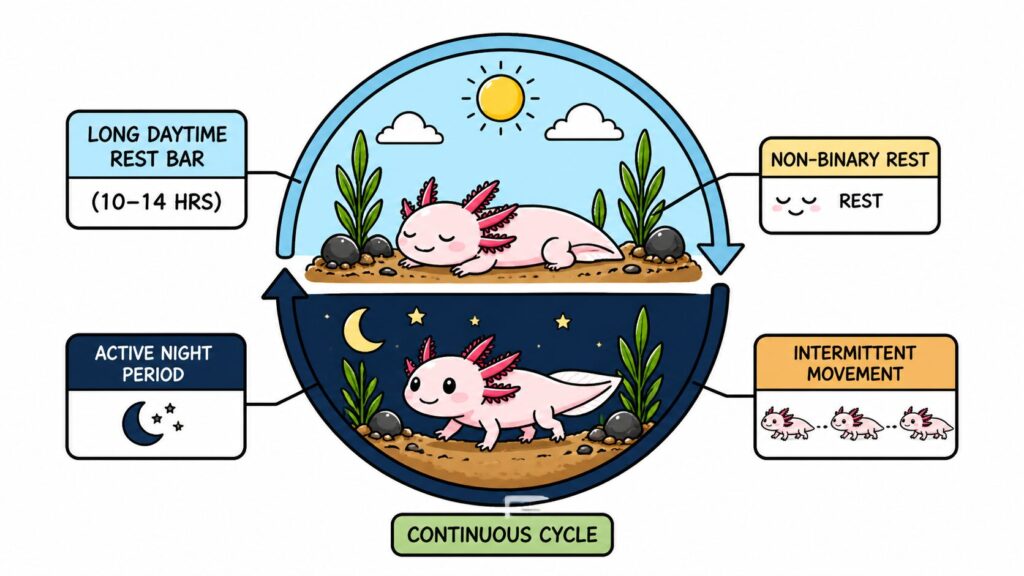
Axolotls have no fixed, easily quantifiable sleep duration the way humans do. Their rest is better understood as a continuous modulation of activity level rather than a binary sleep/wake state — they shift from periods of very low activity and reduced responsiveness (rest) to periods of active movement, foraging, and responsiveness (active waking) in a cycle driven primarily by light exposure and feeding.
In a tank with a natural light cycle, a typical adult axolotl will spend the majority of daylight hours in a resting state — potentially 10–14 hours — and the majority of the evening and night hours in a more active state. This rest is not uninterrupted — the axolotl may emerge from its hide briefly to shift position, investigate something, or move to a different resting spot, then settle back.
Temperature also significantly affects axolotl activity levels — cooler water within the optimal range (60–68°F/16–20°C) is associated with more naturalistic activity patterns, while elevated temperature tends to cause lethargy even during normally active periods as the axolotl’s physiology is stressed. Maintaining correct temperature with a water chiller or cooling fan and monitoring with a tank thermometer is directly relevant to normal sleep and activity patterns. Our guide on what temperature axolotls need provides full temperature management guidance.
Creating the Best Sleep Environment for Your Axolotl
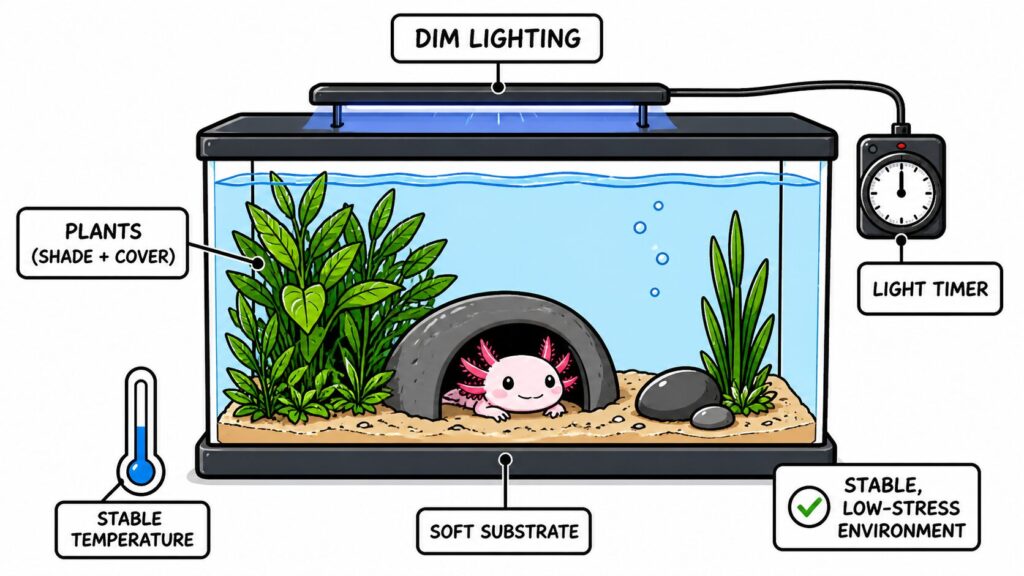
Understanding axolotl sleep leads directly to understanding what tank setup features best support healthy natural activity and rest patterns.
Adequate hides for daytime resting. Every axolotl needs at least one proper hide — an enclosed, dark space where it can rest without light exposure during its inactive period. A resting axolotl consistently using its hide throughout the day and emerging actively in the evening is the target behaviour. Our guides to the best axolotl hides and best axolotl caves cover the best products.
Appropriate dim lighting with a consistent cycle. Set your tank light to run at low intensity (20–30% of maximum) for 8–10 hours, then fully off for the remaining 14–16 hours. Use a built-in timer to make this automatic and consistent. This regularity is what establishes and maintains a healthy circadian rhythm in your axolotl.
Low-light areas in the tank. Even during the light period, having areas of the tank that are naturally shaded — by plants, decor, or the positioning of hides — allows your axolotl to choose its light exposure rather than being forced into bright conditions it cannot escape.
Temperature stability. Consistent temperature within the correct range supports consistent, predictable activity patterns. Fluctuating temperature disrupts natural rhythms and causes atypical activity or lethargy at unpredictable times.
Minimal disturbance during rest periods. Avoid cleaning, feeding, or rearranging the tank during your axolotl’s primary rest phase (typically daytime). Repeated disturbance during rest creates stress that accumulates over time and may manifest as reduced feeding, increased hiding, or illness susceptibility.
Frequently Asked Questions
Is my axolotl sleeping or sick? Check for gill health (normal pink/red, full plumes versus curled, sparse, or discoloured), body posture (normal upright position versus tilted or floating), and feeding response (responds to food presentation versus consistent food refusal). If any of these are abnormal, test water parameters immediately. A sleeping axolotl looks normal in all respects and responds to food stimulus within a few seconds.
Why is my axolotl always hiding and never active? If your axolotl hides consistently even during what should be its active evening hours, this typically indicates stress — most commonly from water quality problems, temperature problems, or insufficient shelter creating anxiety. Check ammonia, nitrite, nitrate, and temperature. Ensure the hiding spaces are genuinely enclosed and dark. A comfortable, secure axolotl with good water quality will reliably become active in the evenings.
Should I turn off the lights at night for my axolotl? Yes. A full dark period during the night (and potentially late evening) is beneficial for axolotl natural rhythms. Using a timer to turn the light off automatically each evening is the easiest and most consistent way to provide this.
Does my axolotl recognise me? Axolotls do appear to show some degree of learned association — many keepers report that their axolotls become more alert and active when the keeper approaches, particularly around feeding times. Whether this represents genuine recognition or simply a learned association between visual stimuli and feeding is unclear. Either way, the behaviour suggests that axolotls are not simply inert during their waking periods — they are responsive to and aware of their environment.
Can I wake up my axolotl for feeding during its rest period? Yes — feeding during the day is possible and will typically produce a feeding response, since axolotls are opportunistic feeders that will eat when food is available regardless of their rest state. However, for the most enthusiastic feeding response and the most naturalistic behaviour, feeding in the evening around the time your axolotl naturally becomes active produces the best results.
Understanding Your Axolotl Makes You a Better Keeper
Knowing that your axolotl sleeps — and understanding what healthy rest looks like — gives you the framework to interpret its behaviour correctly every day. The axolotl motionless in its hide at noon is not sick; it is doing exactly what a healthy, secure axolotl should do. The one that is still motionless and unresponsive at 9pm when it should be foraging — that one warrants investigation. The more you understand your axolotl’s natural patterns, the faster you recognise when something is genuinely wrong and the better equipped you are to act on it. For everything your axolotl needs to thrive — from the right tank and lighting to the best food, health supplies, and enrichment — Best Axolotl Products is your keeper-tested guide to the best gear in every category of axolotl care.