
Origin And History
The English Mastiff, known formally by the AKC and Kennel Club simply as the Mastiff, is simultaneously the largest dog breed in the world by mass and one of the oldest, a gentle giant of documented antiquity whose ancestors appear in the bas reliefs of the Assyrian palace at Nineveh from around 645 to 635 BC and whose modern lineage has been bred in England for over two thousand years. It is the largest living canine, outweighing the wolf by up to 50 kilograms on average, and it combines this extraordinary physical presence with a temperament of such consistent gentleness, patience, and loyalty that its admirers call it the gentle giant with the justified accuracy of a description that captures what is perhaps the most essential paradox in the dog world.
The breed’s ancient origins are traced through the Molossian dogs of ancient Greece, the large guardian and war dogs of the Near East depicted in Babylonian art from around 2200 BC, and the massive battle dogs that Roman legions both fought against and were so impressed by that they began importing them back to Italy. The ancient Romans were particularly enamored with the breed. They reportedly exported some back to Italy to fight in the Colosseum, a fate that, ironically, fell to a good number of lions as well. When the Romans arrived in England during Julius Caesar’s invasion in 55 BC, they encountered Mastiffs that had already preceded them, likely brought by ancient traders, and they were reportedly astonished by the size and courage of these British dogs.
The English Mastiff’s most celebrated historical moment is the story of the Battle of Agincourt in 1415. Sir Piers Legh, an English knight, was wounded during the battle. A female Mastiff stood sentry over him on the battlefield, preventing advancing French soldiers from taking him prisoner or killing him. Legh’s servants eventually rescued him, but he died in Paris. His Mastiff was brought to his ancestral home, Lyme Hall in Cheshire, where she whelped a litter of puppies that contributed to the famous Lyme Hall strain, the world’s oldest kennel of Mastiffs. The present-day English Mastiff is based largely on the Lyme Hall strain and the Duke of Devonshire’s kennels at Chatsworth.
The first documented Mastiff in what is now the United States was a dog named Grace, who arrived at Plymouth, Massachusetts aboard the Mayflower in the fall of 1620. The 19th century brought both challenges and formal recognition. The first breed standard was established, and the AKC recognized the breed in 1885, one of the earliest breeds admitted to the registry, with first registration the same year. The 20th century brought near-extinction twice over: after World War I the breed was considered non-existent outside the UK, with its salvation coming from Canada in 1918 when a puppy named Beowulf was born to imported British stock. World War II proved catastrophic again for the UK population, and post-war recovery required careful rebuilding.
The English Mastiff remains classified as a vulnerable native breed in the UK with only 104 registered births recorded in 2020, while the breed has recovered much more strongly in North America where it remains a popular giant breed companion.
Breed Overview
| Trait | Details |
|---|---|
| Breed Group | Working |
| Height | Males minimum 76 cm (30 inches) / Females minimum 70 cm (27.5 inches) |
| Weight | 68–113 kg (150–250 pounds); most adults 80–100 kg |
| Lifespan | 6–10 years |
| Coat | Short, fine, close-lying |
| Colors | Fawn, apricot, brindle; always with black mask |
| Temperament | Gentle, affectionate, patient, loyal, protective |
| AKC Recognition | 1885 |
Appearance And Size
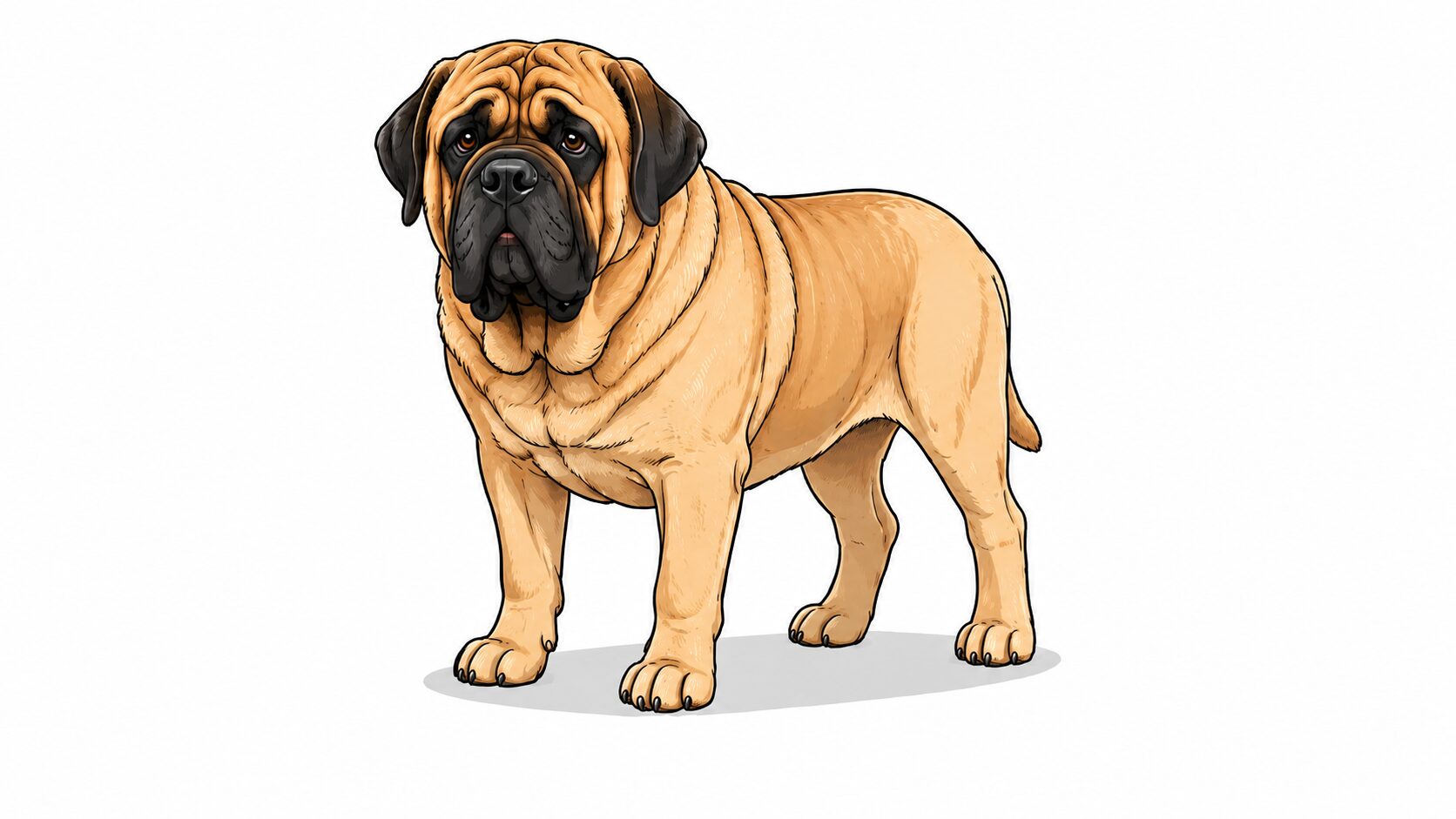
The English Mastiff is a dog of extraordinary dimensions whose appearance consistently provokes the same double-take from people encountering one for the first time. Males must stand a minimum of 76 centimeters at the shoulder and typically weigh between 80 and 100 kilograms, with some exceptional individuals reaching 113 kilograms or more. This is the heaviest dog breed in the world, and the physical presence of an adult English Mastiff is genuinely and immediately impressive in a way that photographs rarely fully communicate.
The head is the breed’s most immediately defining feature: massive, broad, and square, with a pronounced stop, heavy wrinkled brow, and a broad, deep muzzle. The skull’s circumference can approach or exceed that of the dog’s height at the withers in some well-developed males. The characteristic black mask over the muzzle, around the eyes, and on the ears is required by the breed standard and provides the most immediately recognizable facial marking across all coat colors. The eyes are small relative to the massive head, hazel or dark brown, with a soft, gentle expression that is one of the most immediately surprising features of a breed this large.
The neck is powerful and muscular, flowing into extremely heavy, well-muscled shoulders. The body is massively framed, with a broad, deep chest, a level back, and hindquarters of considerable muscular development. The tail is long and tapering, thick at the base, carried with a curve when the dog is active.
The coat is short, fine, and close-lying, in fawn (ranging from light silver through golden to deep apricot fawn), apricot, or brindle, always with the characteristic black mask. The short coat requires minimal grooming in terms of coat care but provides no insulation in cold weather and creates heat management challenges in warm conditions.
Housing And Living Requirements
The English Mastiff’s housing requirements are shaped primarily by its extraordinary physical size rather than by any particular activity requirement, and this is an important distinction from many other large working breeds. The English Mastiff is not a high-energy breed that demands extensive daily exercise. It is a calm, settled giant whose primary domestic requirement is adequate space to exist comfortably in.
A home with meaningful indoor space and some outdoor access is the baseline appropriate setting. The English Mastiff should not be thought of as an outdoor dog or a dog that needs to range widely. It is most content indoors with its family. The minimum practical requirement is a home large enough that a 100-kilogram dog moving through it doesn’t create constant management challenges, and a garden or outdoor area for toileting and gentle exercise.
The English Mastiff cannot manage extreme heat. The combination of its size, its short coat that provides minimal sun protection, and its brachycephalic tendency means that hot weather creates genuine heat stress risk. Air conditioning is a practical necessity rather than optional comfort in any climate with warm summers. Exercise in hot weather should be scheduled for cooler parts of the day, and the dog should always have access to shade and fresh water.
A large orthopedic dog bed is genuinely one of the most important investments available to an English Mastiff owner, providing the joint support that a dog of this weight requires from its first day in the home. Hard flooring provides no joint cushioning for a 100-kilogram dog, and the orthopaedic pressure points that develop in giant breeds resting on hard surfaces without appropriate padding create genuine ongoing welfare concerns.
Exercise Requirements
The English Mastiff’s exercise requirements are moderate and more achievable than those of many other large working breeds, but they should not be misunderstood as absent or negligible simply because the breed’s calm indoor manner might suggest otherwise. A daily walk of 20 to 30 minutes combined with gentle outdoor play is appropriate for most healthy adults.
The exercise prescription for this breed is genuinely different from that of most large breeds: more is not better, and intensive exercise creates risks rather than benefits. The English Mastiff’s size, weight, and documented joint predispositions make high-impact activities, extended running, and repetitive jumping genuine injury risks rather than beneficial activities. Gentle, moderate, consistent exercise that keeps the dog at appropriate body condition without stressing joints excessively is the appropriate standard.
During puppyhood, exercise restriction is particularly important. Growing Mastiff puppies should not be allowed to run on hard surfaces, jump, or engage in activities that create impact stress on developing joints. The consequences of inadequate growth management in a breed that may reach 100 kilograms are significant and long-lasting.
Puzzle toys and enrichment activities provide meaningful cognitive engagement for a breed that is more intelligent than its placid exterior might suggest.
Grooming Requirements
The English Mastiff’s short, fine, close-lying coat is one of the most practically low-maintenance grooming commitments of any breed in the working group. Weekly brushing with a rubber grooming mitt removes loose hair and keeps the coat in healthy condition. The breed sheds moderately throughout the year.
Bathing every four to six weeks is appropriate under normal conditions. The short coat dries quickly after bathing. The wrinkles on the face and forehead, characteristic of the breed’s massive head structure, require more frequent attention than the coat itself. Moisture, food residue, and debris accumulate in the wrinkles and create conditions favorable to bacterial and yeast infections if not cleaned and dried regularly. Wiping the facial wrinkles with a damp cloth and drying thoroughly, ideally daily, prevents the skin fold dermatitis that develops reliably when maintenance is inconsistent.
The English Mastiff drools substantially, particularly around mealtimes and after drinking. This is a permanent and breed-typical quality that owners should experience directly before committing to the breed. A drool cloth kept accessible near food and water areas and a wiping routine after meals is the most practical management approach.
Dental care should be established as a consistent routine from puppyhood. Ears should be checked and cleaned weekly. Nails should be trimmed monthly.
Diet And Nutrition
The English Mastiff’s dietary management is shaped by the same two priorities that define the French Mastiff article in this series: bloat prevention and weight management. Both are directly life-limiting health concerns in a breed of this size, and both are meaningfully influenced by feeding practices.
A high-quality large or giant breed formula with a named protein source as the first ingredient provides the nutritional foundation this enormous breed requires. Large and giant breed puppy formulas during the growth phase are critical: overfeeding Mastiff puppies accelerates growth in ways that directly increase the risk and severity of hip and elbow dysplasia in a breed already significantly predisposed to these conditions. Puppy feeding should be carefully measured and calibrated to controlled growth rather than maximum growth.
Two strictly measured meals daily rather than one large serving is the most important single dietary management practice for bloat prevention. The English Mastiff’s deep, extremely broad chest places it at one of the highest bloat risk levels of any breed. Using a slow-feeder bowl to reduce eating speed, avoiding vigorous activity for at least an hour before and after meals, and recognizing early warning signs of bloat are essential ongoing management practices. Any suspicion of gastric dilatation-volvulus requires immediate emergency veterinary treatment. Prophylactic gastropexy surgery that tacks the stomach to prevent rotation is worth discussing seriously with your veterinarian.
Maintaining lean body condition throughout the dog’s entire life is the most practically meaningful health investment available to English Mastiff owners. An overweight English Mastiff is a dog whose already-challenged joints carry unnecessary additional burden, whose cardiac system faces greater strain, and whose respiratory capability is further compromised. Training treats should be counted into the daily calorie total. Discussing joint supplements with your veterinarian from the dog’s early adult years is worthwhile.
Compatibility
The English Mastiff’s reputation as one of the most family-compatible giant breeds is well-earned and accurately reflects what living with this breed is actually like, which is often genuinely startling to people who encounter one for the first time expecting an intimidating large dog and find instead a gentle, affectionate, somewhat goofy giant that leans against people, seeks physical closeness, and demonstrates its warmth with a thoroughness that is entirely out of proportion to its fearsome appearance.
With its own family, the English Mastiff is profoundly devoted and demonstrably warm. Despite their massive size, Mastiffs are often described as couch potatoes who love to cuddle with their families, and this is accurate. The breed forms deep bonds with every household member and expresses those bonds through the physical closeness that the leaning behavior most characteristically demonstrates. An English Mastiff that leans its full weight against a person it loves is providing an entirely sincere expression of affection.
With children, the English Mastiff is notably patient and gentle, widely considered one of the safest giant breeds with children when raised alongside them and properly socialized. The combination of gentle temperament and calm indoor manner makes it an appropriate family companion for households with children of various ages. The size of an adult English Mastiff means that very young children benefit from adult supervision during interactions, not because of any aggressive tendency but simply because a dog this heavy moving through a space can accidentally bowl over a small child.
With strangers, the breed’s guardian character is present but typically measured and controlled. The English Mastiff is not an aggressive breed, but it maintains a watchful awareness of unfamiliar people and will position itself between its family and any perceived threat with the quiet conviction of a dog that has been guarding its people for two thousand years.
With other dogs and household pets, the breed is generally sociable and adaptable when properly socialized from puppyhood. A dog crate appropriately sized for a giant breed is a useful management tool during puppyhood.
Behavior And Temperament
The English Mastiff’s temperament is one of the most consistently and most warmly described in the giant breed world. The breed is gentle, affectionate, patient, calm, and devoted to its family with the total, uncomplicated loyalty of a breed that has been protecting its people since before recorded British history. The irrepressible protective streak was frequently remarked upon by the Victorians, but so was the gentleness that coexists with it in a breed that could be frightening in its physical capability and is instead reliably kind.
The calmness is genuine and pervasive. The English Mastiff at home with its family is a settled, unhurried, deliberately-paced companion that brings a tranquil presence to its household and engages with daily life at the measured pace of a dog that has never needed to prove itself through agitation. This calm is not passivity or lack of awareness. It is the settled confidence of a breed that knows precisely what it is and has no need to demonstrate it unnecessarily.
The affection is physical and direct. English Mastiffs lean, they drool on people they love, they rest their enormous heads on laps, they curl around their people in ways that seem geometrically implausible given their dimensions, and they demonstrate in every available physical form that their family is their most important possession.
The stubbornness that experienced owners acknowledge is the relaxed self-direction of a breed that has made its own decisions about threats and responses for millennia. This requires patient, consistent training rather than any confrontational approach.
Training And Handling
The English Mastiff is an intelligent breed that is genuinely trainable with the right approach, though the combination of its size, its stubbornness, and the physical management challenges of working with a 100-kilogram dog mean that training must begin from the first day the puppy arrives home and must be maintained consistently throughout the dog’s life.
The mathematical reality of English Mastiff training is worth stating directly: a behavior that is charming in an eight-week-old 10-kilogram puppy can become genuinely dangerous in an adult 100-kilogram dog. Jumping up to greet people is the most obvious example. Establishing from the first day of ownership the behaviors that will be required of the adult dog is considerably easier than managing the consequences of overlooked puppy behaviors once the dog has reached its full size.
Positive reinforcement methods are the most effective foundation. The English Mastiff responds to reward and genuine engagement, and harsh corrections or confrontational approaches produce resentment in a breed this proud and this capable. Training treats are effective motivators and should be used purposefully in every training session from puppyhood onward.
Early socialization from puppyhood is important for a breed whose guardian character and substantial size make the quality of its social calibration a genuine welfare and safety consideration. Broad, positive early socialization produces the calm, well-adjusted adult that the English Mastiff’s temperament naturally supports.
Health And Lifespan
The English Mastiff’s health profile requires the same honest engagement as the Bernese Mountain Dog and French Mastiff sections in this series, because the breed’s documented health challenges and shortened lifespan are genuinely serious and genuinely determine the quality and duration of partnership that owners can expect. The average lifespan is 6 to 10 years, with many individuals dying before reaching 8 years. This is one of the shortest lifespans of any dog breed, and owners who acquire an English Mastiff should understand this reality fully before committing to the breed.
Hip and Elbow Dysplasia Abnormal joint development causing pain, restricted movement, and progressive arthritis is the most consistently documented hereditary health concern in the breed, and the English Mastiff’s extreme body weight creates compounding mechanical stress on joints that are already predisposed to abnormal development. OFA hip and elbow evaluation of all breeding animals is the recommended preventive standard, and sourcing from breeders who provide this documentation with results for both parents is the most important preventive step available. Growth management through appropriate giant breed puppy nutrition, avoidance of high-impact exercise during puppyhood, and maintaining lean body condition throughout the dog’s entire life are the most meaningful ongoing protective measures.
Bloat (Gastric Dilatation-Volvulus) The English Mastiff sits at one of the highest risk levels for GDV of any breed, given the combination of extreme chest depth and breadth with very large total body size. This is the second major cause of death in Mastiffs. Two smaller meals daily, slow-feeder bowls, strict avoidance of vigorous exercise around mealtimes, and awareness of the warning signs are the foundational preventive measures. Prophylactic gastropexy surgery is worth discussing seriously with your veterinarian, particularly when the dog undergoes any procedure requiring general anesthesia.
Cancer Cancer is one of the leading causes of death in the breed, with osteosarcoma (bone cancer) and mast cell tumors documented at elevated rates. The connection between giant breed status and elevated osteosarcoma risk is well-established across multiple giant breeds. Regular veterinary examinations from middle age onward that specifically include cancer monitoring give the best opportunity for early detection and the most treatment options.
Cardiac Disease Cardiomyopathy affecting heart muscle function is documented in the breed. Annual cardiac evaluation as part of routine preventive care allows for early detection and appropriate medical management.
Cystinuria An inherited metabolic disorder causing abnormal cystine accumulation in urine, leading to the formation of cystine bladder and kidney stones, is documented in the breed. DNA testing identifies affected and carrier dogs, and responsible breeders test their breeding animals. Male dogs with cystinuria are at greater risk from urinary obstruction, which is a medical emergency.
Eye Conditions The breed suffers from a range of eye diseases including cataracts, ectropion, entropion, progressive retinal atrophy, corneal dystrophy, retinal dysplasia, and prolapse of the nictitans gland. Regular annual veterinary eye examinations allow for early detection and appropriate management.
Cruciate Ligament Rupture The significant body weight the English Mastiff carries creates meaningful mechanical stress on the cruciate ligaments of the knees, and ligament tears are documented at higher rates than in lighter breeds. Maintaining appropriate weight throughout the dog’s life is the most meaningful preventive measure.
Degenerative Myelopathy Progressive spinal cord disease causing hind limb weakness and eventual paralysis is documented in the breed. DNA testing is available and recommended for breeding animals.
Panosteitis A painful inflammation of the long bones that typically affects growing Mastiff puppies between six and eighteen months of age, causing shifting lameness that moves from leg to leg. The condition typically resolves without treatment as the puppy matures, but veterinary management of the pain during the affected period is important welfare care.
Given the range and severity of conditions the English Mastiff is predisposed to, pet insurance established from the day the puppy arrives home is one of the most practically important financial management steps available. Routine preventive care including regular vet check-ups, consistent dental hygiene, up-to-date vaccinations, and wrinkle management provides the framework for managing the breed’s health proactively.
Price And Availability
The English Mastiff is a moderately available breed in the United States with an established community of reputable breeders, though the breed’s extreme size creates unique costs and logistics that make it more specialized than most companion breeds. From reputable breeders, expect to pay between $1,000 and $3,500 for a well-bred puppy from health-tested parents, with dogs from champion bloodlines and elite health-tested programs at the upper end of that range.
The Mastiff Club of America is the most authoritative starting point for locating breeders who adhere to the AKC breed standard and conduct appropriate health testing. Responsible breeders will conduct OFA hip and elbow evaluations, cardiac evaluation, DNA testing for cystinuria, and CAER eye certification on their breeding animals. They will be transparent about all health testing results, honest about the breed’s documented health challenges and shortened lifespan, and ask thorough questions about the prospective buyer’s living situation, experience with giant breeds, and genuine understanding of what English Mastiff ownership involves day to day.
Adoption is a meaningful option for experienced giant breed owners. English Mastiff rescue organizations regularly have dogs of various ages available, often surrendered by owners who underestimated the drooling, the size, or the cost of veterinary care for a dog this large.
Annual ongoing ownership costs are among the highest of any breed, reflecting the English Mastiff’s size in every dimension: food alone runs $100 to $150 monthly, veterinary care including joint monitoring and cardiac evaluation as the dog ages is substantial, and the specific costs of treating bloat, hip dysplasia surgery, or cancer if they develop can each run to thousands of dollars. Pet insurance is not merely recommended but genuinely essential for responsible English Mastiff ownership.
Conclusion
The English Mastiff appeared in the bas reliefs of Nineveh’s palace walls in the 7th century BC, sailed to England with ancient traders before the Roman invasion, stood guard over a wounded English knight at Agincourt in 1415, crossed the Atlantic on the Mayflower in 1620, and has been gently leaning its enormous weight against the people it loves ever since with the uncomplicated, total devotion of a breed that has been protecting and cherishing human families for longer than any of the nations that now breed it have existed. It is the largest dog in the world, one of the shortest-lived, one of the most consistently gentle in temperament, and one of the most demanding in terms of the financial and emotional commitment its health challenges require. The right owner goes into English Mastiff ownership fully informed about the bloat protocols, the joint management, the cancer monitoring, the shortened lifespan, and the certainty of grief that arrives too soon, and considers the years of extraordinary companionship worth every aspect of that investment. Get properly set up before bringing one home. Our Best Dog Products page has everything you need for massive, wrinkle-browed, whole-heartedly devoted British giants that carry two thousand years of English guardian heritage and the full weight of their affection into every home they grace.