
Origin And History
The Porcelaine, pronounced pohr-suh-LEN in the French manner that reflects its specifically and most personally evocative naming origin — the word means porcelain in French, and the breed’s shining, fine-textured, predominantly white coat is said to make it resemble a porcelain statuette in the way that the light catches the short, glossy fur — is believed to be the oldest French scent hound in existence, a medium-sized, athletically elegant, aristocratic-appearing pack hunter from the Franche-Comté region of eastern France bordering Switzerland, formerly known as the Briquet Franc-Comtois and still alternatively called the Chien de Franche-Comté after the historical Burgundian region from which it originated, a breed whose earliest documentation traces to pre-Revolutionary records from abbeys at Luxeuil and Cluny where noble families including the Choiseuls kept hounds noted for their distinctive white coats and hunting prowess, and whose history is simultaneously one of the most ancient, the most specifically culturally aristocratic, the most specifically French-Revolution-endangered, and the most specifically reconstruction-achieved of any scent hound in this series.
The breed’s name was coined in the mid-19th century by the Marquis de Foudras — the most specifically personal and the most specifically documented individual naming event in any scent hound breed’s history in this series — who chose porcelaine for the lustrous, glazed quality of the coat that distinguishes these white hounds from every other French scent hound breed. The name captured something specific and specifically accurate: the Porcelaine’s coat in direct sunlight has a glow that is unlike any other white-coated breed, a quality that the white skin with black mottling visible beneath the short white fur contributes to as much as the coat itself.
The breed’s ancestry is the most honestly and most specifically debated individual founding fact, with the most widely accepted theory tracing the Porcelaine to a cross between the English Harrier — the medium-sized British pack hound bred for stamina and endurance in pursuit of hares — the now-extinct Montaimboeuf of Savoy, and the smaller Laufhunds of Switzerland. This specifically documented ancestry explains the breed’s most characteristic working qualities: the endurance from the Harrier heritage, the mountain-terrain capability from the Swiss Laufhund influence, and the specific white coloration that may have been concentrated through the Montaimboeuf — whose own white coat was among its most frequently noted individual characteristics. The breed is thought to have emerged during the 18th century, though some sources suggest its origins may reach as far back as the 15th century, when abbey records from Luxeuil and Cluny described white-coated hounds of exceptional hunting quality.
The French Revolution (1789-1799) was the most catastrophic individual event in the breed’s history. The breed actually disappeared after the French Revolution. The specific mechanism was direct: the organized aristocratic hunts that had sustained the breed as a working pack hound were abolished along with the nobility who had maintained them, and the Porcelaine — whose primary patrons were precisely the aristocrats who were dispossessed, exiled, or guillotined — lost the institutional support that had sustained it. Following the Revolution, surviving examples of the Porcelaine were found at the Franco-Swiss border, which led to disputes over whether the breed was of French or Swiss origin that persisted for decades. The Comte de Mallores, a historian of the veneries (French hunt establishments), settled the question finally by establishing the breed’s French origin — and France has been recognized as the country of origin in the FCI standard ever since.
Revival efforts began in earnest in the mid-19th century when dedicated French and Swiss breeders began preserving and selectively breeding the surviving specimens. The first group of dogs formally defined as Porcelaines was shown at the Tuileries in Paris in 1884, causing a sensation as it was the first time the breed was introduced to a wider circle of huntsmen — and with this Tuileries showing, the breed’s modern formal documented history began. Records of the breed in France date from 1845 and in Switzerland from 1880, when the first hunting packs were formally established. The FCI published its official breed standard on October 19, 1964, and granted definitive recognition on October 26, 1964, classifying the breed in Group 6 (Scenthounds), Section 1.2 (Medium-sized Hounds), with a working trial requirement. The Club du Porcelaine was founded in 1971 under the auspices of the Société Centrale Canine, the official French kennel club. The UKC recognized the breed on January 1, 1996 in the Scenthound Group. The AKC admitted the breed to its Foundation Stock Service in 2017. The breed remains primarily concentrated in France, Switzerland, and Italy, with 326 new LOF inscriptions in 2024 documenting the modest but stable modern population.
Breed Overview
| Trait | Details |
|---|---|
| Origin | Franche-Comté region, eastern France (documented from 1700s; possibly 15th century) |
| French Name | Porcelaine (named by Marquis de Foudras, mid-19th century) |
| Former Names | Briquet Franc-Comtois; Chien de Franche-Comté |
| Name Meaning | “Porcelain” — referring to the lustrous, glazed-porcelain quality of the white coat |
| Status | Believed to be the oldest French scent hound in existence |
| Ancient Documentation | Pre-Revolutionary abbey records from Luxeuil and Cluny; Choiseul family hounds |
| Ancestry | English Harrier × Montaimboeuf (extinct) × Swiss Laufhunds |
| French Revolution Impact | Breed disappeared entirely; aristocratic patronage destroyed |
| Origin Dispute | French-Swiss border survival led to origin debate; Comte de Mallores confirmed French origin |
| First Modern Showing | Tuileries, Paris, 1884 — “caused a sensation” among French huntsmen |
| French Records | From 1845 |
| Swiss Records | From 1880 (first formal hunting packs) |
| FCI Standard | October 19, 1964 (definitive recognition October 26, 1964) |
| FCI Classification | Group 6, Section 1.2 (Medium-sized Hounds; with working trial) |
| Club du Porcelaine | Founded 1971 (under Société Centrale Canine) |
| UKC Recognition | January 1, 1996 (Scenthound Group) |
| AKC Status | Foundation Stock Service (since 2017) |
| Current Population | Approximately 326 new LOF inscriptions in France (2024) |
| Geographic Concentration | France; Switzerland; Italy; scattered in England and rest of Europe |
| Possible US Connection | Some sources suggest Porcelaines came to America as a gift from King of France to President Washington |
| Height | Males 56–58.5 cm (22–23 inches) / Females 53.5–56 cm (21–22 inches) |
| Weight | 25–28 kg (55–62 pounds) |
| Lifespan | 12–13 years |
| Coat | Very short, fine, smooth, glossy; white with orange spots; skin white with black mottling visible beneath |
| Orange Markings | Often specifically on ears; may appear as orange spots on body |
| Nose | Black with very wide nostrils |
| Ears | Long, thin; curl slightly; set low |
| Musical Voice | Celebrated characteristic; vocal when on trail |
| Working Method | Pack hunting; independent without orders; drives game to guns |
| Primary Quarry | Hare; roe deer; wild boar (north) |
The Coat That Named the Breed
Before discussing care, the Porcelaine’s most specifically unusual and the most personally beautiful individual visual characteristic deserves dedicated acknowledgment, because it is the characteristic that every person who encounters this breed in person consistently reports as its most immediately striking individual quality, and because it is the quality that specifically and personally moved the Marquis de Foudras to give the breed one of the most poetic individual names in the history of any recognized breed.
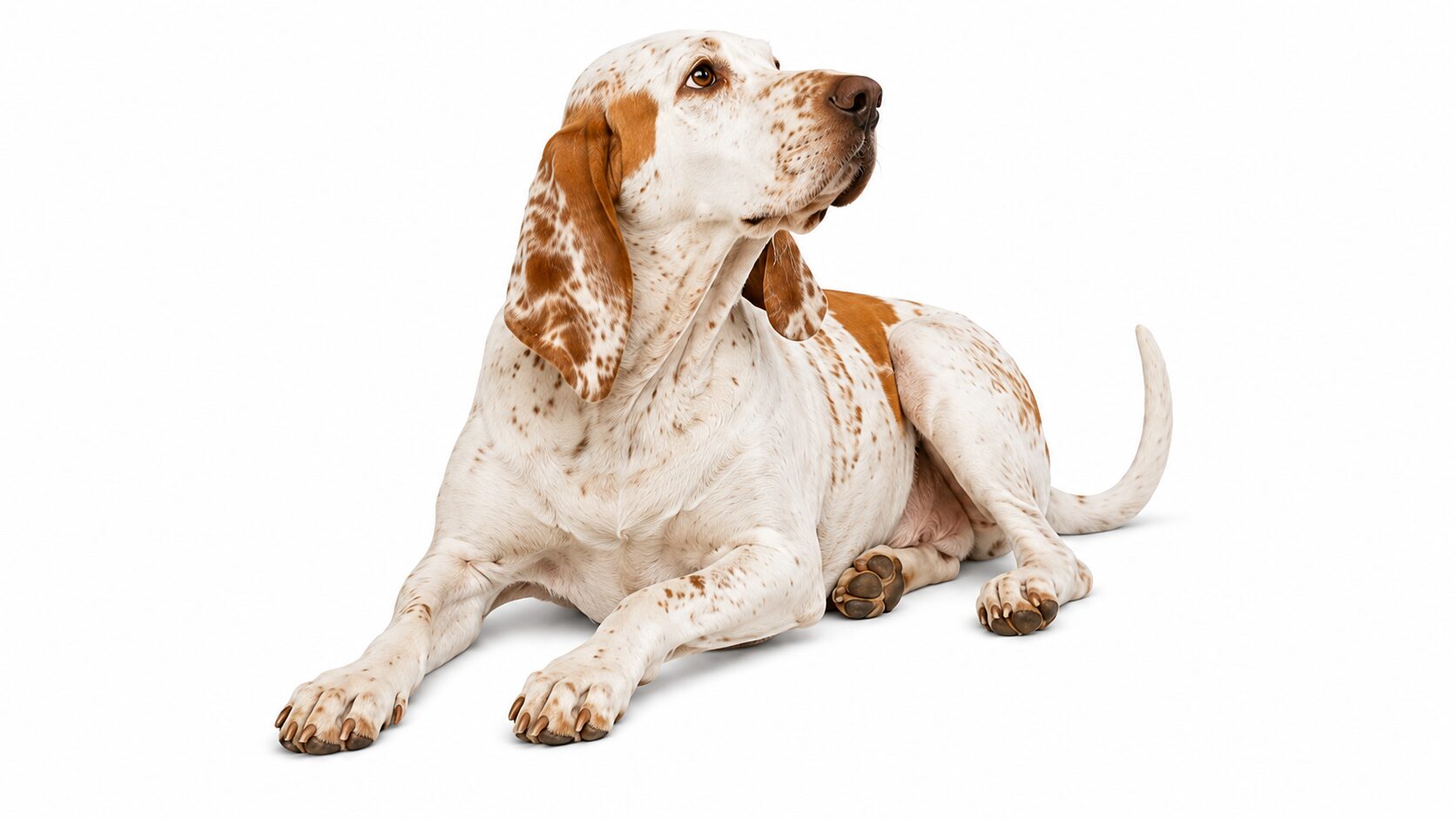
The Porcelaine gets its name from its shiny coat, said to make it resemble a porcelain statuette. The coat is incredibly short and very fine — the shortest and the finest-textured of any French scent hound — and the white color combined with the black mottling of the skin that shows through the fine coat produces a specific optical effect in direct sunlight that is unlike any other white-coated breed. The white skin with black mottling visible through the white coat gives the breed a translucent quality that the thicker coats of other white-colored breeds — the Great Pyrenees, the Kuvasz, the Slovenský Čuvač — completely obscure. The orange spots, characteristically appearing on the ears and occasionally on the body, complete the visual effect with the warm contrast that makes the breed’s coat pattern among the most immediately and the most personally distinctive of any hound in the Scenthound Group.
Appearance And Size
The Porcelaine is a medium-sized, athletically elegant, and specifically refined scent hound that presents with the aristocratic bearing that its name and its noble French ancestry evoke — the finely sculpted head, the dark intelligent eyes, the long thin ears that curl slightly at the tips, the lean athletic frame, and the porcelain-quality white coat creating an impression that one experienced French hunter described as studying a masterpiece of art.
Males stand 56 to 58.5 centimeters and weigh 25 to 28 kilograms; females are slightly smaller. The body is athletic and well-proportioned for endurance: deep-chested for cardiovascular capacity, well-muscled for sustained pack pursuit, and light enough in bone for the lively, gay gait and tireless gallop that distinguish the Porcelaine in the field from heavier-boned European pack hounds. The nose is specifically black with very wide nostrils — a functional feature that contributes directly to the scenting capability that hunters celebrate as on par with that of the Bloodhound. The coat is so short and fine that it requires virtually no maintenance to reveal the breed’s full visual elegance — a quality that specifically distinguishes the Porcelaine from the coated French scent hounds like the Briard whose elegance requires sustained grooming investment.
Housing And Living Requirements
The Porcelaine is not recommended for apartment life — the most directly and the most honestly important individual housing assessment for a breed developed to run in packs across the varied terrain of the Franche-Comté for full working days. Because these dogs hunt together without orders from their owner, they have developed into very independent dogs which are brave and very sociable — and this specific working independence is the most important character quality for any domestic housing context to understand and manage.
Rural environments with secured outdoor space provide the most appropriate context. A securely fenced yard is specifically and non-negotiably essential — the scent hound’s pursuit instinct means a detected trail will take a Porcelaine through any gap in fencing, over any inadequate barrier, and to any distance that the trail leads. The Porcelaine is one of the few French hunting dogs that has overcome the confines of its native land and aroused interest abroad, and the breed’s gentle domestic character makes it a genuinely rewarding companion for active rural households.
A comfortable dog bed in a social area suits the breed’s warmly family-integrated domestic character. An orthopedic dog bed provides appropriate joint support given the hip and elbow dysplasia documented in the breed.
Exercise Requirements
The Porcelaine is a vigorous and tireless hunter that requires at least one to two hours of vigorous daily exercise reflecting its heritage as a pack hound that historically pursued hare, roe deer, and wild boar across the mountains and forests of Franche-Comté and Burgundy for full working days. Without enough mental and physical exercise this dog can become high-strung and distractible — the most specifically practical individual welfare assessment for any Porcelaine owner in a domestic non-hunting context.
Scent work and tracking activities engage the extraordinary nose in purposeful organized sport — the most directly heritage-appropriate competitive outlet for a breed whose extraordinary scenting capability is its most specifically celebrated individual quality. Dog agility suits the breed’s athleticism in structured competitive sport. Swimming and hiking provide varied outdoor engagement that approximates the cross-terrain endurance work the breed was developed for.
Puzzle toys and enrichment activities are genuinely important between outdoor sessions for a breed this intelligent and this specifically mentally engaged in scent work. A GPS tracker is an absolutely essential safety investment for outdoor exercise in any area where fencing is not complete — a scent hound with a live trail will not respond to recall until the pursuit impulse exhausts or the trail goes cold.
Grooming Requirements
The Porcelaine’s very short, fine, smooth coat is the most practically low-maintenance grooming commitment of any recognized French scent hound, requiring minimal time and minimal equipment while maintaining the breed’s most celebrated visual characteristic without any intervention whatsoever.
Weekly brushing with a hound mitt or rubber curry brush removes minimal loose hair and keeps the coat clean and shiny. The white coat shows mud and field debris readily but the fine texture sheds field contamination more efficiently than longer coats, and an occasional bath maintains the porcelain-quality sheen. Good outdoor exercise should ideally keep nails at manageable length, but periodic trimming is still appropriate.
The long, thin, low-set ears are the most specifically important ongoing health maintenance feature. The reduced airflow in the ear canal created by the pendant ear structure creates the warm, moist environment where bacterial and yeast infections develop readily. Weekly inspection and cleaning, with specific attention after field exercise and water exposure, is the most consistently important preventive practice. Dental care should be established as a consistent routine from puppyhood. Nails should be trimmed periodically as needed.
Diet And Nutrition
The Porcelaine is a medium-to-large, highly active working breed with significant daily caloric needs calibrated to its actual size and genuine working output. A high-quality medium-large breed formula with a named protein source as the first ingredient provides the nutritional foundation.
Most adults do well on two measured meals per day. The deep chest creates meaningful GDV risk — two smaller meals, slow-feeder bowls, and avoiding vigorous exercise for at least one hour before and after meals are permanent preventive practices. Maintaining lean, athletic body condition appropriate to an active pack scent hound supports both working performance and long-term health. Training treats are effective motivators given the breed’s food engagement and willingness to learn.
Compatibility
The Porcelaine is an energetic and fierce hunter, but gentle at home and easy to handle. It is good with other dogs and children. This friendly hound is vigorous and tireless with a wonderful sense of smell and a musical voice. This characterization from the breed’s working tradition captures the essential domestic compatibility truth with specific and specific accuracy.
With its own established family, the breed is warmly devoted. These dogs are very affectionate and known to bond tightly with their human family members, old and young. The same sociable, cooperative character that makes the breed so specifically appropriate for pack hunting translates directly to family life — a dog bred to cooperate with dozens of other dogs without becoming aggressive or dominant is naturally inclined toward warm domestic social integration.
With children, the breed is consistently appropriate. Their friendly nature usually extends to children, and proper socialization from puppyhood ensures the most complete social development. With other dogs, the breed is characteristically sociable given the pack heritage — this is among the most specifically cooperative with other dogs of any scent hound in this series. With cats and small prey animals, the hunting drive requires specific management and early introduction. A dog crate is a useful management tool during puppyhood.
Behavior And Temperament
The Porcelaine is lively, affectionate, balanced, and brave, and is a very good companion in a family environment — the Club du Porcelaine’s most concise characterization of the breed’s domestic character captures it with specific accuracy. In the field, this breed becomes the vigorous, tireless, independent pack hunter that the Franche-Comté aristocracy valued so specifically. At home, it is a warmly social, calm, and genuinely affectionate companion.
The musical voice is the most specifically celebrated and the most personally memorable individual vocal quality — the Porcelaine gives tongue (bays) when on the scent trail with a musical, resonant voice that hunters in the forests of eastern France have celebrated for centuries as among the most beautiful of any French scent hound. While generally quiet indoors, Porcelaines can be quite vocal when on the scent trail — a quality that reflects the specific working tradition of a breed whose voice was its primary communication tool in dense forest hunting.
The independence is genuine and specifically functional. Because these dogs hunt together without orders from their owner, they have developed into very independent dogs — and this working independence requires specific handling in domestic contexts where owner authority must be established clearly and consistently from puppyhood.
Training And Handling
The Porcelaine is intelligent, responsive, and has a strong drive to please, making them relatively easy to train for experienced hound handlers. The breed’s intelligence and the genuine desire to please combine to produce one of the more naturally trainable French scent hounds available — but the working independence and the scent pursuit drive require specific and consistent management from the earliest possible age.
Positive reinforcement methods are the most effective approach. Training treats are effective motivators in short, varied, genuinely engaging sessions. Training sessions should avoid long, repetitive drilling that breeds this active find tedious — varied, engaging sessions that honor the breed’s intelligence produce the most cooperative adult results. Leash training and recall training are the most critically important individual training investments, given the scent hound’s pursuit instinct that makes off-leash reliability in unenclosed areas genuinely challenging.
Health And Lifespan
The Porcelaine is a remarkably healthy breed with a lifespan of 12 to 13 years, reflecting the constitutional robustness of a breed maintained through working selection and the genetic diversity that the post-revolutionary reconstruction crossing with regional French scent hounds introduced. The breed is described as generally healthy dogs that suffer from relatively few health problems.
Hip and Elbow Dysplasia Hip and elbow dysplasia are the most consistently documented orthopedic concerns. OFA hip and elbow evaluation of breeding animals is recommended. Maintaining lean body condition and appropriate juvenile exercise management are the most meaningful protective measures.
Bloat (Gastric Dilatation-Volvulus) The deep chest creates meaningful GDV risk. Two smaller meals daily, slow-feeder bowls, and avoiding vigorous exercise for at least one hour before and after meals are permanent preventive practices.
Ear Infections The long, pendant ears create specific infection risk. Weekly inspection and cleaning after every field session is the most consistently important preventive health practice.
Genetic Conditions Genetic testing is recommended for hyperuricosuria, degenerative myelopathy, and progressive rod-cone degeneration in breeding animals.
Routine preventive care including regular vet checks, OFA hip and elbow evaluation for breeding animals, genetic testing for DM and PRCD, consistent dental hygiene, up-to-date vaccinations appropriate for an active outdoor hunting breed, year-round tick and parasite prevention, and regular ear cleaning provides the foundation for a healthy Porcelaine.
Price And Availability
The Porcelaine is extremely rare outside France, Switzerland, and Italy. There are no Porcelaine breeders listed on the AKC Marketplace, and only one or two breeders have been identified in both the United States and the United Kingdom. Finding a Porcelaine requires direct engagement with the Club du Porcelaine, the Société Centrale Canine, or the dedicated specialist breeders who maintain the breed’s modest population. Puppies in France typically cost €1,000 to €1,300; imported individuals command higher prices to reflect the import complexity.
Conclusion
The Porcelaine is believed to be the oldest French scent hound in existence, with documentation tracing to pre-Revolutionary abbey records from Luxeuil and Cluny where the Choiseul family’s white-coated hounds were noted for exceptional hunting prowess, descending most likely from the English Harrier, the now-extinct Montaimboeuf of Savoy, and the smaller Laufhunds of Switzerland, was named in the mid-19th century by the Marquis de Foudras for the lustrous porcelain quality of the fine white coat in direct sunlight, nearly disappeared entirely during the French Revolution (1789-1799) when the aristocratic hunts and noble families who sustained it were destroyed, survived in specimens found at the Franco-Swiss border that were later confirmed by the Comte de Mallores as being of French origin, was first formally shown at the Tuileries in Paris in 1884 to a sensation among French huntsmen, has been recorded in France since 1845 and Switzerland since 1880, had the FCI publish and grant definitive recognition on October 26, 1964 in Group 6 Section 1.2, had the Club du Porcelaine founded in 1971, received UKC Scenthound Group recognition on January 1, 1996, was admitted to AKC Foundation Stock Service in 2017, had 326 new LOF registrations in France in 2024, remains concentrated in France, Switzerland, and Italy, has a coat with black-mottled skin visible through the white fur creating the specific glazed-porcelain visual effect that named it, has a musical voice celebrated by French hunters for centuries, hunts independently in packs without handler orders, and stands today as the most specifically Marquis-de-Foudras-poetically-named, the most specifically French-Revolution-disappeared-then-reconstructed, the most specifically Tuileries-1884-showed-to-a-sensation, the most specifically black-mottled-skin-visible-through-white-coat-porcelain-sheen, the most specifically oldest-French-scent-hound-in-existence, and the most specifically musical-voice-tireless-and-lively-gait of all the French Scenthound breed partnerships available. Get properly set up before bringing one home. Our Best Dog Products page has everything you need for glossy-white-porcelain-sheen-coated, orange-spotted-ears, wide-nostriled, musical-voiced, tireless-galloping, whole-heartedly devoted Franche-Comté pack hunting dogs that carry the full heritage of the Luxeuil and Cluny abbey noble hound tradition, the Marquis de Foudras’s 19th-century naming inspiration, the Harrier and Montaimboeuf and Laufhund founding cross, the French Revolution’s near-annihilation and Franco-Swiss border survival, the Comte de Mallores’s French-origin confirmation, the 1884 Tuileries showing sensation, the 1964 FCI recognition, the 1971 Club du Porcelaine founding, and the specific vigorous, tireless, musical-voiced, independent-in-the-pack, gentle-at-home, porcelain-gleaming intelligence of the oldest scent hound that France ever produced.