
Origin And History
The Pudelpointer — a name that is simultaneously the most transparently descriptive and the most specifically informative individual breed name in this series, combining the German Pudel (the German Hunting Poodle, ancestor of the modern Standard Poodle) with Pointer (the English Pointer) to identify both founding breeds in a single compound word — is a medium-sized, wire-coated, liver-or-chestnut-colored, beard-sporting, thoroughly athletic and thoroughly versatile German hunting dog created through one of the most specifically documented and the most specifically purposeful individual deliberate breed development programs in the history of gundog breeding, initiated in 1881 by Baron Hegewald von Zedlitz — a well-known author and expert on hunting dogs who wrote under the pen name Hegewald — with the founding cross between Tell, an English Pointer belonging to Kaiser Friedrich III of Germany, and Molly, a German Hunting Pudel owned by Hegewald himself, a cross so specifically documented in its foundation pair and so specifically focused in its developmental goal — the creation of a single dog that could find, point, track, and retrieve all game on both land and water — that it stands as the most precisely recorded individual breed creation event of any versatile hunting dog breed in this series, and a breed whose development philosophy is so specifically committed to working performance over aesthetic appearance that the most knowledgeable American breeders actively and specifically avoided AKC conformation recognition for decades out of concern that the split into show and working lines that typically follows kennel club recognition would compromise the breed’s most important individual quality: its genuine, consistent, tested working ability.
The breed development goal that Hegewald articulated in 1881 was among the most specifically ambitious in the history of German gundog breeding: to combine the outstanding natural working abilities of two great specialists in one dog — the intelligence, love of water, retrieving instinct, easy trainability, and willingness to please wrapped into the protective coat of the Pudel, with the unending desire to hunt, birdiness, pointing instinct, exceptional field nose, and endurance of the English Pointer. The founding sire Tell was specifically chosen because he was an excellent specimen belonging to the German Emperor himself. The founding dam Molly was the German Hunting Pudel — a dog that contemporary breed historians specifically emphasize bore far more resemblance to a practical hunting retriever than to any modern show Poodle, possessing a keen love of water, a strong retrieving instinct, and exceptional intelligence without any of the aesthetic grooming associations of the modern companion Poodle.
The genetics of the development program proved significantly more complex than Hegewald’s initial conceptualization. The Pudel’s genes proved dramatically dominant, continually reasserting the retriever character, coat, and temperament over the pointer qualities Hegewald was specifically trying to incorporate. The resulting first-generation crosses, when bred together, tended to produce offspring of either the Pudel or the Pointer type rather than the balanced combination of both that was the goal. This genetic challenge required a systematic correction: over the first 30 years of the breeding program, 11 Pudels and 80 Pointers were used — a ratio that reflects the continuous reassertion of Pudel genetics and the necessity of repeated Pointer outcrossing to maintain the balanced hunting character. Despite this genetic complexity, Zedlitz maintained strict standards throughout the program, placing puppies only with trusted friends and hunting enthusiasts where he could closely document each dog’s performance, refusing to commercialize the breed while he was still developing it into the consistent type he envisioned.
The breed was introduced to North America in 1956 by Bodo Winterhelt, a Canadian hunter whose Winterhelle Kennel became the foundation of the entire North American Pudelpointer population and who remained personally involved in maintaining the breed standard until his death in 2018 — a 62-year individual commitment to a single breed’s North American establishment that is the most specifically personal individual custodianship of any imported breed’s continental development in this series. Winterhelt founded the Pudelpointer Club of North America (PCNA) in Canada in 1977. Recognition milestones in North America include UKC recognition placing the breed in the Gun Dog Group, and AKC admission to the Sporting Group in 2016 after a period in the Foundation Stock Service — a recognition that the most hunting-oriented North American breeders had specifically and deliberately resisted for years.
The FCI recognizes the Pudelpointer in Group 7 (Pointing Dogs), Section 1.2 (Continental Pointing Dogs — Griffon Type), placing it alongside the Wirehaired Pointing Griffon and the German Wirehaired Pointer among the wire-coated continental versatile hunters — a classification that accurately places the breed in the specific competitive context where it is most specifically and the most personally celebrated.
Breed Overview
| Trait | Details |
|---|---|
| Origin | Germany (created 1881; developed over 30 years by Baron von Zedlitz “Hegewald”) |
| Name Origin | Pudel (German Hunting Poodle) + Pointer (English Pointer) — both founding breeds named |
| Founding Cross | Tell (English Pointer; owned by Kaiser Friedrich III) × Molly (German Hunting Pudel; owned by Hegewald) |
| Breeding Program | 11 Pudels and 80 Pointers over 30 years to achieve balanced type |
| Development Philosophy | Working performance only; no aesthetic/show breeding |
| Introduced to North America | 1956 (Bodo Winterhelt; Winterhelle Kennel, Canada) |
| PCNA Founded | 1977 (Pudelpointer Club of North America; Canada) |
| AKC Recognition | 2016 (Sporting Group) |
| FCI Classification | Group 7, Section 1.2 (Continental Pointing Dogs — Griffon Type) |
| UKC | Gun Dog Group |
| Parent Club (USA/Canada) | Pudelpointer Club of North America (PCNA) |
| German Breed Club | Verein Pudelpointer (Germany) |
| Working Test Requirement | Before being approved for breeding, dogs must pass working tests in field, tracking, and water |
| NAVHDA | Most North American breeders use NAVHDA testing system for breeding qualification |
| North American Upland Survey | 5.8% of upland hunters owned a Pudelpointer in 2024 (No. 8 in popularity) |
| Height | Males 60–65 cm (24–26 inches) / Females 55–60 cm (22–24 inches) |
| Weight | 20–30 kg (44–66 pounds) |
| Lifespan | 13–14 years |
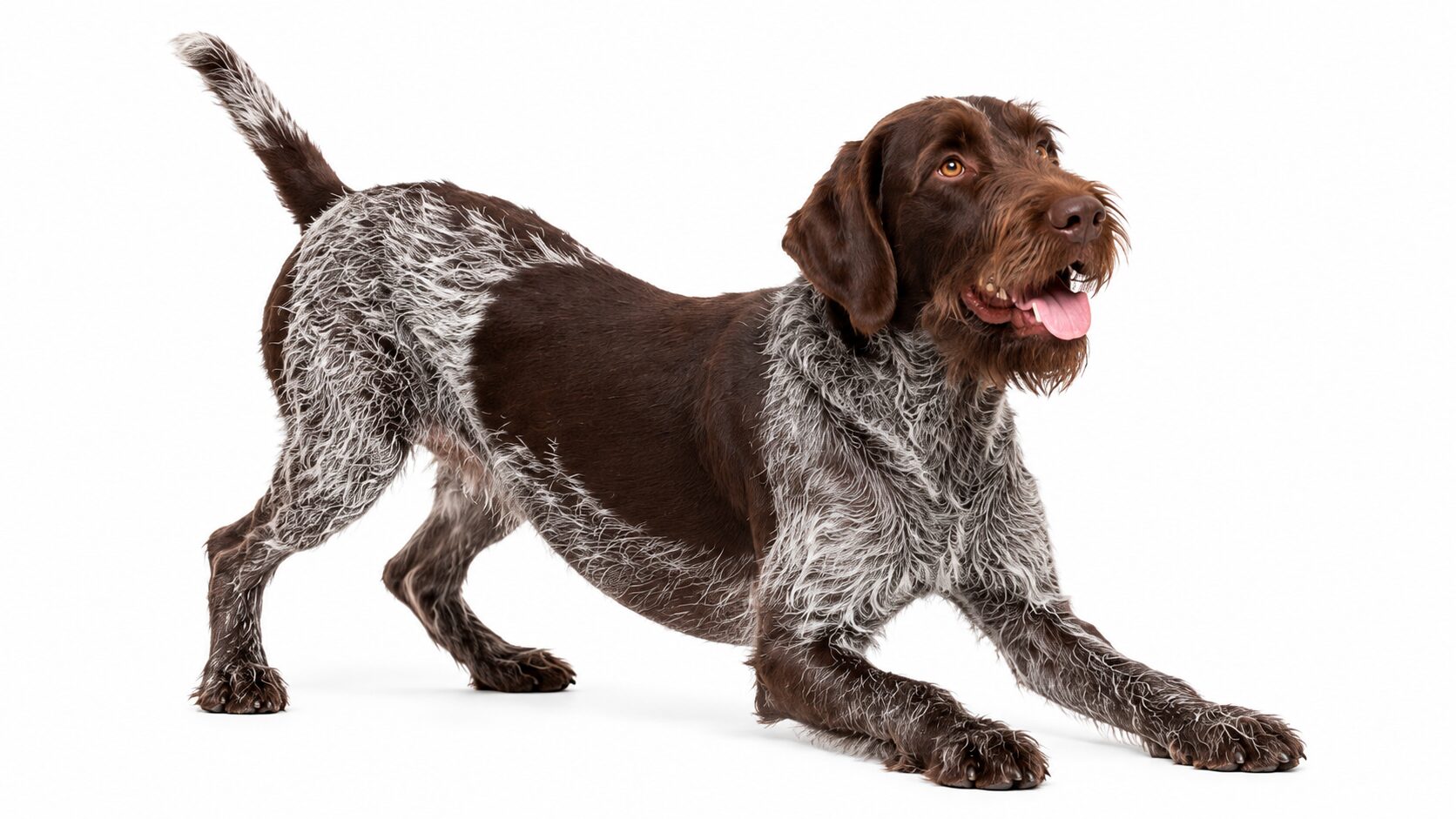
| Coat | Harsh, wiry, dense; flat-lying; medium length; dense undercoat; beard and facial furnishings |
| Colors | Liver; liver roan; chestnut; dead leaf (lighter brown); occasionally black; small white markings |
| Nose | Large, liver-colored; wide nostrils |
| Ears | Medium; flat-lying; well-covered in hair |
| Tail | Straight; reaches hock; carried saber-like |
| Shedding | Very low — considered a low-shedding breed |
The Working Test Requirement: What Makes the Pudelpointer Unique
Before discussing care, the Pudelpointer’s most specifically and the most philosophically unusual individual breed management requirement deserves dedicated acknowledgment, because it is the most specifically performance-focused individual breeding standard of any breed in this series and because it is the requirement that most specifically distinguishes the Pudelpointer from every show-line gundog breed in the AKC Sporting Group.
Before being approved for breeding, every male and female Pudelpointer must pass a working hunt test with minimum scores in field performance, tracking, and water skills set by the relevant breed clubs. This is not a recommendation but a requirement — dogs that do not pass the working tests may not be registered for breeding in the official programs. The Verein Pudelpointer in Germany organizes the VJP (spring hunting test), HZP (autumn hunting test), and VGP (all-age comprehensive test). In North America, the NAVHDA (North American Versatile Hunting Dog Association) testing system is the most commonly used working evaluation framework. For over 140 years, the quality of the breed’s performance has been assured almost exclusively by this testing system — an unbroken commitment to working function that makes the Pudelpointer arguably the most consistently working-quality-maintained of any hunting breed in the world.
Appearance And Size
The Pudelpointer is a medium-sized, strong-boned, and specifically athletic gundog that presents with the harmonious, balanced construction of a dog built for endurance and efficiency across varied terrain and in water — the most immediately practically informative individual physical assessment of a breed that must perform effectively from the salt marsh to the mountain and from the prairie to the forest.
Adults typically stand 55 to 65 centimeters and weigh 20 to 30 kilograms. The ideal coat is harsh, wiry, and dense — the most critical individual physical characteristic from both working and identification perspectives, providing the weather resistance, burr-shedding capability, and water protection that a versatile hunting dog working across all seasons and all terrain types requires. The breed sports a distinctive beard, moustache, and a lock of hair above the forehead — the facial furnishings that are the most immediately personally charming individual aesthetic quality and that contribute to what one longtime owner described as more resemblance to a Wookie than to today’s fluffy show poodle or to the shorthaired, mostly-white English Pointer that founded the breed.
Coat genetics remain the breed’s most specifically interesting individual challenge: even in litters from parents with near-perfect coats, it is not unusual to find a variety of coat types ranging from smooth to woolly to just right, reflecting the complex Pudel-Pointer coat genetics that Zedlitz spent 30 years working to stabilize and that the small gene pool of early North American breeding exacerbated.
Housing And Living Requirements
The Pudelpointer is among the more specifically and the more practically rurally-oriented of any versatile hunting breed in this series, and the most direct assessment from experienced owners and breeders is consistent: this is a hunting dog bred by hunters for hunters, still exclusively owned by hunting families in the most knowledgeable breed circles, and its genuine welfare requires either active hunting engagement or the equivalent sustained daily vigorous outdoor activity.
The breed does need a secure fence to contain it — the prey drive that makes it exceptional in the hunting field will take it after any unsuspecting quarry in any unsecured outdoor area, regardless of traffic or distance from home. Rural environments with active hunting or working engagement provide the most appropriate domestic context.
A comfortable dog bed in a social area of the home suits the breed’s warmly family-integrated domestic character. An orthopedic dog bed provides appropriate joint support.
Exercise Requirements
The Pudelpointer is a tireless and agile sporting dog with an enormous amount of energy that needs thorough daily vigorous exercise — at minimum 60 to 90 minutes, with the most genuinely satisfied individual dogs receiving actual hunting engagement, extended field work, or at minimum several miles of vigorous outdoor activity daily. At a baseline, this breed needs to do two miles of walking in the morning, followed by a chance to run hard at a faster pace in an open field every afternoon, and a proper five-to-ten-mile hike, run, or hunt at least weekly throughout the year — characterizations from experienced owners that confirm the genuine athletic demand this breed places on any owner’s daily schedule.
Swimming is the most naturally fulfilling individual exercise outlet — a breed created specifically to combine the Pudel’s love of water with the Pointer’s hunting drive will embrace any water opportunity with entirely characteristic and entirely genuine enthusiasm. NAVHDA versatile hunting dog testing provides the most comprehensive organized working evaluation for the breed, assessing pointing, tracking, retrieving on land, and water retrieve capability in the integrated format that the Pudelpointer’s specific working heritage demands.
Dog agility suits the breed’s athleticism in structured competitive sport. Scent work and tracking activities engage the exceptional field nose in purposeful organized sport. AKC Hunt Tests provide organized working evaluation in the hunting sport format most directly appropriate to the breed’s heritage.
Puzzle toys and enrichment activities are genuinely important between outdoor sessions for a breed with the Pudel’s intelligence and the Pointer’s hunting drive simultaneously active. A GPS tracker is an absolutely essential safety investment for outdoor exercise in any open or semi-open area given the hunting drive that will take this breed after any detected game at full speed.
Grooming Requirements
The Pudelpointer’s harsh, wiry, dense coat is a surprisingly low-maintenance individual grooming commitment given its working-dog appearance, with the wire coat’s natural self-cleaning properties meaning that field debris tends to fall away after drying without requiring intensive daily brushing.
Weekly brushing removes loose hair and maintains coat health. The coat sheds very little — one of the most specifically valued individual qualities for owners who share their home with this breed and do not wish to manage the significant shedding that the double-coated sporting dogs typically produce. Occasional baths after particularly muddy field sessions are appropriate, but the coat’s natural properties reduce bathing frequency significantly.
The beard and facial furnishings require specific regular cleaning given their tendency to accumulate food, moisture, and field debris. Periodic hand-stripping — pulling dead coat rather than cutting it — maintains the correct harsh wire texture that the breed standard requires and that cutting compromises. Regular trimming of ear hair may be appropriate given the well-covered, flat-lying ears.
Dental care should be established as a consistent routine from puppyhood. Ears should be inspected and cleaned weekly. Nails should be trimmed regularly.
Diet And Nutrition
The Pudelpointer is a medium-sized, highly active working sporting breed with significant daily caloric needs calibrated to its actual size and genuine working output. A high-quality medium breed active formula with a named protein source as the first ingredient provides the nutritional foundation.
Most adults do well on two measured meals per day — puppies and adolescents may require more frequent feeding to support their active growth without hypoglycemia risk. Maintaining lean, athletic body condition appropriate to a working versatile hunting dog supports both field performance and long-term health. Training treats are highly effective motivators given the breed’s food engagement and genuine desire to work cooperatively with its handler.
Compatibility
The Pudelpointer is an intelligent and social dog — a focused hunter but also a loving companion. When at home with its family, it is calm but still requires significant social interaction and exercise — a characterization that captures the breed’s essential domestic character with specific accuracy.
With its own established family, the breed is completely devoted and specifically attentive. The intelligence inherited from the Pudel and the handler-focus inherited from the Pointer combine to produce a dog that is genuinely engaged with its people in both the field and the home. The clownish personality — owners consistently describe a friendly, goofy quality — makes the breed as enjoyable to be around at home as in the hunting field.
With children, the breed is consistently gentle. Pudelpointers are very gentle with children. With strangers, the breed can be initially reserved before warming with socialization — a watchdog quality appropriate to a hunting dog whose environmental awareness is constitutionally high. With other dogs, the breed typically gets along well given the pack-hunting tradition. With cats and other small pets, the prey drive is genuine and requires management. Do not leave the breed unattended with smaller pets including cats and birds, as the hunting instinct could harm them. A dog crate is a useful management tool during puppyhood.
Behavior And Temperament
The Pudelpointer is calm, self-controlled, versatile, and possesses a distinct hunting instinct while lacking game or gun shyness — the AKC’s most concise individual breed characterization captures the essential behavioral truth with specific and practical accuracy. The breed is enjoyed and valued for its desire and drive — the most personally celebrated individual working quality among the experienced hunting community that has always been the breed’s primary ownership circle.
The vast majority of Pudelpointers hunt — a specific and specifically remarkable individual statistical claim across 140 years of breeding that is unique among the breeds in this series. For the breed that was bred by hunters for hunters and that still requires working test passage for breeding approval, the consistency of the hunting drive across the entire population reflects the most successfully maintained individual working standard of any gundog in this series.
The breed’s intelligence means it can anticipate training sequences and start performing behaviors before cues are given if patterns become too predictable — a specific and specifically interesting individual training management note that reflects the Pudel’s exceptional cognitive capability applied to the hunting partnership context. Varying the training structure, introducing new challenges regularly, and using the dog’s problem-solving ability as a feature produces the most complete individual working partnership available in the versatile gundog category.
Training And Handling
The Pudelpointer is among the most naturally cooperative and the most genuinely trainable of any versatile hunting breed, combining the Pudel’s exceptional intelligence and willingness to please with the Pointer’s natural hunting capability in a working partnership that rewards the most positive, the most varied, and the most genuinely challenging training available.
Positive reinforcement methods are the most effective and the most specifically appropriate approach. Training treats are highly effective motivators in short, varied, genuinely engaging sessions. The breed’s intelligence makes it a capable training partner from an early age — the Pudel genetics that required 80 Pointer crosses to balance phenotypically produced a breed with arguably the most complete individual combination of trainability and hunting drive in the versatile gundog family.
Early socialization from puppyhood is important for building the social confidence that manages the initial stranger-reserve most effectively. Leash training should begin in puppyhood — given the breed’s inherent small-game hunting and retrieving tendencies, leash control in open or unsecured areas is a specific and specifically critical safety management practice.
Health And Lifespan
The Pudelpointer is a genuinely healthy and constitutionally robust breed with a lifespan of 13 to 14 years, and no notable hereditary health issues have been prominently reported — one of the most specifically encouraging health assessments of any versatile hunting breed and a direct reflection of the 140-year working-performance-only selection program that eliminated constitutional weaknesses from the breeding population without the concentrated hereditary disease introduction of narrow aesthetic show-line breeding.
Hip and Elbow Dysplasia Hip and elbow dysplasia are the most consistently possible orthopedic concerns for any medium-to-large active sporting breed. OFA hip and elbow evaluation of breeding animals is recommended as standard practice.
Bloat (GDV) The deep chest creates some GDV susceptibility. Two smaller meals daily and avoiding vigorous exercise for at least one hour before and after meals are sensible permanent preventive practices.
Eye Conditions Eye conditions are worth monitoring annually given the breed’s age and activity level. Annual CAER ophthalmological examination from the dog’s first year provides clinical monitoring.
General Robustness Routine preventive care including regular vet checks, OFA evaluation for breeding animals, CAER ophthalmological examination, consistent dental hygiene, up-to-date vaccinations appropriate for an active outdoor hunting breed, year-round tick and parasite prevention given the hunting terrain the breed works through, and regular grooming maintains the foundation for a healthy Pudelpointer.
Price And Availability
The Pudelpointer is a genuinely rare breed in North America and remains exclusively in the hands of hunting families who maintain the working test requirements that distinguish it from show-line sporting breeds. Finding a Pudelpointer requires direct engagement with the Pudelpointer Club of North America or the NAVHDA network of versatile hunting dog enthusiasts. From reputable breeders with NAVHDA working documentation and OFA health testing, expect to pay between $1,500 and $2,500 for a well-bred puppy.
Conclusion
The Pudelpointer was created in 1881 by Baron Hegewald von Zedlitz from a founding cross between Tell — an English Pointer belonging to Kaiser Friedrich III of Germany — and Molly, a German Hunting Pudel owned by Hegewald himself, with the specific goal of combining the Pudel’s intelligence, water love, retrieving instinct, trainability, and protective coat with the Pointer’s unending hunting desire, birdiness, pointing instinct, field nose, and endurance, required 11 Pudels and 80 English Pointers across 30 years of systematic crossing to overcome the Pudel’s genetic dominance and achieve the balanced versatile type, was introduced to North America in 1956 by Bodo Winterhelt whose Winterhelle Kennel founded the entire North American population and who remained involved for 62 years until his 2018 death, had the Pudelpointer Club of North America founded in 1977, has always required working test passage in field, tracking, and water for all breeding animals, uses the NAVHDA testing system in North America, received AKC Sporting Group recognition in 2016 following a period in the Foundation Stock Service, is classified by the FCI in Group 7 Section 1.2 alongside the Wirehaired Pointing Griffon and German Wirehaired Pointer, remains exclusively owned by hunting families with no show or pet lines, has 5.8% of North American upland hunters owning one as of 2024 making it No. 8 in upland hunting dog popularity, and stands today as the most specifically Kaiser-Friedrich-III-English-Pointer-founding-sire, the most specifically 80-Pointers-to-11-Pudels-to-balance-the-genetics, the most specifically working-test-required-before-approved-for-breeding, the most specifically Bodo-Winterhelt-1956-North-American-introduction-and-62-year-stewardship, the most specifically exclusively-hunting-family-owned-no-show-or-pet-lines, and the most specifically 140-years-working-performance-maintained-without-aesthetic-compromise of all the versatile gundog breed partnerships available. Get properly set up before bringing one home. Our Best Dog Products page has everything you need for wire-coated, liver-colored, bearded, low-shedding, whole-heartedly devoted German versatile hunting dogs that carry the full heritage of Kaiser Friedrich III’s Pointer Tell, Hegewald’s Hunting Pudel Molly, 30 years of 80-Pointer-to-11-Pudel systematic development, the Verein Pudelpointer’s 140-year working test tradition, Bodo Winterhelt’s 1956 North American founding, the 1977 PCNA establishment, the NAVHDA working test framework, the 2016 AKC Sporting Group recognition, and the specific calm, self-controlled, clownish-at-home, unendingly-hunting-focused, water-loving, game-finding, pointing-tracking-and-retrieving-all-in-one versatile intelligence that Baron von Zedlitz spent thirty years and ninety dogs building from scratch and that has remained genuinely, consistently, and specifically whole-heartedly hunting-capable ever since.