
Origin And History
The Rhodesian Ridgeback, known in the early period of its formal recognition as the African Lion Dog and later as Van Rooyen’s Lion Dog, called simply the Ridgeback by knowledgeable fanciers who specifically and consistently use this shortening — never Rhodesian, since as the AKC notes, any dog can in theory hunt a lion, but not every dog has the telltale cowlick up its back that attests to its roots in the rocky headlands of the Cape of Good Hope — is a large, athletic, wheaten-coated, ridge-bearing southern African hound breed that is the most specifically and the most personally unique breed in this series for one characteristic shared with only two other breeds in the entire canine world: the dorsal ridge — a symmetrical stripe of hair growing in reverse direction along the spine, beginning just behind the shoulders and tapering toward the hips, anchored by two identical whorls or crowns directly opposite each other — that the Khoikhoi people’s half-wild hunting dogs of southern Africa possessed and contributed to the founding of the modern Ridgeback, and a breed recognized by the AKC in 1955 when Tchaika of Redhouse became the first Rhodesian Ridgeback registered in the AKC Stud Book as the 112th breed to receive registration facilities, placed in the Hound Group where it remains today.
The breed’s founding history is the most specifically and the most personally adventure-embedded of any breed in this series, beginning at the tip of the African continent in the mid-17th century when the Dutch East India Company established a port at the Cape of Good Hope as a refueling station on the trade route between Europe and Asia. The Dutch settlers at the Cape encountered the Khoikhoi people — the pastoral indigenous inhabitants of the Cape Peninsula — and specifically noted the distinctive dogs that the Khoikhoi kept: described by European observers as absolutely fearless and ferocious when acting as guard dogs, measuring approximately 18 inches at the withers with a lean but muscular frame, and bearing the most specifically unusual individual physical characteristic — the ridge of backward-growing hair along the spine that no other dog type in the world possessed.
As European colonists expanded their presence in southern Africa in the 18th and early 19th centuries, they imported a variety of European hunting breeds including Greyhounds, Mastiffs, Great Danes, Bloodhounds, and the now-extinct Dogo Cubano — also called the Cuban Bloodhound — which was heavily emphasized in the early Ridgeback’s composition. These European breeds were crossed with the indigenous Khoikhoi dogs and other native African dogs by the Boer farmers who needed the most specifically demanding individual working dog brief in this series: a dog that could withstand extreme temperature swings from blazing daytime heat to below-freezing nights, survive 24 or more hours without water, resist tsetse flies and the African bush’s other insect hazards with a short coat, flush partridge and bring down wounded buck, protect farms from prowlers and wild animals at night, and accompany hunters on horseback when pursuing the most dangerous quarry in Africa — the lion.
The most specifically and the most dramatically documented individual founding moment in the breed’s history involves Cornelius van Rooyen — a big-game hunter in what was then Rhodesia — and the Reverend Charles Helm of the Hope Fountain Mission. When business required Helm to travel back to South Africa, he left his two ridged dogs — Lorna and Powder — with van Rooyen, whose own pack included Greyhounds, Irish and Airedale Terriers, Collies, and Bulldogs. Unplanned matings between Helm’s ridged females and van Rooyen’s hunting pack produced the foundation of the modern Ridgeback. Van Rooyen was immediately impressed: the progeny that carried the ridge proved to be specifically and specifically superior hunters, and he spent the next 35 years developing his pack with the ability to bay a lion — not to attack it, but to harass it with quick snaps and confusing movements, darting in and out in the manner of a matador taunting a bull, holding the lion’s attention while the hunter positioned himself for the killing shot.
The most critically important individual clarification about the Ridgeback’s lion work — repeated as the biggest misconception about the breed in breed education materials — is that these dogs never made contact with lions as catch dogs and never attempted to kill lions. The Ridgeback’s role was that of the baying dog — holding the lion at bay through courageous harassment rather than physical combat. The courage required for this specific application is genuinely extraordinary: a dog that could repeatedly dart close to a lion, attract its attention and rage, and then spring back from those devastating paws without being struck required both athletic speed and the specific calm courage that does not escalate into the recklessness that would get the dog killed.
Van Rooyen’s Lion Dogs became so noteworthy that they were mentioned in the famous 1893 book Travel and Adventure in South East Africa by Frederick Courteney Selous — one of the most celebrated African big-game hunters of the Victorian era — who specifically described a dog resembling a mongrel deerhound that van Rooyen would not have parted with at any price. Van Rooyen died before his time at age 55 of pneumonia, never having intentionally created a breed but having done so nonetheless.
Formal breed recognition came through the work of Francis R. Barnes, who drafted the first Rhodesian Ridgeback breed standard in Bulawayo, Southern Rhodesia (now Zimbabwe) in 1922 at the founding meeting of the first Rhodesian Ridgeback Club at a Bulawayo Kennel Club show. Barnes modeled the standard substantially on that of the Dalmatian — a dog that, like his own, needed to be able to trot alongside a horse or wagon all day — adding the details of the ridge and the words to indicate this unique African breed needed speed as much as endurance. The standard was approved by the South African Kennel Union in 1924/1927. The breed’s ridge genetics were identified in a landmark 2007 collaborative study by researchers at Uppsala University in Sweden, the Swedish University of Agricultural Sciences, and the Broad Institute. The first Rhodesian Ridgeback was registered by the AKC in November 1955, making it the 112th breed to gain recognition.
Breed Overview
| Trait | Details |
|---|---|
| Origin | Southern Africa (Southern Rhodesia/Zimbabwe and South Africa) |
| Also Known As | African Lion Dog; Van Rooyen’s Lion Dog; Ridgeback |
| Correct Shortening | “Ridgeback” (never “Rhodesian”) |
| First Breed Standard | 1922 — F.R. Barnes, Bulawayo, Southern Rhodesia; modeled on Dalmatian standard |
| South African Kennel Union | 1924/1927 |
| AKC Recognition | November 1955 (112th breed; Hound Group) |
| First AKC Registered | Tchaika of Redhouse (1955) |
| FCI Classification | Group 6, Section 3 (Related breeds) |
| UKC | Scenthound Group |
| Parent Club (USA) | Rhodesian Ridgeback Club of the United States (RRCUS; formed 1959) |
| Foundation Breeder | Cornelius van Rooyen (35-year program in Rhodesia) |
| Key Event | Rev. Charles Helm’s dogs Lorna and Powder left with van Rooyen; created the breed |
| Literary Reference | Mentioned in Selous’s 1893 Travel and Adventure in South East Africa |
| Barnes Standard Note | “Rough treatment should never be administered” — written directly into the original 1922 standard |
| Ridge Genetics | Identified by Uppsala University/Swedish University of Agricultural Sciences/Broad Institute (2007) |
| Ridgeless Ridgebacks | Purebred offspring lacking the ridge gene; only disqualification in AKC standard |
| Khoikhoi Heritage | Retained 4% pre-colonial ancestry (ancient genome sequencing) |
| Great Dane Connection | Genetic analysis shows Rhodesian Ridgeback and Great Dane share the same genetic clade |
| Height | Males 63–69 cm (25–27 inches) / Females 61–66 cm (24–26 inches) |
| Weight | Males ~38 kg (85 pounds) / Females ~32 kg (70 pounds) |
| Lifespan | 10–12 years |
| Coat | Short, dense, sleek; light wheaten to red wheaten |
| Ridge | Runs from behind shoulders to hips; contains two identical whorls; the only AKC disqualification |
| Nose Color | Black or liver (matching coat); no other color permitted |
| Eyes | Dark with black nose; amber with liver nose |
| Silent Trailer | Characteristic of sighthound ancestry; hunts without baying on the trail |
| AKC Popularity | 54th of recognized breeds |
The Ridge: The Most Specifically Unusual Physical Feature in This Series
Before discussing care, the Rhodesian Ridgeback’s most immediately and the most specifically defining individual physical characteristic deserves dedicated acknowledgment, because the dorsal ridge is genetically unique, aesthetically arresting, and historically foundational in a way that makes it the most specifically unusual breed-defining individual physical feature in this series.
The ridge consists of a strip of hair growing in the reverse direction to the surrounding coat, running symmetrically from immediately behind the shoulders and tapering toward the hips, anchored by two identical crowns or whorls directly opposite each other — one at the cranial end and one toward the caudal end. The genetic mechanism producing the ridge was identified in a landmark 2007 study: it is caused by a duplication of three developmental genes, specifically fibroblast growth factor genes (FGF3, FGF4, and FGF19) on chromosome 18. The ridge is not merely a cosmetic breed identifier but is the only disqualification in the AKC breed standard — ridgelessness in an otherwise conforming dog is the only thing that disqualifies it from AKC conformation competition. The only other recognized breeds that naturally possess a similar dorsal ridge are the Phu Quoc Ridgeback of Vietnam and the Thai Ridgeback of Thailand — making the ridge an independently evolved trait in three geographically widely separated dog populations, each of which developed it through the same genetic duplication event.
The Lion Work: The Most Misunderstood Working Application
Because the Rhodesian Ridgeback’s most celebrated historical working application — lion baying — is simultaneously its most frequently misrepresented individual characteristic, an honest clarification provides essential context for any breed discussion.
The Ridgeback never attacked, wrestled, caught, or killed lions. Its role was the baying dog — harassing the lion through quick approach and retreat, keeping the lion’s attention focused and the lion disoriented and agitated while the mounted human hunter positioned himself for a rifle shot. The skill required was not combat courage but the specific combination of athletic speed, spatial awareness, and calm calculated courage that could dart close enough to attract the lion’s attention and anger without getting struck by those devastating paws. A dog that engaged a lion physically would be killed. A dog that retreated too far would lose the lion’s attention and the hunter’s positioning advantage. The specific behavioral competence of staying in the precise harassment zone — close enough to engage, far enough to survive — is the most specifically demanding individual working brief in this series and the quality that van Rooyen spent 35 years selecting for.
Appearance And Size
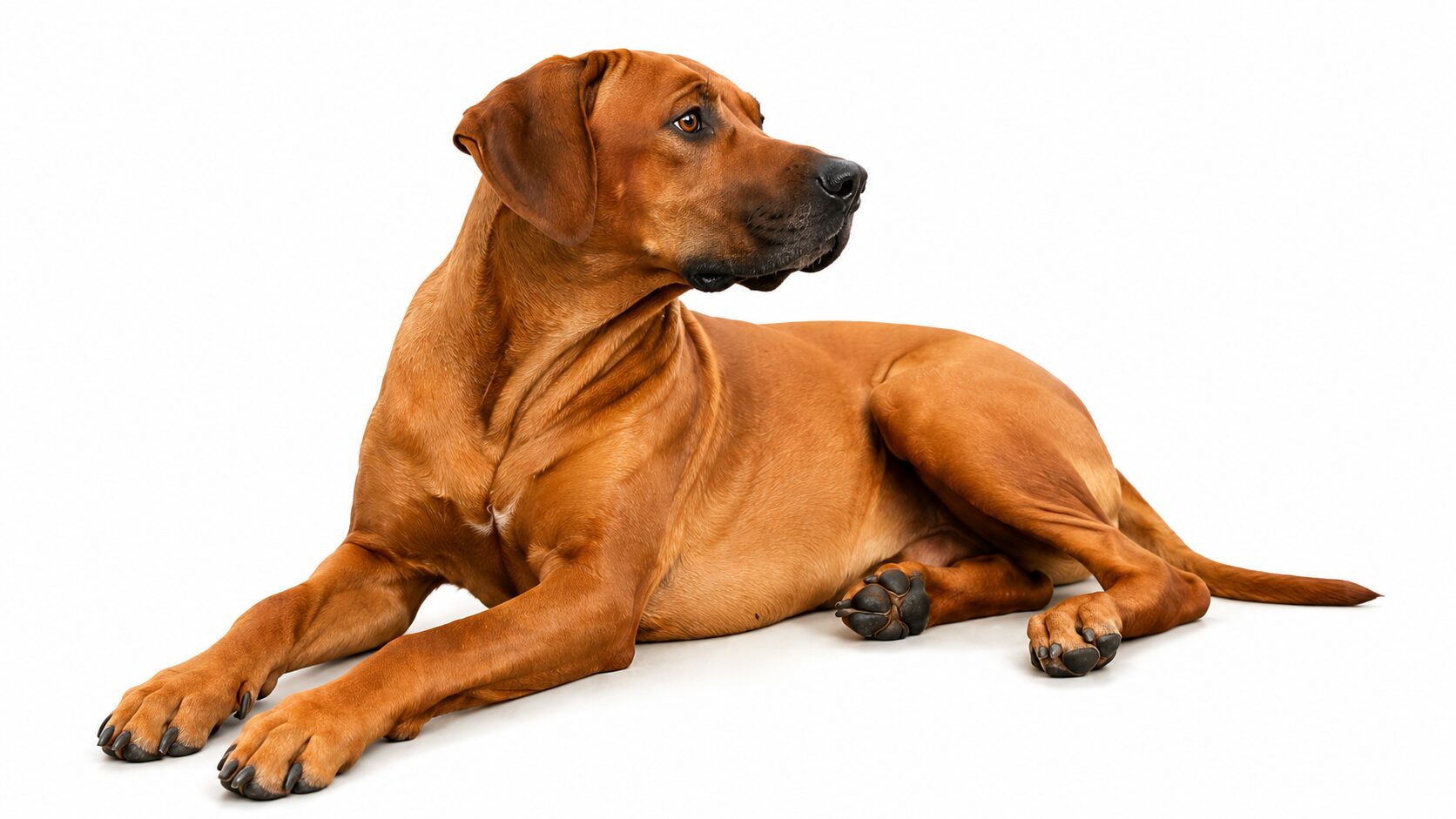
The Rhodesian Ridgeback is a large, muscular, balanced, and athletically impressive dog that presents with the most immediately memorable combination of the wheaten-to-red coat, the ridge that runs the length of the topline, and the dignified, alert expression of a dog bred for the most demanding working conditions in southern Africa.
Males stand 63 to 69 centimeters and weigh approximately 38 kilograms; females are somewhat smaller. The coat is short, dense, and sleek, ranging from light wheaten to red wheaten — a color palette that provides both heat management in Africa’s daytime temperatures and sufficient camouflage in the veldt. White is permissible on the chest and toes but excessive white on the belly or above the toes is undesirable. The body is slightly longer than tall — the proportion that balanced athleticism between speed and endurance produces in working breeds — and the gait is efficient and powerful yet specifically graceful.
Housing And Living Requirements
The Rhodesian Ridgeback is more adaptable in terms of living environment than its large size and dramatically wild working heritage might initially suggest — these dogs are genuinely appropriate for suburban homes and can even adapt to city living for sufficiently active owners — but the most honest assessment is that the breed’s most genuine welfare is served in a home with meaningful outdoor space and consistent active outdoor engagement.
The most critically important housing welfare considerations are secure fencing and appropriate management of the breed’s territorial guardian instinct. A Ridgeback that decides to investigate the perimeter of its territory will do so with the methodical persistence of a dog bred to patrol farmsteads in the African bush, and fencing that is not specifically robust will not remain a barrier to a 85-pound motivated dog. The breed should never be trained as a protection dog — the natural protective instinct should be subjected to elementary obedience training for control rather than deliberate enhancement.
An orthopedic dog bed is specifically important for a large athletic breed with the hip dysplasia and joint conditions documented in Ridgebacks. A comfortable dog bed in a social area suits the breed’s warmly family-devoted domestic character.
Exercise Requirements
The Rhodesian Ridgeback is a breed of great endurance with a fair amount of speed — the AKC breed standard’s characterization that captures the working heritage most accurately. At minimum 60 to 90 minutes of vigorous daily exercise is appropriate, and the breed’s capability for sustained athletic output over challenging terrain makes extended hiking, running, and active outdoor engagement the most personally fulfilling daily exercise contexts.
Lure coursing is the most specifically celebrated competitive sport for the Ridgeback — the silent-trailing sighthound heritage engages most naturally in this organized coursing format. Dog agility suits the breed’s athleticism and intelligence in structured competitive sport. Tracking activities engage the excellent nose in working format. The breed has been known to compete in pointing and retrieving — a remarkable versatility for a breed traditionally classified as a hound.
Puzzle toys and enrichment activities are genuinely important between outdoor sessions for a breed this intelligent. A GPS tracker is a practical safety investment for outdoor exercise given the breed’s athletic capability and instinct to pursue any detected prey. Joint supplements discussed with your veterinarian from early adulthood are specifically warranted.
Grooming Requirements
The Rhodesian Ridgeback’s short, dense, sleek coat is among the most practically low-maintenance grooming commitments of any large breed, specifically designed for the African bush environment where a longer coat would trap insects, debris, and the heat that a short coat dissipates efficiently.
Weekly brushing with a rubber grooming mitt or hound glove removes minimal loose hair and maintains the coat’s characteristic sleek sheen. The breed sheds moderately. Bathing every six to eight weeks or when genuinely needed maintains coat and skin health.
The ridge itself requires no special grooming attention — it is simply hair growing in the reverse direction and maintains itself naturally. Dental care should be established as a consistent routine from puppyhood. Ears should be checked and cleaned weekly. Nails should be trimmed regularly.
Diet And Nutrition
The Rhodesian Ridgeback is a large, highly active breed with significant daily caloric needs calibrated to its actual size and genuine working output. A high-quality large breed formula with a named protein source as the first ingredient provides the nutritional foundation.
Most adults do well on two measured meals per day. Giant breed puppy nutrition management during the first 18 to 24 months is the most critically important individual dietary investment — large breed puppies fed high-calorie formulas that accelerate growth produce skeletal development that outpaces structural maturation, significantly increasing orthopedic disease risk. Maintaining lean, athletic body condition appropriate to a working hunting breed supports both performance and long-term health. Training treats are effective motivators in training sessions.
Compatibility
The Rhodesian Ridgeback is devoted and affectionate to its master and reserved with strangers — the most concisely accurate individual temperament characterization of a breed whose entire working heritage was built on the specific combination of loyalty to the hunting partner and independent guardian capability toward the unfamiliar.
With its own family, the breed is extraordinarily devoted. Ridgebacks are gregarious animals, enjoying the company of other dogs, and with proper socialization they are excellent companions for the entire family. With children, the breed is good but both child and dog must learn to behave around one another — a specifically important note for a breed this large and this physically capable. With strangers, the reserved dignity of the breed’s bearing is genuine and specifically embedded.
Families should be cautious about having several male Ridgebacks in one household, because this can lead to dominance struggles — a specific caution from the breed community that reflects the confident, self-assured character of a breed that has always made its own decisions in the field. With cats, the Ridgeback can coexist when raised together from puppyhood, with the specific supervision appropriate to a large sighthound-heritage breed. A dog crate is a useful management tool during puppyhood.
Behavior And Temperament
The Rhodesian Ridgeback is dignified, reserved with strangers, intelligent, and — the quality most specifically emphasized in the original 1922 breed standard by F.R. Barnes himself — sensitive to harsh treatment in a way that requires acknowledgment before any discussion of training. Barnes wrote directly into the first standard that rough treatment should never be administered to these dogs, especially when they are young, and that they go to pieces with handling of that kind. That original breed standard’s specific inclusion of this sensitivity characterization is the most personally moving individual document in any breed’s founding history in this series — a breeder who drafted the first standard of a lion-baying big-game hunting dog felt it important enough to document the breed’s emotional sensitivity as a breed characteristic.
The silent trailer quality — the Ridgeback was developed as a dog that hunts without baying on the trail, characteristic of its sighthound ancestry — is the most specifically unusual individual behavioral quality among coon- and bay-hunting American breeds. The wide-open terrain of the southern African veldt, coupled with the habits of the lion and other large game, required a dog that pursued silently rather than announcing its position to the prey.
Training And Handling
The Rhodesian Ridgeback is easily trained and has above-average tractability among hound breeds — a specific and specifically encouraging individual training assessment that acknowledges the breed’s intelligence and cooperation while noting that an untrained Ridgeback can become a terrible nuisance.
Positive reinforcement methods are the most effective and the most specifically required approach given the specific emotional sensitivity that Barnes documented in the original 1922 breed standard. The breed accepts correction as long as it is fair and justified, and as long as it comes from someone whom the dog knows and trusts — the most specifically personally important individual training management note for any breed in this series. Training treats are highly effective motivators in positive, varied sessions. Early socialization from puppyhood is the most critically important behavioral investment for managing the reserved dignity with strangers that the breed’s guardian heritage produces.
Health And Lifespan
The Rhodesian Ridgeback has a lifespan of 10 to 12 years and is considered a generally healthy breed with the constitutional robustness of working selection across challenging conditions. Several specific hereditary conditions require awareness and testing.
Hip and Elbow Dysplasia Hip and elbow dysplasia are the most consistently documented orthopedic concerns. OFA hip and elbow evaluation of breeding animals is specifically recommended. Lean body condition management and appropriate puppy nutrition are the most practically meaningful protective measures.
Degenerative Myelopathy (DM) A progressive neurological condition affecting the spinal cord with loss of hind limb coordination as the earliest sign. DNA testing identifies at-risk individuals and carriers. Dogs with two copies of the mutation should be excluded from breeding programs.
Early-Onset Adult Deafness (EOAD) A breed-specific condition causing hearing loss in both ears within the first 1 to 2 years of life. The associated genetic variant has been identified specifically in the Rhodesian Ridgeback. DNA testing is available and recommended for breeding animals.
Dermoid Sinus A dermoid sinus — a tubular skin defect along the dorsal midline sometimes associated with the ridgeback gene — is documented in the breed. Thorough examination of puppies at birth is specifically recommended, as surgical correction before infection develops is far simpler than treatment after.
Hypothyroidism Thyroid disease is documented. Annual thyroid testing from middle age provides monitoring for early detection.
Routine preventive care including regular vet checks, OFA hip and elbow evaluation, DM and EOAD DNA testing for breeding animals, CAER ophthalmological examination, thyroid testing from middle age, consistent dental hygiene, up-to-date vaccinations, and parasite prevention provides the foundation for a healthy Rhodesian Ridgeback.
Price And Availability
The Rhodesian Ridgeback is moderately available in the United States through the Rhodesian Ridgeback Club of the United States and its network of member breeders, with a healthy population distributed across the country reflecting the breed’s genuine popularity as both a companion and a working athletic partner. From reputable breeders with appropriate OFA, DM, and EOAD health testing documentation, expect to pay between $1,500 and $3,000 for a well-bred puppy.
Conclusion
The Rhodesian Ridgeback descends from the ridged hunting and guardian dogs of the Khoikhoi people of southern Africa crossed with Great Danes, Greyhounds, Mastiffs, Bloodhounds, and the extinct Dogo Cubano by Boer farmers who needed a dog that could survive 24 hours without water, withstand extreme temperature swings, resist bush insects, protect farms at night, flush game, and bay lions from horseback, was developed over 35 years by Cornelius van Rooyen from the unplanned matings between Reverend Charles Helm’s ridged dogs Lorna and Powder and van Rooyen’s hunting pack, was mentioned in Frederick Selous’s celebrated 1893 travel memoir as a dog van Rooyen would not have parted with at any price, had its first breed standard drafted by F.R. Barnes in Bulawayo Southern Rhodesia in 1922 modeled on the Dalmatian standard and specifically documenting the breed’s emotional sensitivity to rough treatment, was approved by the South African Kennel Union in 1924/1927, had the first AKC registration in November 1955 with Tchaika of Redhouse, had the ridge genetics identified by Uppsala University researchers in 2007, is the only breed in the world that bayed lions while never attacking them, is a silent trailer characteristic of sighthound ancestry, and stands today as the most specifically Khoikhoi-ridged-dog-founded, the most specifically Van-Rooyen-35-year-lion-baying-program, the most specifically Selous-1893-Travel-and-Adventure-mentioned, the most specifically Barnes-1922-rough-treatment-never-be-administered-documented, the most specifically only-breed-that-bayed-lions-without-attacking-them, the most specifically Uppsala-University-2007-ridge-genetics-identified, the most specifically matador-not-combatant-lion-interaction, the most specifically silent-trailer-sighthound-ancestry, and the most specifically one-of-only-three-naturally-ridged-breeds of all the Hound Group breed partnerships available. Get properly set up before bringing one home. Our Best Dog Products page has everything you need for wheaten-to-red short-coated, symmetrical-two-whorl-ridged, dignified-reserved-with-strangers, whole-heartedly devoted southern African lion-baying hounds that carry the full heritage of the Khoikhoi ridge dog tradition, the 17th-century Cape Colony Dutch settler crosses, the Boer farmer’s African-bush working brief, Reverend Helm’s Lorna and Powder unplanned founding matings, Cornelius van Rooyen’s 35-year lion-baying program, Frederick Selous’s 1893 travel memoir mention, F.R. Barnes’s 1922 Bulawayo breed standard, the 1955 AKC recognition, and the specific dignified, sensitive-to-rough-treatment, silent-on-the-trail, reserved-with-strangers, devoted-to-the-family intelligence of the breed that bayed Africa’s most dangerous predator with the specific courage and the specific calm of a matador rather than the recklessness of a fighter.