

Choosing the best axolotl tank decor is about far more than aesthetics. The decorations in an axolotl’s tank serve a genuine welfare purpose — providing shelter that reduces stress, creating a naturalistic environment that encourages natural behaviours, and enriching the living space of an animal that can live for 10–15 years in captivity. Done well, axolotl tank decor makes your tank a beautiful display that you want to look at, and a comfortable, well-enriched home that your axolotl genuinely benefits from. Done poorly — with the wrong materials, sharp edges, or decor that traps waste — it creates health risks and maintenance headaches. This guide covers everything: what makes decor axolotl-safe, which categories of decoration to use, what to avoid, and our top Amazon picks for every aspect of axolotl tank decoration. Pair this with our full axolotl care guide, our dedicated guides on best axolotl hides, best axolotl caves, and best axolotl tank plants, and our articles on best axolotl tank substrate and best axolotl tank light for the complete aquascape picture.
Why Decor Matters for Axolotl Welfare
Axolotls are native to the Xochimilco lake system in Mexico City — a shallow, vegetated, organically rich freshwater environment with abundant cover in the form of aquatic plants, submerged roots, rocks, and organic debris. The wild axolotl population is critically endangered, and understanding their natural habitat tells us what kind of environment supports their wellbeing in captivity.
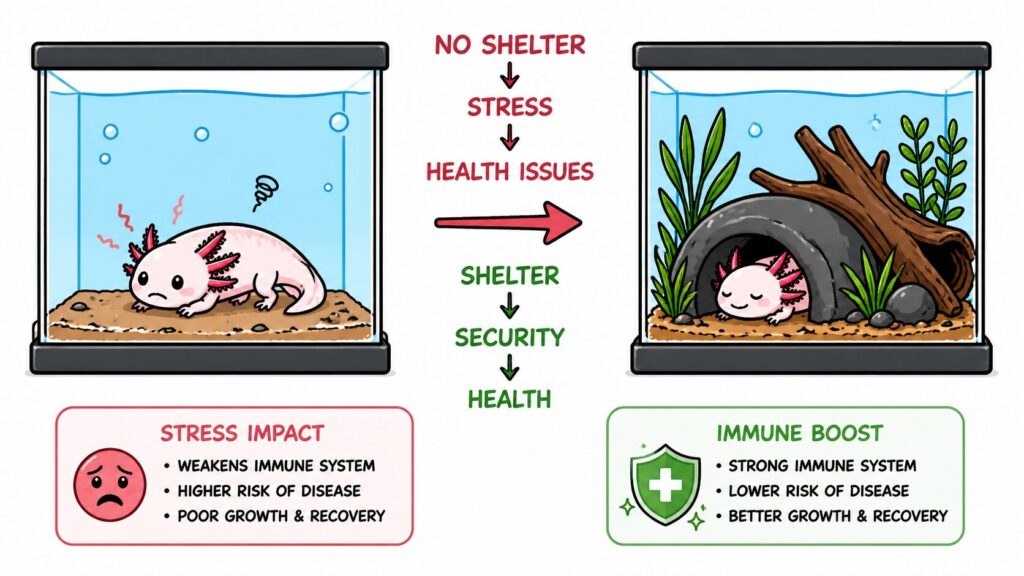
In the wild, axolotls are not open-water animals — they spend the majority of their time sheltered, resting beneath or between objects on the lakebed, emerging primarily at dusk and dawn to forage. Without adequate shelter in a captive tank, axolotls experience chronic stress from sustained exposure with nowhere to retreat to. This stress suppresses immune function and over time contributes to gill degradation, skin problems, and susceptibility to fungal infections — the same conditions that require methylene blue and aquarium salt treatments. Research published in Aquaculture has consistently documented that environmental enrichment — including hides and structural complexity — reduces cortisol-driven stress responses in captive aquatic salamanders and improves long-term health outcomes.
Good axolotl tank decor is therefore not optional. It is part of responsible husbandry. At minimum, every axolotl needs at least one hide large enough to shelter its full body. Beyond that minimum, a well-decorated tank that includes multiple shelter options, some visual interest, and appropriate plant cover creates a genuinely enriched environment that benefits the animal’s quality of life over its full lifespan.
What Makes Axolotl Tank Decor Safe?
Before getting into specific product categories and picks, it is important to understand what makes a decoration axolotl-safe — because not everything sold as “aquarium decor” meets the requirements for an axolotl specifically.
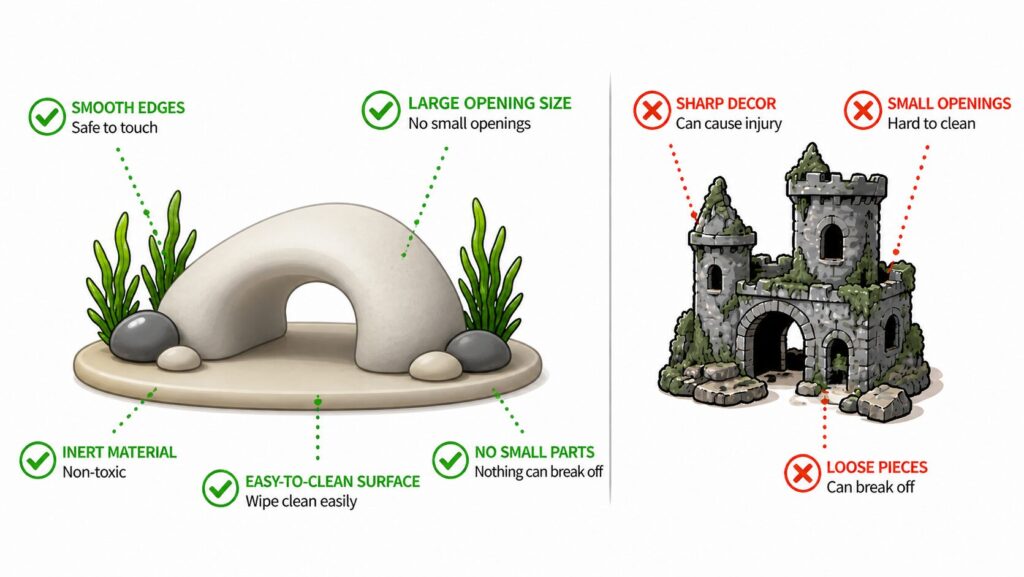
Smooth, rounded edges with no sharp points. Axolotls are soft-bodied animals with delicate, permeable skin and exposed external gill plumes. Sharp or rough edges on decor can cause lacerations and abrasions that open the door to bacterial and fungal infection. Every piece of decor that an axolotl might walk on, brush against, or retreat into must have smooth, polished edges and no protruding sharp points. Always run your fingers across every surface of a new decoration before adding it to the tank — if it snags your skin, it will damage your axolotl’s gills.
Aquarium-safe, inert materials. Decor must be made from materials that will not leach chemicals, alter water chemistry, or degrade in cold freshwater over time. Approved materials include: aquarium-grade resin (BPA-free, pH-neutral), unglazed ceramics, natural inert stone (slate, granite, smooth river stone — not calcareous rocks like limestone or marble which raise pH), untreated driftwood (which releases tannins — see our best axolotl indian almond leaves guide for context on beneficial tannins), and silk or plastic artificial plants made from aquarium-safe materials.
Large enough entrance openings for adult axolotls. This is one of the most common decor mistakes — buying hides or caves that look great but have openings too small for an adult axolotl to comfortably enter and exit. An adult axolotl can reach 9–12 inches in length and a body width of 2–3 inches. Any hide or cave opening should allow the axolotl to enter and reverse out without squeezing, stress, or risk of getting stuck. Always check dimensions before purchasing.
No loose, small parts. Anything small enough for an axolotl to accidentally ingest during its powerful suction feeding strike is a risk. Decorations with small attached pieces, beads, spikes, or components that can detach must be avoided. Axolotls are not selective — they strike at anything that moves or smells interesting near their mouths, and they will ingest small objects accidentally.
Easy to clean. Axolotl tanks require regular maintenance — as detailed in our guides on how to clean an axolotl tank and how often to clean an axolotl tank. Decor with complex internal geometry, narrow hidden passages, or porous textures that trap waste and cannot be cleaned with a turkey baster or siphon creates maintenance headaches and water quality problems. Simple, smooth-surfaced decor is always easier to maintain than complex, heavily textured pieces.
Categories of Axolotl Tank Decor
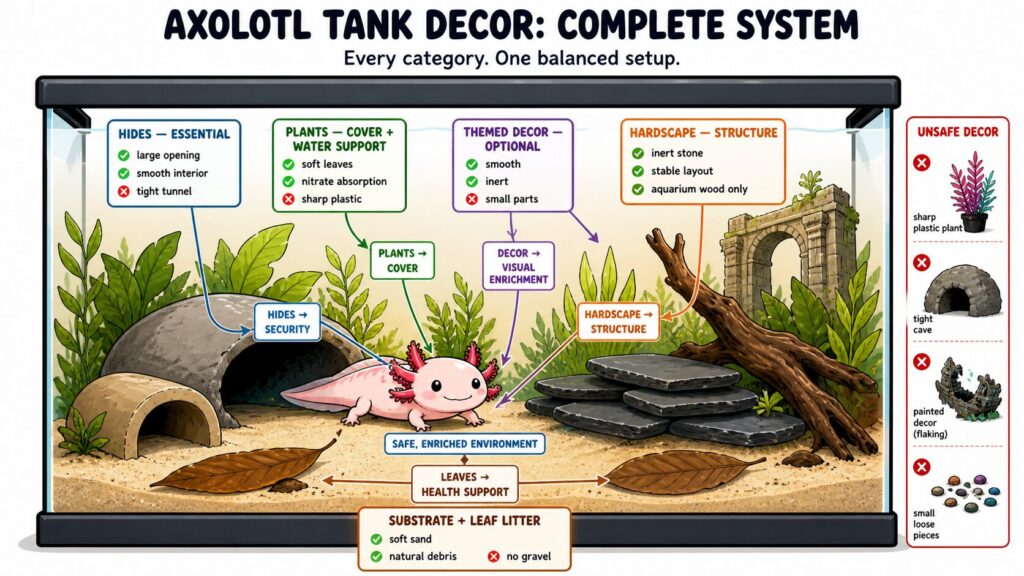
Hides and Caves — The Non-Negotiable Foundation
Every axolotl tank needs at least one hide, and ideally two — one on each side of the tank for an axolotl that may want to shift its resting spot. Hides are the most functionally important category of decor in an axolotl tank. For dedicated coverage, see our full guides on best axolotl hides and best axolotl caves.
The key requirements for an axolotl hide are: large enough entrance opening for the full body, smooth internal surfaces, inert aquarium-safe material, and a shape that allows an axolotl to comfortably reverse out without turning around (since axolotls are not flexible enough to turn in tight spaces). A hide that an axolotl can enter but cannot exit creates a serious entrapment risk.
Natural Hardscape — Rock and Driftwood
Large, flat pieces of natural inert stone — slate, smooth river stone, granite — are some of the most attractive and functional decorations you can add to an axolotl tank. They provide flat resting surfaces, create visual interest, contribute structural complexity, and are completely inert in freshwater. Pair them with fine sand substrate for a naturalistic, Xochimilco-inspired aquascape. Our best axolotl tank sand and best axolotl tank tiles guides cover substrate options that pair beautifully with natural hardscape.
Driftwood is a popular aquarium decoration that releases tannins into the water as it leaches — creating the amber-tinted “blackwater” environment that many experienced keepers find beneficial for axolotl stress reduction and skin health. Always use aquarium-safe, treated driftwood from a reputable supplier rather than wild-collected wood that may carry parasites, pesticides, or organisms harmful to axolotls.
Plants — Live or Silk
Plants are essential for creating a visually complete and environmentally enriched axolotl tank. They provide natural hiding spots between plant stems and leaves, contribute to a more naturalistic aesthetic, and in the case of live plants, improve water quality by absorbing nitrates. Our dedicated guide to the best axolotl tank plants covers the best cold-water species in detail.
Silk plants — artificial plants made from soft fabric rather than hard plastic — are an excellent alternative to live plants for keepers who do not want to manage live plant care. They are safe for axolotl skin and gill plumes in a way that stiff plastic plants are not, and they look realistic enough to create a genuinely attractive aquascape. Hard plastic plants with sharp moulded edges are not appropriate — they can lacerate gill plumes.
Indian Almond Leaves
As discussed in our best axolotl indian almond leaves guide, dried catappa leaves on the tank floor serve as both a functional health supplement and a natural, beautiful decorative element. As they soften and settle into the substrate they create an authentic leaf-litter aesthetic that closely mimics the organic debris of natural axolotl habitat — particularly appropriate given how closely the Xochimilco lakebed resembles a rich organic substrate environment.
Themed Decorative Items
Many keepers enjoy adding themed resin decor — ruins, sculptures, wooden structures, and other decorative pieces — to create personality and visual interest in their axolotl tank. These can be entirely appropriate as long as they meet the safety requirements above: smooth edges, inert materials, no small detachable parts, and appropriate opening sizes. The wide range of axolotl morphs available in captive breeding means different colour axolotls look stunning against different decor aesthetics — a pale leucistic or golden albino axolotl against dark slate and moody driftwood is a genuinely beautiful display combination.
What Decor to Avoid in an Axolotl Tank
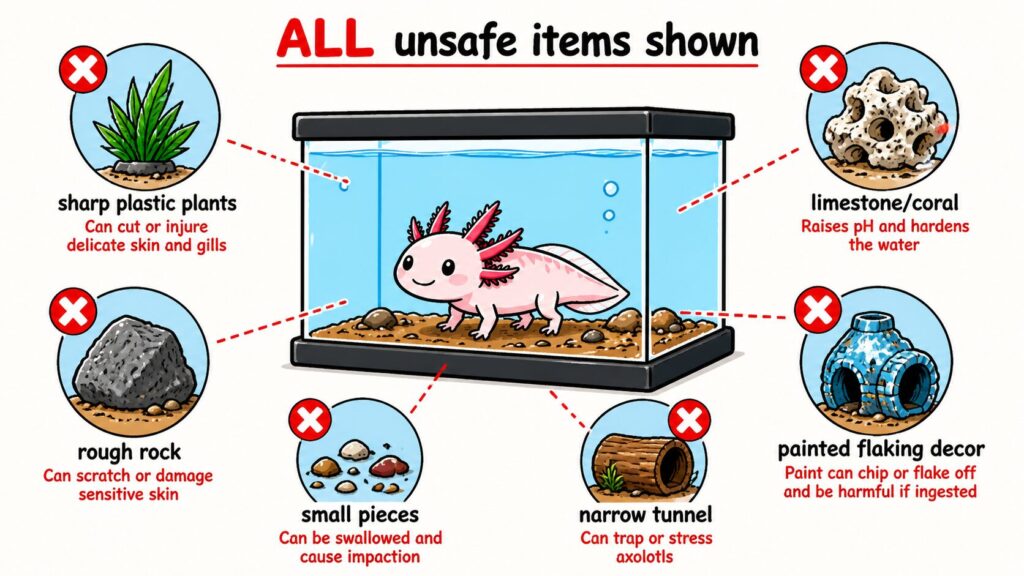
Sharp plastic plants. Hard plastic aquarium plants with moulded edges, rigid stems, and pointed tips are one of the most common causes of gill plume injury in axolotl tanks. Always choose silk plants over hard plastic ones.
Calcareous rocks (limestone, marble, coral skeleton). These rocks raise water pH and hardness significantly, disrupting the stable water chemistry your axolotl needs. They also break down slowly over time, releasing calcium that progressively alters your water parameters. Stick to silicate rocks — slate, granite, quartz-based river stone.
Painted or coated decorations with unstable finishes. Some aquarium decorations use paints or coatings that chip, flake, or dissolve over time in water. Ingested paint or coating material is potentially toxic. Always choose decorations with stable, cured finishes from reputable aquarium brands.
Very small decorations with many small parts. Tiny ornaments, small figurines, and any decoration with protruding beads, spikes, or attachable components are swallowing hazards.
Decorations with very rough or abrasive surfaces. Rough lava rock, volcanic stone, and any highly abrasive surface in areas where your axolotl regularly walks or rests will cause microabrasions that allow bacterial entry.
Sealed, narrow-entry tunnels. Hides with only one small opening that an axolotl can enter but not reverse out of, or tunnels sealed at one end, risk entrapment. Always verify that any tunnel or cave has a safe exit.
Our Top Axolotl Tank Decor Picks
Best Complete Starter Decor Set: Axolotl Tank Accessories Set with Resin Rock Cave and 2 Artificial Plants
The Axolotl Tank Accessories Set with Resin Rock Cave Hideout and 2 Artificial Plants is explicitly designed for axolotl tanks and provides everything a new keeper needs to get their tank decorated in a single purchase. The set includes a resin rock cave hideout — natural-looking, smooth-edged, and aquarium-safe — alongside two artificial plants that add visual depth and additional natural shelter. The rock cave mimics a natural stone hideaway and is sized for small to medium axolotls. The artificial plants are soft enough to be safe for axolotl gill plumes. This set is a practical, attractive starting point for a new axolotl setup.
Best Functional Hide with Silk Plants: Axolotl Hide Tube and 2 Artificial Plants Aquarium Decor Set
The Axolotl Hide Tube and 2 Artificial Plants Aquarium Decor Set pairs a dedicated axolotl hide tube with two soft artificial plants in one set. The hide tube design is specifically suited to axolotls — it provides a dark, enclosed retreat space with openings at both ends, allowing the axolotl to enter from one side and exit from the other without needing to reverse in a tight space. The two soft artificial plants add natural-looking greenery at each side of the hide. The entire set is made from aquarium-safe materials confirmed for axolotl use, and the soft plant leaves will not damage gill plumes. This is a strong decor bundle for keepers who prioritise functional enrichment.
Best Natural Hardscape: Natural Slate Stone Aquarium Pieces (8–10 Inch, USA Sourced)
As we recommended in our best axolotl tank substrate and best axolotl tank tiles articles, the Natural Slate Stone Aquarium Decorations (8–10 Inch Pieces) are the best natural hardscape option for axolotl tanks. Large, flat, inert, and aquarium-verified, these pieces create a beautiful naturalistic aquascape when arranged as a combination of ground cover and stacked accent pieces. They provide non-slip walking surfaces, partial shade, and resting ledges that axolotls use readily. The dark grey slate colour creates stunning visual contrast against pale axolotl morphs like leucistic and golden albino varieties.
Best Corner Hide Tunnel: Axolotl Hide Corner Fish Tunnel (Various Colours)
The Axolotl Hide Corner Fish Tunnel is a handmade aquarium-safe tunnel specifically designed and named for axolotl use. Its corner design tucks neatly into the back corner of a tank, occupying minimal floor space while providing a secure, enclosed sheltered area. The tunnel design — open at both ends — ensures axolotls can enter and exit without entrapment risk. It is available in natural, black, and white colourways, allowing you to choose the option that best suits your substrate and overall tank aesthetic. The black version pairs particularly well with pale sand and light-coloured morphs; the white version works beautifully against darker CaribSea Moonlight sand.
Best Decorative Cave Hide: PENN-PLAX Reptology Shale Scape Step Ledge and Cave Hideout (Medium)
The PENN-PLAX Reptology Shale Scape Step Ledge and Cave Hideout (Medium) is one of the most widely used and consistently praised cave decorations in the axolotl community. It is made from PENN-PLAX’s proprietary safe resin material — the same brand used in hundreds of aquarium and terrarium decorations over decades — with a realistic shale texture and multiple level design. The base cave opening is wide enough for most adult axolotls, and the stepped ledge design creates multiple resting surfaces at different heights. The realistic grey shale appearance pairs naturally with slate hardscape and dark substrate for a cohesive natural aquascape. It is fully submersible, weighted to stay in place, and easy to clean with a siphon. PENN-PLAX is one of the most trusted names in aquarium decor — their products are confirmed aquarium-safe and widely distributed according to the PENN-PLAX product documentation.
Best All-in-One Decor and Hide Bundle: 90-Degree Corner Aquarium Tunnel Hide (Driftwood Style, Axolotl-Safe Resin)
The 90-Degree Corner Aquarium Tunnel Hide in Driftwood Style is a beautifully realistic resin cave that explicitly names axolotls as a target species. Its driftwood aesthetic creates a natural, organic look that blends seamlessly into any planted axolotl aquascape. The wide tunnel openings make it accessible for small to medium adult axolotls. The 90-degree corner configuration means it sits flush in any tank corner without wasted space, and the weighted resin base keeps it firmly in position on the substrate. For a keeper who wants the aesthetic of natural driftwood without the tannin release and maintenance of real wood, this resin alternative delivers the visual result cleanly.
Building Your Complete Axolotl Tank Decor Layout
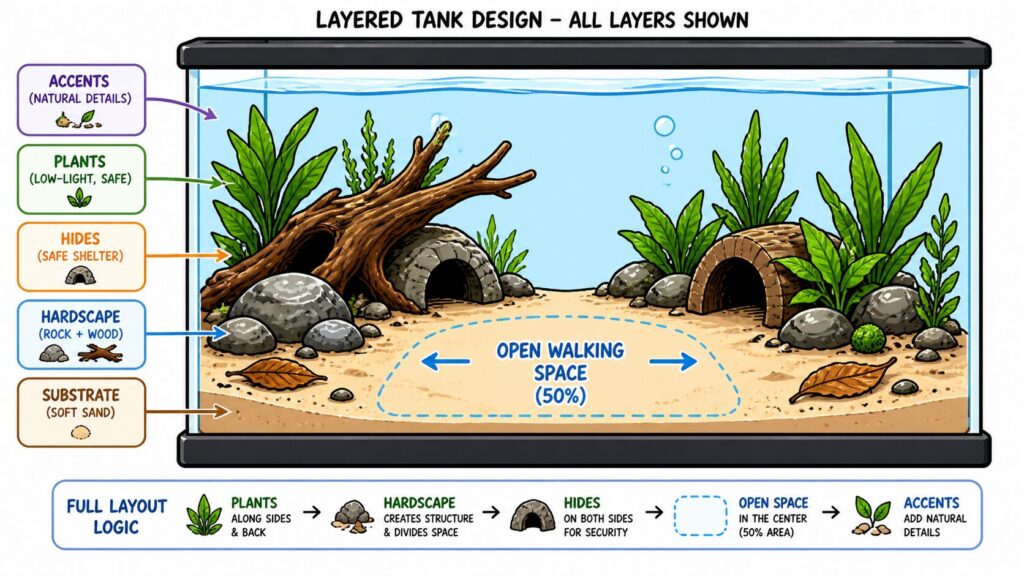
The best approach to axolotl tank decor is to think in layers: substrate, structural hardscape, functional hides, plants, and finishing accent pieces.
Start with your substrate — fine sand or tiles — as the foundation layer. Add your structural hardscape — slate pieces, driftwood, or smooth stone arrangements — to create the visual framework of the tank. Place your primary hides in sheltered corners or low-light areas where your axolotl is most likely to choose to rest. Then fill in with plants — live or silk — and any accent decor that adds personality without creating maintenance problems. Finish with Indian almond leaves scattered naturally on the substrate to complete the organic, natural-habitat look.
Leave enough open floor space for your axolotl to walk freely — a heavily over-decorated tank with no open floor space is as stressful as one with no decor at all. A rough guide is that decor should occupy no more than 40–50% of the tank floor footprint, leaving the rest as open walking space.
Consider lighting when planning your layout. As discussed in our best axolotl tank light guide, axolotls prefer dim conditions and appreciate areas of the tank that are naturally shaded by overhanging plants or decor. Designing your layout with a naturally shaded zone — where the axolotl can rest outside its hide in lower light — and a more open, slightly brighter zone gives your axolotl the ability to self-regulate its light exposure throughout the day.
Maintaining Your Axolotl Tank Decor
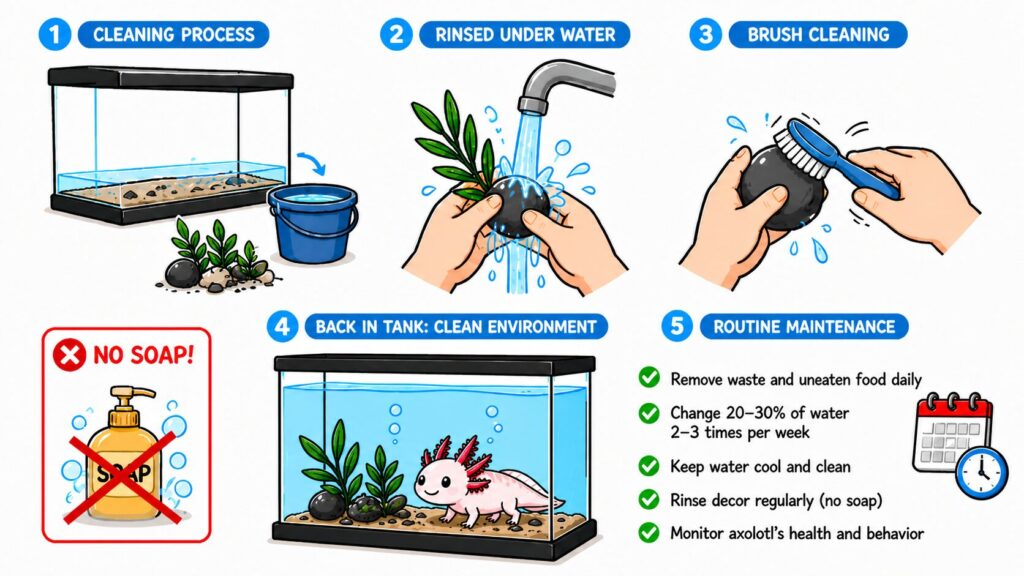
All decor in an axolotl tank accumulates algae, biofilm, and waste over time and requires periodic cleaning. Remove each piece during your periodic deep cleans and scrub with a clean brush under plain running water — never soap or detergent. Return to the tank and allow your filter to clear any released debris over the following 24 hours. During routine weekly water changes, use your turkey baster to remove visible waste around and behind decorations without disturbing the full layout.
Frequently Asked Questions
Do axolotls actually use hides? Yes, consistently. An axolotl without a hide will spend its time in the corner of the tank trying to find shelter. A well-placed hide is used daily, particularly during daylight hours when the axolotl naturally rests.
Can I use real driftwood in an axolotl tank? Yes, with caveats. Aquarium-safe, commercially prepared driftwood is fine. Wild-collected driftwood carries risks of parasites, pesticides, and organisms harmful to axolotls. Driftwood releases tannins that lower pH slightly — beneficial at moderate levels, but monitor your water test kit readings when first adding wood.
Are live plants safe with axolotls? Yes. Low-light cold-water species like Java fern, Anubias, and Hornwort thrive in axolotl tanks. Axolotls do not eat plants and do not significantly damage them. Plants improve water quality by absorbing nitrates. See our best axolotl tank plants guide for full species recommendations.
How many hides does an axolotl need? At minimum one, but two is better — one on each side of the tank. This allows your axolotl to shift its resting spot without competition for a single shelter. Two hides is also essential for housing two axolotls together, after first reviewing our guides on axolotl cannibalism and tank mate compatibility.
Does decor affect water quality? Decor with porous surfaces or complex internal geometry can trap waste and create localised areas of poor water quality. Smooth, easy-to-clean decor minimises this risk. Always maintain a cleaning routine that addresses the areas around and inside hides and caves.
An Axolotl That Feels at Home Is a Healthy Axolotl
The difference between a tank with no decor and a tank with thoughtfully chosen, well-placed decor is visible immediately in your axolotl’s behaviour. A sheltered, enriched axolotl spends more time in the open, explores confidently, eats well, and lives with the calm, unhurried energy of an animal that feels secure in its home. That security translates directly into better immune function, better gill health, and a longer, healthier life. If you want the complete keeper-tested resource for every product your axolotl depends on — from filtration and food to health supplies and every category of decor — Best Axolotl Products is your definitive guide to the best gear in axolotl care.