

Choosing the best axolotl water conditioner is one of those care decisions that costs very little but protects your axolotl every single time you do a water change. Tap water — the water most keepers use to fill and top up their axolotl tanks — contains chlorine and chloramines added by municipal water treatment to make it safe for human consumption. These same chemicals are directly harmful to axolotls and to the beneficial bacteria in your filter that keep your tank biologically safe. Without a water conditioner, every water change you perform is actively introducing chemicals that damage your axolotl’s gills and undermine your filtration. This guide covers everything you need to know about axolotl water conditioners — why they matter, what features to look for, how to use them correctly, and our top Amazon picks for every scenario. Pair this guide with our full axolotl care guide and our guides on the best axolotl filter and best axolotl water test kit for the complete picture on water quality management.
Why Axolotls Need a Water Conditioner for Every Water Change
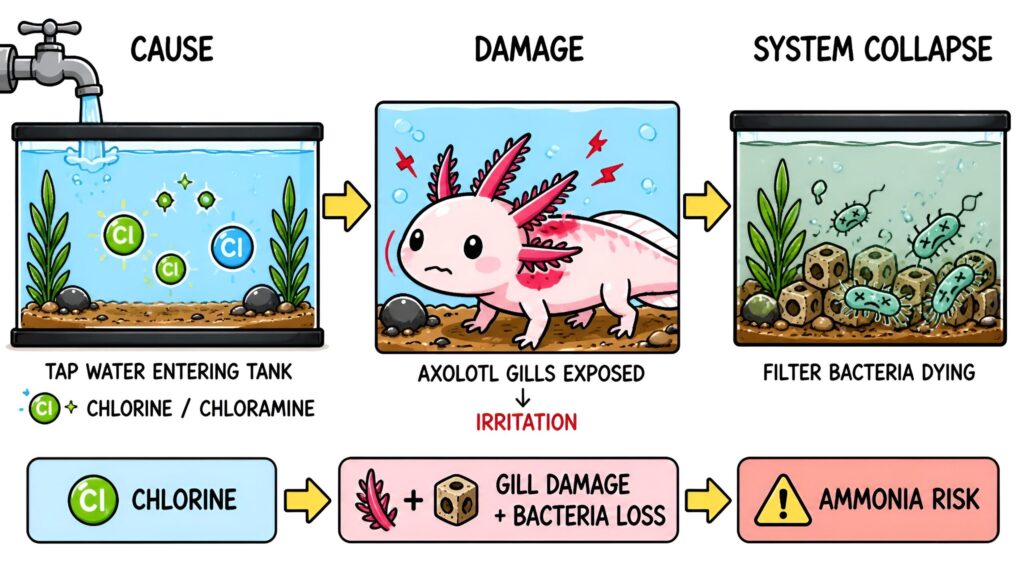
Axolotls are aquatic animals with permeable skin — they absorb substances directly through their skin and through their remarkable feathery external gill plumes, not just through their mouths. This makes them significantly more sensitive to water chemistry than most fish, where primary toxin exposure happens through ingestion. When chlorinated tap water contacts an axolotl’s skin or gills, it causes direct chemical irritation and damage to gill tissue.
According to the United States Environmental Protection Agency, municipal water systems in the United States treat drinking water with chlorine or chloramines to kill harmful bacteria and pathogens. While essential for human health, these disinfectants are toxic to aquatic life. Chlorine dissipates relatively quickly when exposed to air, but chloramines — the combination of chlorine and ammonia now used by most modern water treatment systems — are far more stable and do not off-gas with aeration alone. A water conditioner that neutralises both is therefore essential.
The second major issue is that chlorine and chloramines are directly toxic to the beneficial bacteria that live in your filter media and process ammonia from axolotl waste. According to research cited by the Water Research Foundation, even low concentrations of chloramine can suppress nitrifying bacteria significantly. This means untreated tap water added during water changes does not just harm your axolotl directly — it also undermines the biological filtration that keeps your tank chemistry stable.
Beyond chlorine and chloramines, tap water often contains heavy metals — copper, lead, and zinc leached from plumbing systems — at trace levels that, while safe for humans, are harmful to axolotls in a closed aquarium environment over time. Quality water conditioners neutralise these heavy metals as part of their formulation.
The wild axolotl (Ambystoma mexicanum) is critically endangered in its native Xochimilco lake system, and responsible captive husbandry of the species carries genuine conservation significance. Something as simple as properly conditioning every drop of tap water that enters your axolotl’s tank is a fundamental part of that responsibility.
What Makes the Best Axolotl Water Conditioner?
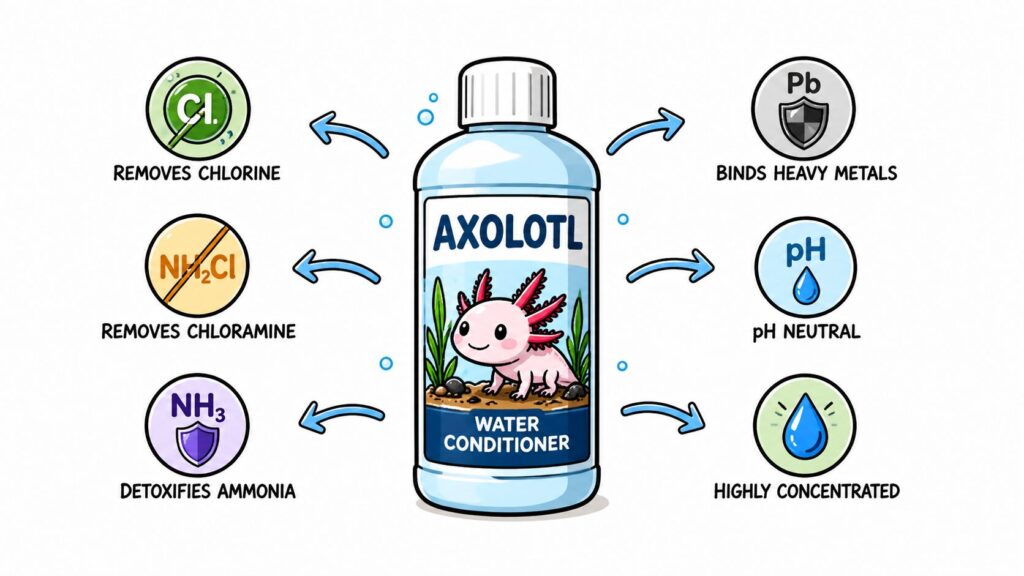
Neutralises both chlorine and chloramines. This is the most important functional requirement. Many budget water conditioners neutralise chlorine effectively but have limited efficacy against chloramines. Given that most modern municipal water systems use chloramine rather than chlorine alone — the EPA’s own guidance notes that chloramines are increasingly the disinfectant of choice in US water treatment — you need a conditioner that explicitly handles both. Always check the product label or description for chloramine neutralisation, not just chlorine removal.
Detoxifies ammonia and heavy metals. Premium water conditioners go beyond basic dechlorination by also temporarily binding and detoxifying ammonia and heavy metals in tap water. For axolotl keepers, the ammonia detoxification function is particularly valuable — it means that even if your tap water contains trace ammonia (common in some municipal systems where chloramines break down), the conditioner handles it before it enters your tank. Seachem Prime, the industry-leading conditioner, detoxifies ammonia for 48 hours while allowing the biofilter to remove it, which is directly beneficial during cycling and any period of elevated ammonia.
Highly concentrated formula. Concentration matters for practical and economic reasons. A highly concentrated conditioner requires only a few drops per gallon, meaning a single bottle treats enormous volumes of water and lasts for months or years of regular use. Dilute formulas cost more per treated gallon and need to be repurchased more frequently. Seachem Prime’s concentration — 5mL per 50 gallons — means a 500mL bottle treats approximately 5,000 gallons of water, making it one of the most cost-effective conditioners available.
Does not affect pH. Axolotls need stable, neutral to slightly alkaline water — ideally between pH 7.0 and 7.8. A water conditioner that shifts pH introduces unwanted chemistry variables into your tank. Quality conditioners are explicitly formulated to be pH-neutral. Always verify this on the product specifications.
Does not leave residue or additives harmful to axolotls. Some water conditioners marketed for fish include aloe vera and slime coat boosters. While these are generally safe for axolotls and can actually be beneficial for skin health, they should be verified as appropriate for amphibians specifically. All the products we recommend below have been used extensively and safely by the axolotl community.
Rapid action. A water conditioner should neutralise chlorine and chloramines immediately upon contact — within seconds of mixing with tap water. This means you can treat replacement water in a bucket, wait a moment, and add it to the tank without a delay period.
How to Use Water Conditioner Correctly for Axolotl Water Changes
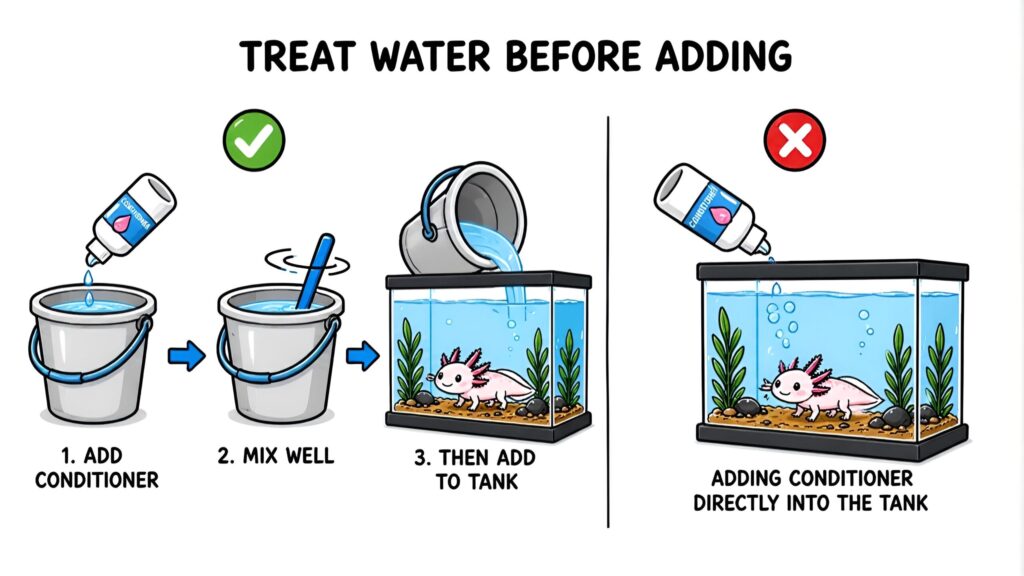
The correct application method for an axolotl water conditioner is to add the conditioner to your replacement water before it goes into the tank, not to the existing tank water. Mix the conditioner into the bucket or container of fresh tap water, wait a few seconds for it to work, then add the treated water to the tank. This ensures every drop of new water is fully treated before it contacts your axolotl or your filter.
The recommended dose for Seachem Prime — which is the standard — is 2 drops per gallon for normal use, or 5mL per 50 gallons of new water. For a standard 20–25% water change on a 40-gallon Aqueon breeder tank (approximately 8–10 gallons of replacement water), you need roughly 16–20 drops of Prime. Always dose based on the volume of new water you are adding, not the total tank volume.
Never skip the water conditioner. Not even once. Not even if you are in a hurry. Untreated tap water in your axolotl’s tank can harm gill tissue within minutes and begin killing filter bacteria within hours. A bottle of conditioner at your tank side makes compliance automatic. Incorporate it directly into your cleaning routine — our guides on how to clean an axolotl tank and how often to clean an axolotl tank walk through the full process.
Always monitor water parameters regularly with a reliable water test kit — conditioner use does not replace the need to track ammonia, nitrite, nitrate, and pH, particularly during the initial cycling period and after any significant maintenance.
Our Top Axolotl Water Conditioner Picks
Best Overall: Seachem Prime Fresh and Saltwater Conditioner (500mL)
The Seachem Prime Fresh and Saltwater Conditioner (500mL) is the single most recommended water conditioner in the aquarium hobby, and it has been the default choice among experienced axolotl keepers for decades. Its unmatched combination of features at a highly concentrated dosage makes it the clear best overall pick.
Prime immediately and permanently removes chlorine and chloramines. It simultaneously detoxifies ammonia, nitrite, and heavy metals found in tap water at typical concentration levels. The ammonia detoxification function is particularly valuable for axolotl keepers — Prime binds ammonia into a non-toxic form for 48 hours while allowing the biofilter to remove it naturally, which means it functions as both a conditioner and an emergency ammonia buffer. According to Seachem’s own product documentation, it is the only product that does all of this in a single dose without affecting pH or altering water chemistry in any other way.
At 5mL per 50 gallons, the 500mL bottle treats approximately 5,000 gallons of water — enough for well over a year of weekly water changes on a standard 40-gallon axolotl tank. This extreme concentration makes it extraordinarily cost-effective despite its slightly higher per-bottle price compared to budget alternatives. It is the conditioner that consistently appears in the recommendations of experienced keepers on established communities like Caudata.org, and it is the one we recommend keeping permanently stocked alongside your water test kit.
Best Large Format for Multi-Tank Keepers: Seachem Prime (2L)
For keepers running multiple tanks — a main display tank and a quarantine tub, or a breeder setup with multiple enclosures — the Seachem Prime 2L provides the same exceptional formulation in a much larger format with a significantly better cost-per-gallon ratio. A 2L bottle of Prime treats approximately 20,000 gallons of water. For any keeper doing regular water changes across multiple tanks, buying Prime in the 2L format is the most economical approach by a significant margin. The larger bottle is also practical — you refill a smaller dosing bottle from it and keep the large bottle stored, which makes daily use convenient.
Best Alternative: Seachem Prime (1L) — Middle Ground Between 500mL and 2L
For keepers who want more volume than the 500mL starter size but are not yet ready to commit to the 2L bulk format, the Seachem Prime 1L is the practical middle-ground option. It treats approximately 10,000 gallons of water — enough for roughly two years of standard weekly 20–25% water changes on a 40-gallon axolotl tank. Most experienced keepers who have been using Prime for any length of time end up moving to this size or the 2L as their default.
Best Runner-Up with Slime Coat Support: API Stress Coat Aquarium Water Conditioner (16oz)
The API Stress Coat Aquarium Water Conditioner (16oz) is a well-established alternative to Seachem Prime, particularly valued for its aloe vera formula that is scientifically proven to reduce stress by 40% and support healing of damaged skin and tissue. For axolotls that have experienced gill damage, minor skin abrasions, or handling stress during tank cleaning or health checks, the slime coat protection function of API Stress Coat provides additional support during recovery.
API Stress Coat removes chlorine, chloramines, and heavy metals effectively, though it does not provide the same ammonia detoxification buffer that Prime does. For keepers whose tanks are fully established and cycling correctly — where ammonia detoxification is not a pressing concern — API Stress Coat is a reliable and widely trusted conditioner. At 5mL per 10 gallons it is less concentrated than Prime, so it is used more quickly and requires more frequent repurchase, but it remains well-priced and is available virtually everywhere aquarium supplies are sold.
Best for Emergency Ammonia Management: Seachem Prime (500mL) Used at 5x Dose
This is not a separate product — it is an important function of Seachem Prime that every axolotl keeper should know about. According to Seachem’s published guidance, Prime can be dosed at up to 5 times the normal dose in an emergency situation to detoxify dangerous ammonia or nitrite levels for 48 hours while you address the underlying problem. If your water test kit ever shows a dangerous ammonia spike — during cycling, after a filter failure, or following a large uneaten food incident — a 5x dose of Prime is a critical emergency response tool that can buy your axolotl 48 hours of safety while you perform water changes and address the root cause. This function alone makes Prime the best axolotl water conditioner choice for any keeper who takes water quality seriously.
How Much Water Conditioner Do You Need?
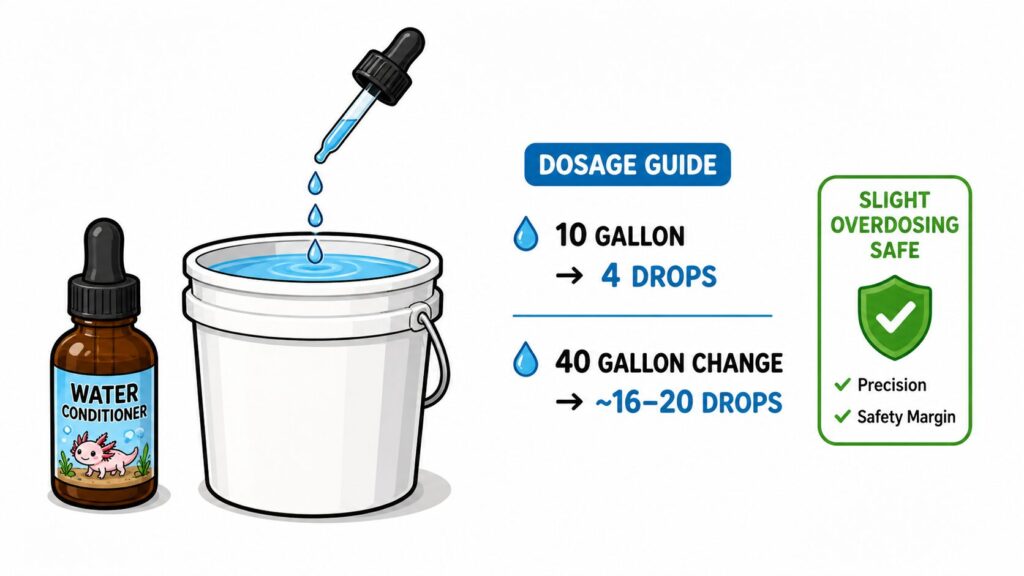
Dosage depends on the conditioner and the volume of replacement water. For Seachem Prime at the standard dose:
For a 10-gallon water change: approximately 4 drops (approximately 0.2mL) of Prime. For a 40-gallon tank with a 25% water change (10 gallons replaced): 4 drops. For a 55-gallon tank with a 25% water change (approximately 14 gallons replaced): approximately 6 drops.
The easiest approach is to use a small measuring cup or a pipette to measure consistent doses. Many experienced keepers keep a dedicated small dropper bottle decanted from a larger Prime bottle for precise daily dosing convenience. At Prime’s concentration, over-dosing by a small amount is not harmful — you can safely use up to 5x the normal dose without adverse effects on your axolotl.
Frequently Asked Questions
Do I really need to use water conditioner every time I do a water change? Yes, every time without exception. Tap water contains chlorine and/or chloramines on every occasion it comes from the tap. There is no situation in which untreated tap water is safe to add directly to your axolotl’s tank.
Can I just let tap water sit out to remove chlorine? Letting tap water sit exposed to air for 24 hours does allow chlorine to off-gas, but it does nothing to remove chloramines — and most modern municipal water systems use chloramines rather than chlorine alone. Letting water sit is not a reliable substitute for a proper water conditioner in an axolotl setup.
Is Seachem Prime safe for axolotls specifically? Yes. Seachem Prime has been used safely with axolotls for decades and is the most consistently recommended conditioner in the axolotl-keeping community. It is pH-neutral and leaves no harmful residue.
Can I use water conditioner when cycling my tank? Yes, and you should. During cycling, your tank has no established bacteria to process ammonia, making Prime’s temporary ammonia detoxification function especially valuable. Using Prime during cycling allows the cycle to proceed while protecting your developing bacterial colony from the ammonia and nitrite spikes that occur.
How long does a bottle of Seachem Prime last for a 40-gallon axolotl tank? A 500mL bottle of Prime treats approximately 5,000 gallons of water. With weekly 25% water changes on a 40-gallon tank (approximately 520 gallons treated per year), a single 500mL bottle lasts roughly 9–10 years. In practice most keepers use slightly higher doses and top-up water as well, so expect 2–5 years of use per bottle. This makes it extraordinarily cost-effective.
Does water conditioner affect beneficial bacteria in my filter? No — dechlorinators like Seachem Prime protect beneficial bacteria by neutralising the chlorine and chloramines in new water before they can damage the bacterial colonies in your filter. Adding untreated tap water directly to your tank is what harms filter bacteria.
Should I dose conditioner based on the tank volume or the water change volume? Dose based on the volume of new water you are adding, not the total tank volume. The conditioner needs to treat only the new tap water being introduced.
Every Drop Counts
A water conditioner is the simplest, most inexpensive product in your entire axolotl care setup — and one of the most important. Every water change, every top-up, every drop of tap water that enters your axolotl’s home should pass through it first. If you want trusted, keeper-tested recommendations for every other product your axolotl relies on — from the tank itself to the food, hides, and health supplies — Best Axolotl Products is your complete guide to the best gear in every category of axolotl care.