
Origin And History
The Bohemian Spotted Dog has one of the most unusual and ethically complex origin stories of any breed in this series. It was not created for hunting, herding, guarding, or companionship. It was created as a laboratory animal, specifically designed for medical and scientific research by a Czech scientist who wanted a dog of consistent, predictable character that could be used repeatedly for experiments. The fact that what emerged from this utilitarian beginning is one of the most cheerful, sociable, and genuinely pleasant companion dogs in Czech cynological history is one of the more remarkable ironies in modern breed development.
The breed takes its name from the spotted tricolor coat that is its most immediately distinctive visual feature. In the Czech Republic it is known as the Český strakatý pes, meaning Czech Spotted Dog, and it was originally called Horákův laboratorní pes, Horák’s Laboratory Dog, after its creator. The two names encapsulate the breed’s entire history: a scientific creation that transformed, through the care of dedicated enthusiasts, into something the scientist who created it never intended.
František Horák was a Czech cynologist working in the laboratories of the Czechoslovak Academy of Science’s Institute of Physiology in Prague in the early 1950s. He wanted to create a dog that would be ideal for laboratory use, specifically for medical research into epilepsy, genetic illnesses, and transplants. The characteristics he sought were not the qualities a hunting or working breed enthusiast would specify. He needed a dog that was calm and gentle enough to allow repeated handling by different people, of suitable size for laboratory work, with a smooth coat for ease of examination, high fertility to maintain the laboratory population, low food consumption to reduce costs, and an easy-going nature that allowed the dog to change owners frequently without behavioral problems.
In 1954, he bred a sable-colored mixed breed female named Riga with a tricolored mixed breed male named Misi. Their exact ancestry is somewhat hard to trace, but the available evidence suggests a female similar to a German Shepherd and a male similar to a Smooth Fox Terrier. In the third generation of development, a German Shorthaired Pointer was crossed with their descendants to refine the type, and subsequent selective breeding produced a new breed with a brown coat and spotted markings that bred predictably.
The existence of the breed remained entirely secret from the public until August 27, 1961, when the dogs were shown at the National Working Dog Breeds Exhibition in Prague, their first public appearance. By the late 1970s, the Czechoslovakian Academy of Science reduced the number of experiments using the breed. In 1981, the remaining laboratory dogs were given to private breeders, and the first litter born outside the laboratory was produced that year. From that point, the breed was renamed the Bohemian Spotted Dog, and its new life as a companion animal began.
This transition proved more difficult than anticipated. Despite the promising start, the breed wasn’t accepted as well as expected by the Czech public, and the dogs were on the edge of extinction. A small group of enthusiasts discovered the breed’s history and, finding only about 11 dogs across all of the Czech Republic, undertook a revival effort. Another litter of pups was born in 1994, giving the breed new hope. As of 2022, approximately 600 Bohemian Spotted Dogs exist, making it one of the rarest recognized breeds in the world.
The breed is recognized by the Czech Kennel Club (ČMKU) but is not recognized by the FCI, AKC, or UKC. The community of breeders continues working toward eventual FCI recognition, which requires a minimum population and documentation of consistent type across multiple generations.
Breed Overview
| Trait | Details |
|---|---|
| Breed Group | Companion |
| Height | 40–52 cm (16–20 inches) |
| Weight | 14–20 kg (31–44 pounds) |
| Lifespan | 12–15 years |
| Coat | Two varieties: short smooth, and medium-length slightly wavy; both with undercoat |
| Colors | Tricolor: black-tan-white or brown-tan-white; white areas always ticked |
| Temperament | Cheerful, sociable, gentle, non-aggressive, playful |
| Czech Kennel Club Recognition | Yes |
| FCI / AKC Recognition | Not recognized |
Appearance And Size
The Bohemian Spotted Dog is a medium-sized companion dog of harmonious, balanced proportions that presents with a pleasant, non-intimidating appearance that accurately reflects its genuinely gentle character. The breed stands 40 to 52 centimeters at the shoulder and weighs between 14 and 20 kilograms. The overall impression is of a well-balanced, moderately built dog of attractive spotted appearance that carries itself with the cheerful, alert energy of a breed whose selection for good nature across generations has produced a dog that radiates genuine accessibility.
The head is medium-sized and well-proportioned, with a moderately broad skull and a muzzle of good length. The eyes are medium-sized, warm, and typically amber or brown, carrying the gentle, friendly expression that is one of the breed’s most immediately appealing physical qualities. The ears are set at the side of the head and hang in a pendant or semi-pendant position, covered with the coat and blending into the overall spotted appearance.
The body is slightly longer than it is tall, with a moderate chest depth, a level topline, and well-muscled hindquarters. The tail is medium in length and feathered, carried in a natural curve.
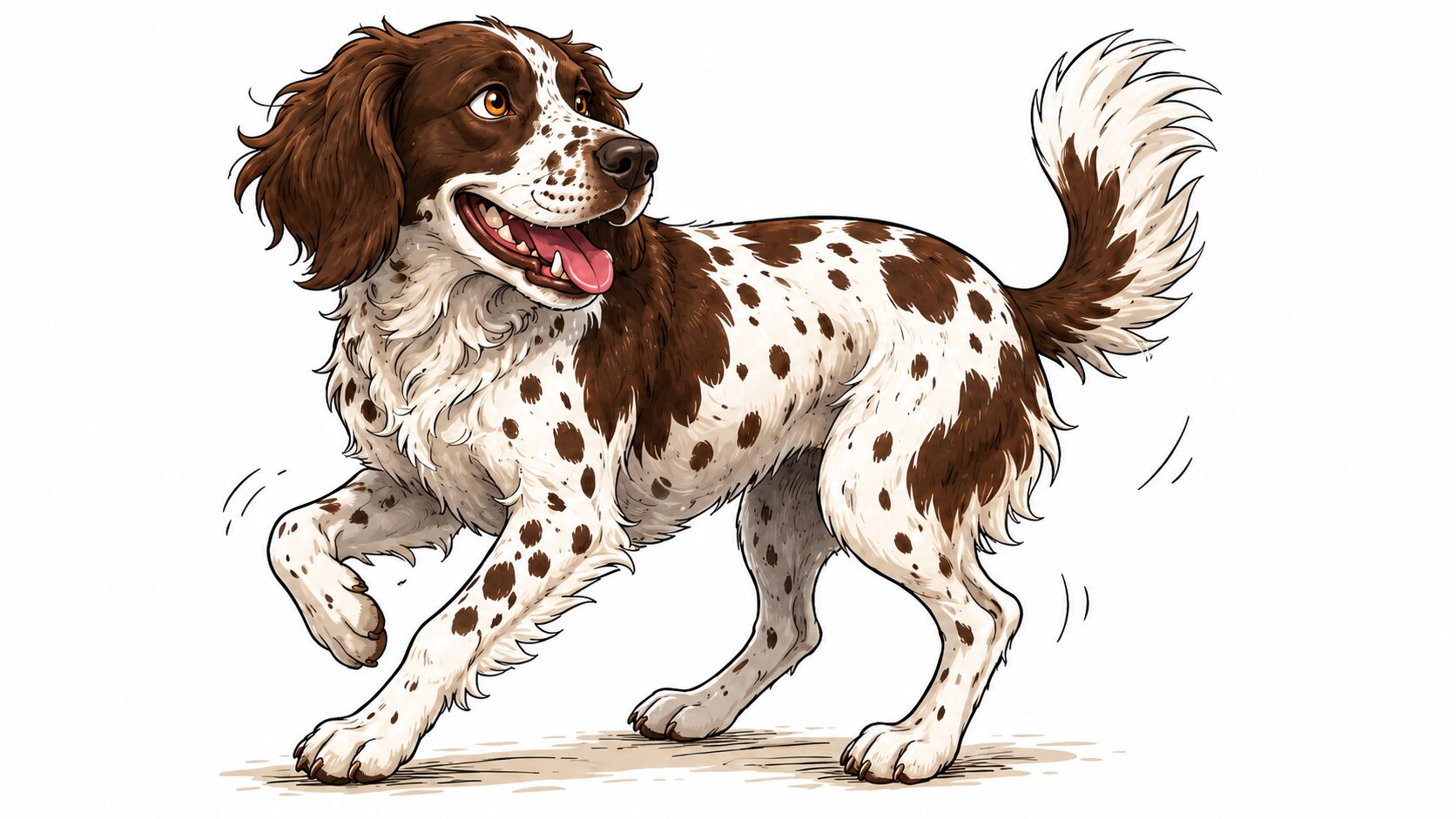
The coat exists in two varieties that are equally accepted within the breed standard. The short coat is close-fitting, layered with undercoat, and smooth across the body. The medium-length coat is flowing and only slightly wavy, with a somewhat more pronounced appearance around the neck and tail. Both coat types carry the same characteristic tricolor spotted pattern.
The color is the breed’s most immediately distinctive and most celebrated feature. The coat is always tricolor in one of two combinations: black-tan-white or brown-tan-white. The white areas of the coat are always ticked, meaning they contain small colored spots within the white field, giving a distinctive speckled appearance to the pale areas. The stippling of the ticking is distinctly individual to each dog and should not create the impression of mottled coloring, rather each tick mark should be clearly distinct. This individually specific ticking pattern makes each Bohemian Spotted Dog visually unique, producing one of the most distinctive and immediately recognizable coat appearances of any breed in Central Europe.
Housing And Living Requirements
The Bohemian Spotted Dog is one of the most genuinely adaptable breeds in terms of living environment, reflecting the selection criteria of its laboratory origin that specifically emphasized the ability to adapt to different handlers, different environments, and different living conditions. The breed adapts perfectly to all ways of life, and this assessment from the Czech Spotted Dog community is accurate and consistent with what the breed’s selection history produced.
Apartment living is genuinely workable for the Bohemian Spotted Dog provided daily exercise is consistently provided. The breed’s moderate size, calm indoor manner, and sociable character make it one of the more practically accessible medium-sized breeds for urban owners. A home with a garden is naturally more suited to the breed’s active, playful character, but the adaptability that was deliberately selected for across the laboratory years extends genuinely to varied domestic settings.
Inside the home, the Bohemian Spotted Dog is a warm, cheerful, and actively participatory companion that bonds closely with its family and expresses that bond through the playful, engaged presence of a breed that consistently seeks human interaction. The very sociable and non-aggressive character that was selected for medical laboratory purposes, ensuring that the dogs could be handled freely by many different people without stress or resistance, translates perfectly to a companion dog that is reliably pleasant in virtually every social context.
A comfortable dog bed in a social position suits the breed’s people-oriented nature during rest periods between active sessions.
Exercise Requirements
The Bohemian Spotted Dog is an active, energetic companion breed with genuine daily exercise needs that reflect the athleticism that was part of its original physical design requirements. A daily walk of 45 to 60 minutes combined with active play sessions is appropriate for most adults. The breed is more athletically capable and enthusiastic about physical activity than its companion dog classification might initially suggest.
The breed is known to be very active, making it good at sports such as agility and dog dancing. Dog agility suits the Bohemian Spotted Dog’s athleticism, intelligence, and handler-focused responsiveness particularly well, and Czech breed enthusiasts have found that the breed brings genuine capability and enthusiasm to competitive agility. The breed is also used in dog therapy work, where its calm, non-aggressive, and socially accessible character makes it an excellent therapeutic companion.
Puzzle toys and enrichment activities are genuinely important between structured outdoor sessions, engaging the breed’s intelligence and preventing the restlessness that develops in any active breed when mental stimulation is insufficient between exercise sessions.
Grooming Requirements
The Bohemian Spotted Dog’s grooming requirements vary between the two coat varieties but are manageable for either option. The short-coated variety requires weekly brushing with a rubber grooming mitt or firm bristle brush to remove loose hair and keep the coat in good condition. The medium-length coat requires brushing two to three times a week to prevent tangles in the slightly wavy outer coat and to manage the undercoat that both varieties carry.
Both coat varieties shed moderately throughout the year with heavier seasonal shedding during spring and fall. The ticked tricolor coat shows shed hair most visibly on dark-colored clothing and furniture, which is a practical consideration for prospective owners.
Bathing every six to eight weeks is appropriate under most normal conditions. Both coat types dry reasonably quickly after bathing, making the process manageable for a breed of this size.
The ears should be checked and cleaned weekly. The pendant ear carriage reduces airflow to the ear canal and creates some susceptibility to moisture accumulation, making regular inspection and occasional cleaning important preventive maintenance. Dental care should be established as a consistent routine from puppyhood. Nails should be trimmed monthly.
Diet And Nutrition
The Bohemian Spotted Dog is a medium-sized, active companion breed with daily caloric needs that should be matched to its actual size and activity level. A high-quality medium breed formula with a named protein source as the first ingredient provides the nutritional foundation the breed requires. The original laboratory selection criteria that included low food consumption as a desirable trait is somewhat reflected in the breed’s moderate dietary needs relative to some more intensely active breeds of comparable size.
Most adults do well on two measured meals per day. Portion control is important throughout the dog’s life, as the breed can gain weight when food quantities are not matched to actual activity levels. The breed’s limited gene pool, a consequence of its small population and the narrow founding base from which the modern population descends, means that maintaining appropriate weight and body condition is particularly important for preserving the joint health that its documented predispositions affect.
Training treats are effective motivators given the breed’s food motivation and its eager, responsive approach to training, and should be counted into the daily calorie total rather than added freely on top of full meals.
Compatibility
The Bohemian Spotted Dog is among the most comprehensively compatible breeds in terms of suitability across varied household compositions and social contexts. This is not a qualification based on selective observation or breed promotion: it is the direct consequence of deliberate selection for exactly this quality across the breed’s entire developmental history.
The laboratory selection criteria that František Horák applied specifically required a dog that was non-aggressive, easy for many different people to handle, adaptable to different environments, and able to change owners without behavioral problems. These qualities produced a breed that is, in the domestic context, genuinely one of the most socially accessible and reliably pleasant companions available.
With its own family, the breed is warmly affectionate, deeply loyal, and genuinely playful. The strong bond with family that is consistently noted across sources is real and expressed through the cheerful, involved, close-proximity companionship that this breed brings to every household interaction.
With children, the breed is excellent. Multiple sources specifically highlight the breed’s particular suitability with children, and the non-aggressive, patient, playful character that was bred into the laboratory dogs for their convenience translates perfectly to patience and gentle engagement with children of all ages.
With strangers, the breed is typically friendly and approachable, though it will bark at unfamiliar people at the door, making it a useful alarm dog despite its fundamentally friendly disposition. Early socialization from puppyhood ensures this natural alertness is expressed as appropriate discernment rather than anxious reactivity.
With other dogs, the Bohemian Spotted Dog is exceptionally sociable. The breed is very friendly towards people and other dogs and can live in a pack, reflecting the laboratory context in which groups of these dogs coexisted without conflict. With cats and other small animals, gradual introductions from puppyhood produce generally tolerant coexistence.
A dog crate is useful during puppyhood and the settling-in period.
Behavior And Temperament
The Bohemian Spotted Dog’s temperament is the most remarkable aspect of its story: a breed created specifically to tolerate handling by strangers, to accept being examined and studied by researchers it had never met before, to change owners without distress, and to remain calm and cooperative in contexts that most dogs would find profoundly stressful. The selection that produced these qualities was not gentle or particularly kind in its motivations, but its outcomes produced a breed of extraordinary social ease, genuine non-aggression, and cheerful adaptability that has earned it the description of one of its most easy-going, low-maintenance, and sociable dogs.
The cheerfulness is one of the most immediately and consistently noted qualities. The Bohemian Spotted Dog approaches its world with a positive, engaged outlook that reflects genuine contentment rather than the anxious people-pleasing of a breed that has been trained into compliance. The friendly, joyful, and loyal character that the Czech Spotted Dog community describes is authentic and reliably expressed across individuals of the breed.
The non-aggression is equally genuine and equally a product of deliberate selection. A breed created for laboratory use could not afford to be unpredictable or defensive, and the consistent selection across multiple generations for dogs that would accept handling from anyone without resistance has produced a breed in which aggressive behavior is genuinely rare and temperamentally atypical.
The breed is active enough to enjoy and benefit from vigorous exercise and sports, but calm enough indoors to be genuinely pleasant company during household downtime. This combination of field energy and domestic ease makes it one of the more balanced companion breeds in Central European cynology.
Training And Handling
The Bohemian Spotted Dog is an intelligent, eager-to-please, and fundamentally trainable breed that approaches training with the same open, cooperative engagement it brings to every other human interaction. The intelligence and adaptability that made it suitable for laboratory work translate directly into training responsiveness, and the breed’s food motivation and genuine desire to engage with its handler make training sessions highly productive.
Positive reinforcement methods are the appropriate and most effective approach. The Bohemian Spotted Dog responds to reward, to genuine engagement, and to training that feels collaborative rather than coercive. The same non-aggressive, socially accessible character that makes it such a pleasant companion also makes it sensitive to harsh handling, and positive approaches consistently produce better outcomes than confrontational ones.
The breed’s laboratory heritage, which specifically selected for dogs that were easy to care for and easy to train, means the Bohemian Spotted Dog is genuinely one of the more accessible breeds for owners who may be less experienced with working or herding breeds. It is an excellent companion for inexperienced owners, and this assessment reflects the breed’s genuine character rather than marketing language.
Early socialization from puppyhood is important for all dogs, and the Bohemian Spotted Dog is no exception, though its naturally sociable character means it typically takes well to broad early socialization. Training treats are highly effective motivators. A GPS tracker is worth considering for outdoor exercise management.
Health And Lifespan
The Bohemian Spotted Dog is a generally healthy breed with a lifespan of 12 to 15 years. However, the breed’s extremely small population, approximately 600 individuals worldwide as of 2022, creates the most significant health management consideration: the limited gene pool that results from so few founding animals and such a narrow population base.
The Czech Spotted Dog community and breed club are acutely aware of this challenge and have made responsible breeding practices that maximize the genetic diversity available within the small population the central focus of their breeding program. The community’s stated goal of achieving FCI recognition explicitly requires breeding functionally healthy dogs with a physical constitution and mentality typical for the breed, and genetic health management is central to that program.
Hip and Elbow Dysplasia Abnormal joint development causing pain, restricted movement, and progressive arthritis is documented in the breed, as it is in most medium-sized breeds generally. The limited gene pool makes the prevalence of any hereditary condition within the population more significant than in larger breed populations, and hip and elbow screening of all breeding animals is an important preventive measure. Maintaining appropriate weight throughout the dog’s life and discussing joint supplements with your vet as the dog reaches middle age are meaningful protective measures.
Genetic Diversity as Primary Health Concern The most significant health consideration for the breed as a whole is not a specific disease but the genetic narrowness of the population itself. Limited genetic diversity increases the risk that any deleterious recessive gene present in the founding population will express itself at higher rates than in broader gene pools. The breed community’s focus on responsible mate selection and on tracking hereditary conditions across all registered offspring is the most practically meaningful health management effort underway for this breed.
Ear Infections The pendant ear carriage creates some susceptibility to moisture accumulation and the bacterial and yeast infections that follow. Weekly inspection and occasional cleaning is the most practical preventive measure.
Generally Robust Constitution Sources consistently note that the breed has no major breed-specific health issues beyond those common to medium-sized dogs generally, and the selection for robust, healthy individuals that the laboratory context demanded has contributed to an overall constitution that is more sound than the breed’s origins might have suggested.
Routine preventive care, including regular vet check-ups, consistent dental hygiene, up-to-date vaccinations, and parasite prevention, provides the foundation for a healthy Bohemian Spotted Dog across its impressive lifespan.
Price And Availability
The Bohemian Spotted Dog is among the rarest breeds in the world by total population, and finding one outside the Czech Republic is an extraordinary challenge that requires direct engagement with the very small community of Czech breeders who maintain the breed. With approximately 600 individuals worldwide, the vast majority of them in the Czech Republic, this is a breed whose acquisition outside its homeland is genuinely exceptional rather than merely difficult.
Within the Czech Republic, prices from breeders reflect the breed’s companion dog rather than working dog context. The Czech Spotted Dog community maintains a breeder registry and welcomes inquiries from international buyers, though the logistics and costs of international export, health certification, and transport make the process complex.
The Czech Spotted Dog Community’s website is the most authoritative starting point for anyone seriously interested in the breed, providing information about the breed’s development, the breeding program, and contact information for the registered breeding community.
Adoption is not a realistic option outside the Czech Republic. The breed’s total global population is too small to support anything resembling an international adoption infrastructure, and the breed essentially does not appear in any international shelter or rescue context.
Conclusion
The Bohemian Spotted Dog began as a scientific project with no pretense of companion dog purposes and ended up as one of the most genuinely pleasant, most sociable, and most cheerful companion breeds in Czech cynology. The qualities that František Horák selected for his laboratory, calm acceptance of strangers, adaptability to different handlers, non-aggressive character, and reliable good nature, turned out to be exactly the qualities that make a companion dog extraordinary. The breed nearly disappeared twice, once when laboratory use ended and the dogs were transferred to breeders who found limited public interest, and once when that breeding community dwindled to fewer than a dozen dogs. Each time, a small group of dedicated enthusiasts recognized what was being lost and refused to let it happen. With approximately 600 individuals in the world today and a community working toward FCI recognition, the Bohemian Spotted Dog is no longer in immediate danger of extinction, but it remains one of the rarest breeds on earth. For the rare owner who finds one through the Czech breeding community and is willing to navigate the logistics of international acquisition, the Bohemian Spotted Dog offers a companion of remarkable social ease, genuine cheerfulness, and the kind of accommodating, warm temperament that its unusual scientific beginning accidentally made its defining quality. Get properly set up before bringing one home. Our Best Dog Products page has everything you need for cheerful, spotted, whole-heartedly sociable Czech companion dogs that carry one of the most unusual origin stories in the dog world into every home they grace.