

Finding the best axolotl cooling fan is one of the most practical and cost-effective ways to manage water temperature in your axolotl’s tank — particularly during summer months when keeping temperatures in the safe 60–68°F (16–20°C) range becomes genuinely challenging. While a full compressor-based water chiller is the most powerful and reliable cooling solution, a quality aquarium cooling fan can drop tank temperature by 3–7°F at a fraction of the cost, and for many keepers in mild climates that is all they need. This guide covers everything about axolotl cooling fans: how they work, what to look for, when they are and are not sufficient, and our top picks from Amazon. Pair this guide with our article on what temperature axolotls need and our full axolotl care guide for the complete picture on thermal management.
Why Temperature Management Is Non-Negotiable for Axolotls
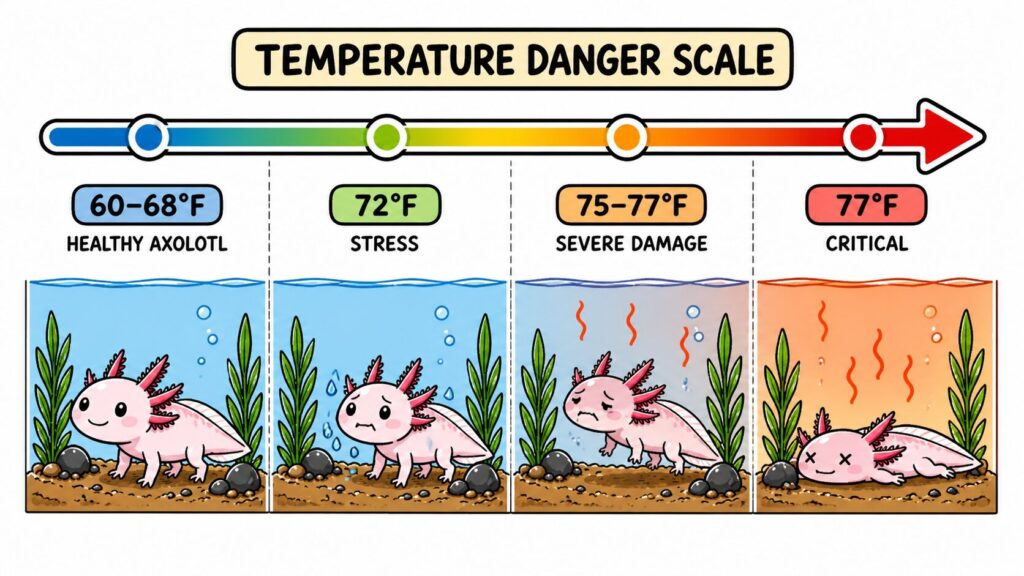
Axolotls are cold-water animals native to the high-altitude lake system of Xochimilco in Mexico City. Their physiology is calibrated to function within a narrow cool-water temperature band, and this is not something that can be ignored or managed casually. When water temperatures rise above 72°F (22°C), axolotls begin experiencing heat stress. When temperatures exceed 74°F (23°C) for sustained periods, immune function deteriorates, appetite disappears, and gill tissue begins to degrade. Above 77°F (25°C), survival time is measured in days.
According to the IUCN Red List assessment of Ambystoma mexicanum, the wild axolotl is critically endangered — meaning the captive population carries real conservation significance, and responsible husbandry matters beyond just the individual animal. Temperature management is one of the most fundamental aspects of that responsibility.
The challenge is real: many homes in summer reach ambient temperatures of 75–85°F (24–29°C), and even a well-shaded tank can climb rapidly in those conditions. The heat generated by filter motors and lighting adds further pressure. A cooling fan addresses this by accelerating evaporative cooling from the water surface. Understanding exactly how much cooling it can provide — and where its limits are — helps you decide whether a fan alone is sufficient or whether you need the additional power of a dedicated water chiller.
How an Axolotl Cooling Fan Works
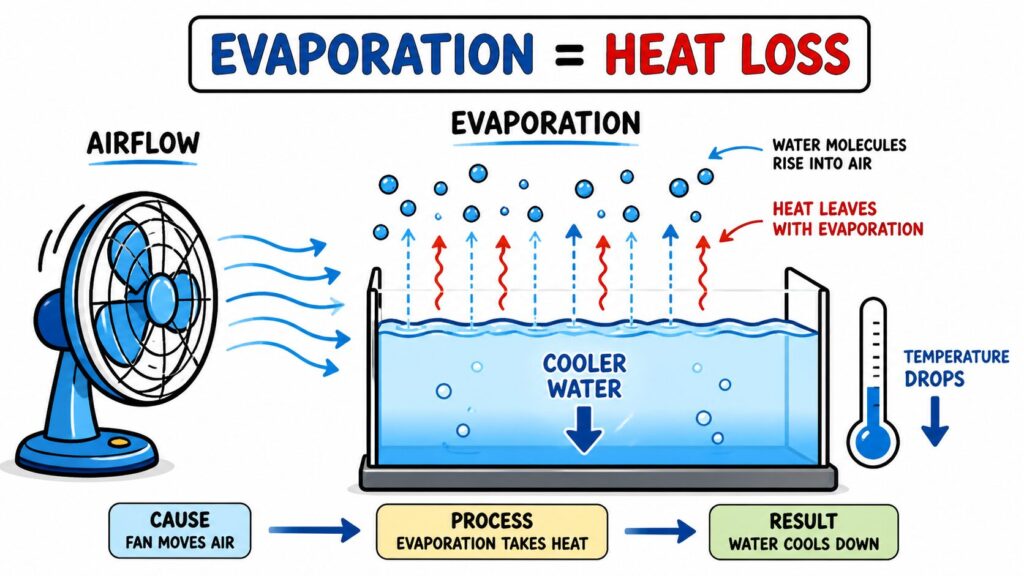
An aquarium cooling fan works through the principle of evaporative cooling. When a fan blows air across the surface of the water, it accelerates the rate at which water molecules escape into the air as vapour. Evaporation is an endothermic process — it absorbs heat from the liquid water as it occurs — so the water that remains becomes slightly cooler. The same principle explains why sweat cools your skin.
The amount of cooling achievable depends on several factors. The most important is ambient humidity: in a dry environment, evaporation occurs rapidly and cooling is significant — potentially 5–8°F in very low humidity. In a humid environment, the air is already carrying a lot of water vapour and cannot absorb as much more, reducing the cooling effect. In a very humid room in summer, a cooling fan may only drop tank temperature by 2–3°F. In a dry climate or air-conditioned room, the same fan might achieve 6–7°F of reduction.
The second factor is the fan’s airflow rate and coverage. Fans that blow across a wider area of the water surface produce more evaporation than small narrow-beam fans. Dual-fan designs that cover more of the tank surface consistently outperform single-fan designs on 40-gallon setups.
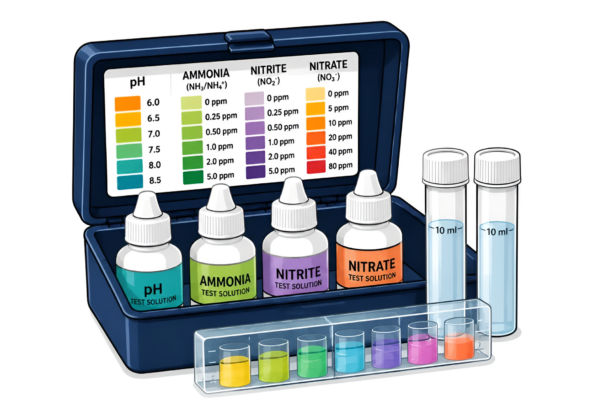
One important side effect of cooling fans to plan for is increased evaporation. A fan running continuously will evaporate water from your tank noticeably faster than normal — you will need to top up the tank with dechlorinated water more frequently to maintain the correct water level and avoid concentrating dissolved minerals. Pair this with your regular water conditioner routine and keep monitoring water parameters with a test kit to ensure evaporation is not affecting your chemistry.
Cooling Fan vs. Water Chiller — Which Do You Need?
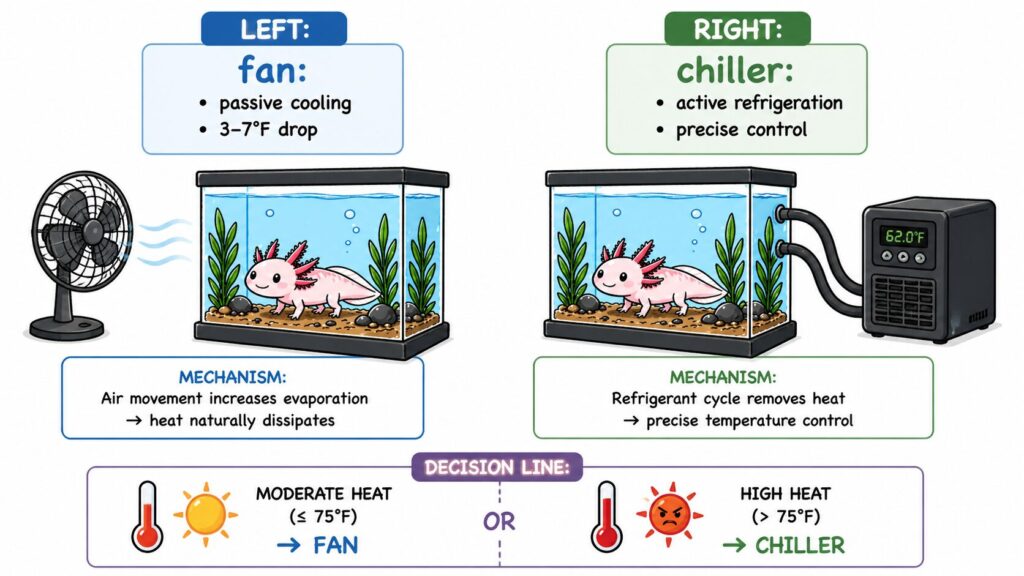
A cooling fan is the right choice when your ambient room temperature during summer peaks at around 77–80°F (25–27°C) or lower and your tank only needs a 3–6°F reduction to stay safely below 68°F (20°C). In these conditions, a quality dual-fan unit with auto temperature control will handle the job reliably and quietly at minimal cost.
A water chiller is the right choice when your ambient room temperature regularly exceeds 80°F (27°C), when humidity is high enough to limit evaporative cooling, or when you have previously run fans without achieving sufficient temperature reduction. A chiller works through active refrigeration rather than evaporation, so it is unaffected by humidity and can hold precise temperatures regardless of how hot the room gets.
For keepers who are unsure, start with a cooling fan at the beginning of summer and use a reliable tank thermometer to monitor water temperature daily. If the fan keeps you consistently below 68°F (20°C) even on the hottest days, it is sufficient. If you find the tank still climbing above 70°F (21°C) on hot days, a chiller is what you need.
What Makes the Best Axolotl Cooling Fan?
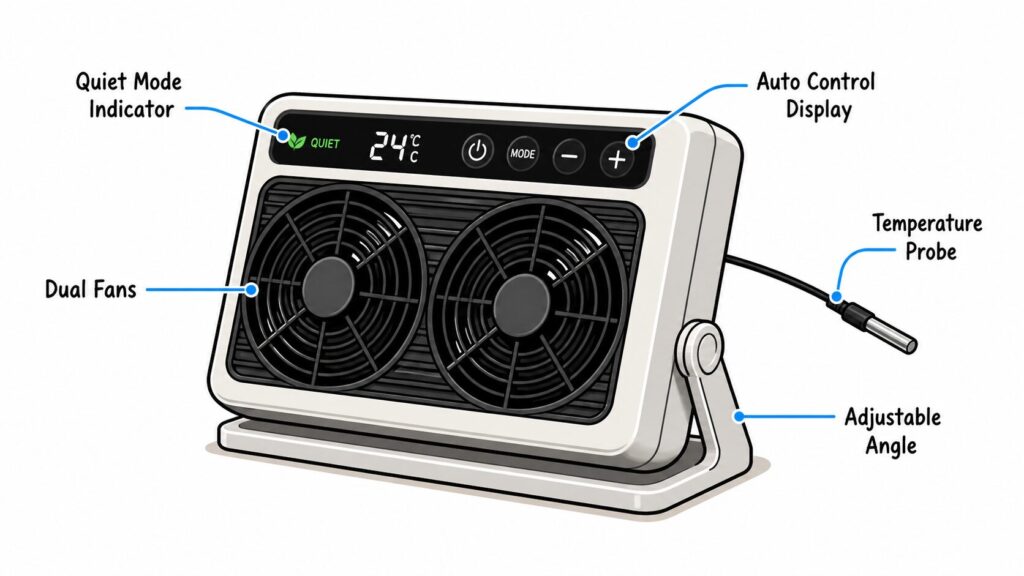
Auto temperature control with a probe. The single most useful feature on an axolotl cooling fan is an automatic temperature control system. Fans with a built-in temperature probe and a programmable thermostat run only when the water temperature exceeds your set target and switch off automatically when it drops back to the safe range. This prevents over-cooling and over-evaporation, saves electricity, and means you do not have to manually monitor and adjust the fan throughout the day. For axolotls, which need to stay within a fairly narrow band, auto temperature control is genuinely valuable rather than just a nice-to-have.
Dual fan heads for better coverage. A single fan head blowing across one area of the tank surface produces less total evaporation than two fans covering a wider area. On a 40-gallon breeder — 36 inches wide — a dual-fan unit covers substantially more surface area and produces meaningfully better cooling. For the standard Aqueon 40-gallon breeder that we recommended in our best axolotl tank article, dual fan heads are worth the marginal extra cost.
Adjustable speed with a quiet low setting. Axolotls are sensitive to vibration and sound. A fan that runs loudly at a single fixed speed is more stressful than a multi-speed fan that can be set to a quiet, low-vibration mode for overnight use. Look for fans with at least three speed settings, including a soft mode that operates at 35 decibels or below.
Adjustable angle. Being able to direct the fan at different angles across the water surface lets you optimise coverage for your specific tank and lid configuration. Fans with 45° or 180° adjustable angles give you much more flexibility than fixed-position units.
Compatibility with rimless and framed tanks. Axolotl cooling fans clip onto the rim or glass edge of the tank. Most fans come with adjustable clips that fit standard tank rim thicknesses up to about 12–15mm. If you are running a rimless tank — like the Landen low-iron glass tanks we mentioned in our best axolotl tank article — verify that the fan’s clip is compatible with the thinner rimless glass edge before purchasing.
Compatible with your lid setup. Aquarium cooling fans work best on open-top tanks or tanks where the lid has an opening at the back for the fan to blow through. If you are running a close-fitting glass lid — like the Aqueon Versa-Top we recommended in our best axolotl tank lid article — you will need to use the existing equipment cutout opening at the back of the lid as the fan’s airflow pathway, or modify the lid to create a larger opening. A polycarbonate lid that can be trimmed easily pairs much better with a cooling fan than a rigid glass lid. Our best axolotl tank lid guide covers this in detail.
Our Top Axolotl Cooling Fan Picks
Best Overall: AQUASMITH Aquarium Chiller Fan with Auto Temperature Control
The AQUASMITH Aquarium Chiller Fan is our top overall pick for axolotl keepers. It combines the features that matter most — a high-precision ceramic temperature sensor, an LED display showing both set and real-time temperature simultaneously, auto start/stop thermostat control with an adjustable range of 59–93°F, and three speed settings including a quiet soft mode — in a dual-fan unit that consistently earns strong reviews from axolotl keepers specifically. Its minimum temperature setting of 59°F means you can set it to hold your tank within the axolotl’s safe range without worrying about under-cooling. The 120° wide-angle air vents deliver airflow across a broader surface area than most competitors, improving evaporative cooling efficiency. The adjustable clip fits aquarium edges up to approximately 0.95 inches thick, covering the vast majority of standard framed tanks. For keepers running the Aqueon 40-gallon breeder in a room that reaches up to 79–80°F in summer, this fan is very likely to hold tank temperature within the safe range. Always verify with a separate thermometer.
Best with Smart Auto-Control and LCD Display: PAIZOO Aquarium Chiller Fan with Temperature Probe and LCD Display
The PAIZOO Aquarium Chiller Fan with Temperature Probe and LCD Display is a strong alternative for keepers who want a larger, more visible LCD display for monitoring tank temperature at a glance. It features dual pure copper brushless motors running at up to 3,600 RPM each, a high-precision temperature probe, auto start/stop temperature control, three speed settings, and a 120° wide-angle airflow design. The set temperature range is 50–99°F, which covers the full axolotl-safe range with comfortable margin. The copper brushless motor design is more durable and generates less heat than standard motors, which is an advantage for a device running continuously through a summer. Its 7W power draw is efficient and the USB-compatible power cable keeps installation clean.
Best Budget Option: PAIZOO Aquarium Chiller Fan (3-Speed, No Probe)
For keepers who want a reliable dual-fan cooling unit at the lowest possible price point, the PAIZOO Aquarium Chiller Fan with 3 Speed Modes is a solid choice. It uses the same dual turbo fan design with pure copper motors as the probe version but without the automatic temperature control. You set the speed manually and monitor temperature yourself with a separate thermometer — which you should be doing anyway with any cooling solution. It is USB-powered, quiet on its soft setting, and specifically cited by axolotl keepers in reviews as effective for summer cooling in standard 20–40 gallon setups. For keepers comfortable monitoring temperature manually and looking to minimise upfront cost, this is the practical pick.
Best for Flexibility and Timer Control: hygger Aquarium Cooling Fan (2-Fan) with Adjustable Speed and Timer
The hygger Aquarium Cooling Fan 2-Fan with Adjustable Speed and Timer is an excellent choice for keepers who want the ability to schedule their fan’s operation around their axolotl’s daily routine. It features four speed settings (20%–50%–75%–100%), eight timer options ranging from 2 to 22 hours, and compatibility with external temperature controllers if you want to add thermostat control later. The hygger fan is specifically noted for compatibility with aftermarket temperature controllers — you can bypass the included controller entirely and run it through a separate thermostat device for fully automated temperature management. This makes it particularly versatile for keepers who already have a temperature monitoring and control setup and want a fan that integrates cleanly into it. It clips on to standard framed tank rims and covers a 40-gallon breeder width well with the two-fan configuration.
Best with Auto-Temperature Control and Timer Combined: Pawfly Aquarium Chiller Fan with Timer and Adjustable Angle
The Pawfly Aquarium Chiller Fan with Timer and Adjustable Angle is a well-rounded option that combines timer functionality with 180° adjustable angle adjustment — the widest range of any fan in this guide. This makes it particularly useful for keepers who need to direct airflow at a specific angle to work around their lid configuration or equipment layout. The timer offers 0.5h, 1h, 2h, 4h, and 12h options, letting you set scheduled cooling during the warmest parts of the day without running the fan overnight when temperatures naturally drop. It is quiet, lightweight, and straightforward to install with no tools required.
How to Use Your Axolotl Cooling Fan Effectively
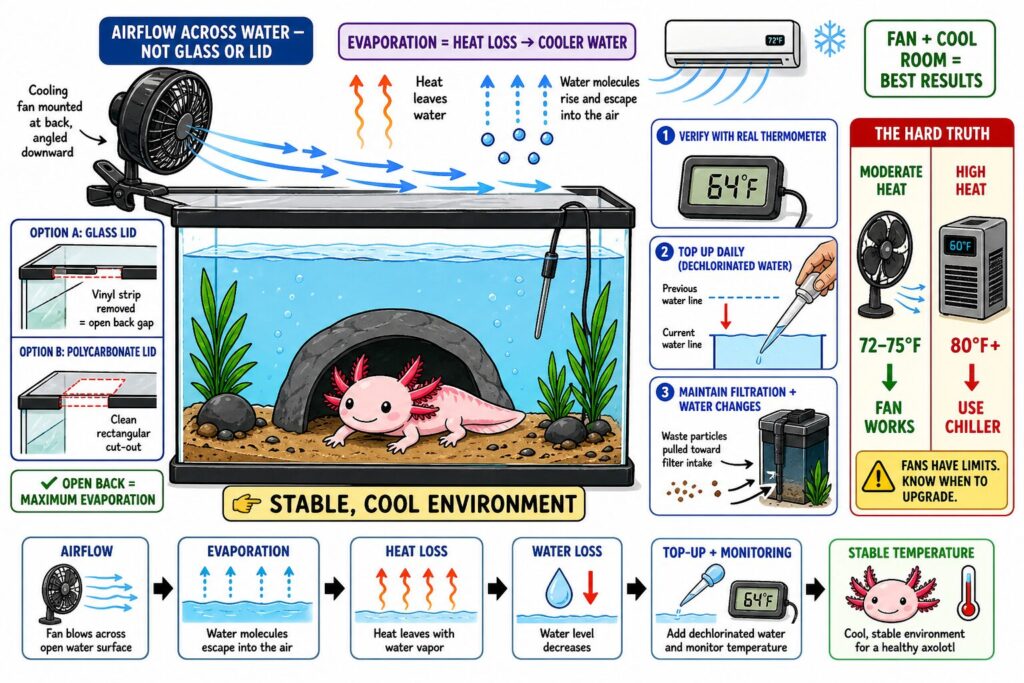
Getting the most out of a cooling fan requires a bit of attention to setup. The fan should be positioned to blow directly across the open water surface — not at the lid, not at the glass, but at the water itself. The more water surface the airflow makes contact with, the more evaporation occurs and the more cooling you get.
If you are running a closed glass lid, the most practical approach is to remove the vinyl back strip entirely and run the fan through the open equipment gap at the back of the lid. This gives a clear airflow path to the water surface. If you want better coverage, a polycarbonate lid — like the Sieral option we recommended in our best axolotl tank lid article — can be trimmed with a knife to create a custom-sized opening for the fan, which is far easier than modifying glass.
Run your fan alongside your existing cooling setup. If you are also running the room’s air conditioning, the combination of lower ambient temperature and active evaporative cooling from the fan is often enough to hold even warmer tanks within range. If you are not running air conditioning and your room regularly exceeds 80°F in summer, the fan is unlikely to be fully sufficient on its own and a water chiller is the more appropriate solution.
Monitor your water level daily when a fan is running. Evaporation is the mechanism that produces cooling, which means water is constantly being removed from your tank. Top up with dechlorinated water whenever the level drops noticeably. A consistent top-up routine prevents the concentration of dissolved minerals and waste products that can accompany significant evaporative loss. Use a turkey baster or a gentle pour to add water without disturbing substrate or decor.
Always verify actual water temperature with a separate thermometer rather than relying solely on the fan’s built-in probe. The best axolotl tank thermometer article covers reliable, accurate options. Even the best fans with temperature probes can have minor calibration offsets, and knowing your actual water temperature is what ultimately matters for your axolotl’s welfare.
Keep your filter running properly alongside your fan. Axolotls produce significant waste, and warm summer temperatures already put water quality under extra strain since beneficial bacteria work faster and waste breaks down more rapidly at higher temperatures. Stay on top of your water change schedule — our guides on how often to clean an axolotl tank and how to clean an axolotl tank will keep you on track.
Frequently Asked Questions
How much can an axolotl cooling fan lower the water temperature? In typical conditions, a quality dual-fan unit can drop water temperature by 3–7°F (2–4°C) depending on ambient humidity, room temperature, and water surface coverage. In dry, air-conditioned environments, the lower end of this range applies at the fan’s coolest setting; in dry climates with low humidity, cooling at the higher end of the range is achievable. In high-humidity environments, 2–4°F is more realistic.
Can a cooling fan alone be enough for an axolotl tank in summer? It depends on your climate. If your room stays below 77–80°F (25–27°C) in summer, a quality cooling fan is often sufficient to keep a 40-gallon axolotl tank below 68°F. If your room regularly exceeds 80°F, or if humidity limits evaporative cooling, a fan alone is unlikely to be sufficient and a water chiller is the more reliable choice.
Do I need to worry about the fan disturbing my axolotl? The fan itself sits outside the tank and produces no current inside the water. The only in-tank effect is gentle surface rippling from the airflow, which axolotls handle without any problem. The concern about current applies to filter output, not to cooling fans.
Does a cooling fan increase evaporation significantly? Yes — evaporation is the mechanism that produces the cooling. Expect to top up your tank with dechlorinated water more frequently, potentially daily in very hot conditions. This is a normal and manageable aspect of fan-based cooling.
Can I run a cooling fan and a water chiller at the same time? Yes, and some keepers do this in very hot climates. A fan reduces the load on the chiller, which means the compressor cycles less frequently and the chiller experiences less wear. This is a sensible approach for keepers who want maximum temperature stability with the best energy efficiency.
What is the best cooling fan for a 40-gallon axolotl tank? The AQUASMITH Aquarium Chiller Fan or the PAIZOO with LCD display and temperature probe are both strong choices for the Aqueon 40-gallon breeder, offering dual fans, auto temperature control, and coverage appropriate for the tank’s width.
Keep Cool, Keep Caring
Temperature is just one part of what makes a great axolotl keeper. Every product in your setup — from the substrate your axolotl walks on to the food it eats to the tools you use to keep things clean — contributes to how well your animal thrives day to day. If you want a complete, keeper-tested guide to every product category in axolotl care, Best Axolotl Products is your one-stop resource for everything your axolotl needs to live its best life.