
Finding the best axolotl feeding tongs is a straightforward search with a surprisingly meaningful impact on your feeding routine and your axolotl’s safety. Feeding tongs are one of the most used tools in axolotl keeping — they are how you deliver food precisely to your axolotl at tank floor level, how you retrieve uneaten food before it degrades your water quality, and how you keep your fingers safely away from your axolotl’s surprisingly powerful feeding strike. This guide covers everything: why feeding tongs are essential for axolotl keeping, exactly what features to look for, and our top verified Amazon picks for every type of setup. Pair this with our complete best axolotl food guide, our best axolotl turkey baster article, and our full axolotl care guide for the complete feeding and maintenance picture.
Why Feeding Tongs Are Essential for Axolotl Keepers
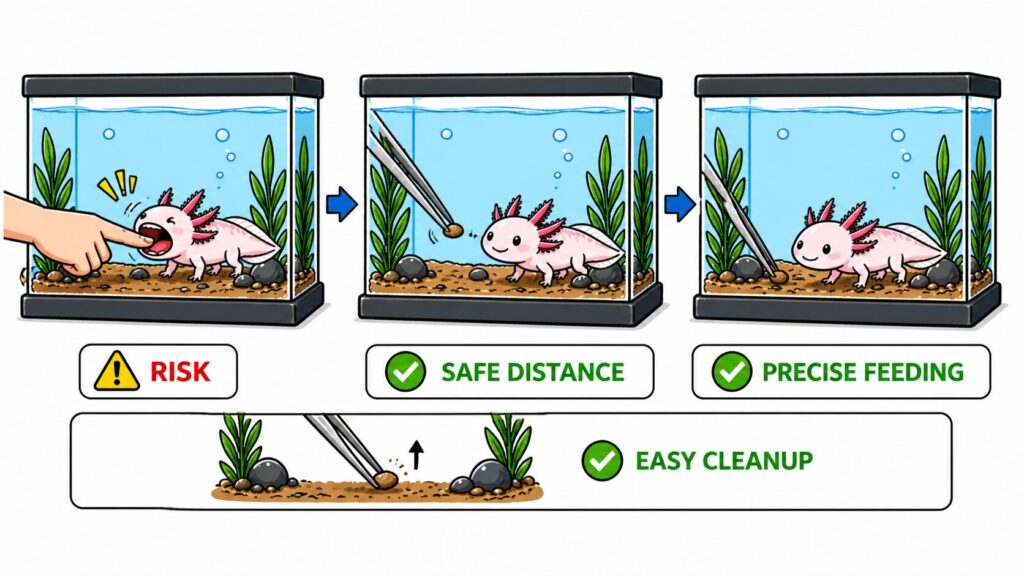
The feeding tong is one of those tools that seems optional until you try using it — and then you never go back to feeding without one. Here is exactly why tongs are essential rather than merely convenient for axolotl feeding.
Axolotls have a powerful feeding strike. Axolotls are carnivores that feed using a strong suction mechanism — they strike at prey rapidly, opening their wide mouths to create a pressure differential that inhales food along with surrounding water. This strike is non-discriminatory and instinctive. Fingers presented near an axolotl’s face during feeding will be struck at with the same enthusiasm as food. While an axolotl bite is not dangerous to a human adult, it is startling, it can cause the keeper to react suddenly in a way that injures the axolotl through handling stress or knocking the tank, and it puts the axolotl’s own health at risk if it bites down on skin and cannot immediately release. Feeding tongs keep your fingers at a safe distance from the strike zone.
Precise food delivery improves feeding success. When you use tongs to lower food to the tank floor directly in front of your axolotl — within detection range of their smell-sensitive nostrils — the strike rate is dramatically higher than dropping food from above and hoping the axolotl finds it. Axolotls have relatively poor eyesight and hunt primarily by smell and ground vibration. Food that lands in the wrong area of the tank may go undetected entirely. Tongs allow you to position food precisely at the axolotl’s nose level, increasing successful feeding and reducing the amount of food that is missed, uneaten, and left to foul the water.
Uneaten food retrieval is faster and cleaner. After a feeding session, any uneaten food must be removed within 30–60 minutes to prevent it from breaking down and spiking ammonia — a critical water quality concern covered in our guides on how to clean an axolotl tank and how often to clean an axolotl tank. Tongs allow you to retrieve a single rejected pellet or worm piece precisely and quickly without disturbing the rest of the tank. Compared to trying to guide a pellet toward a turkey baster tip, tongs retrieve individual pieces in a single motion.
Tongs trigger the feeding response more effectively than dropping food. The gentle wriggling motion that tongs allow — holding a worm piece and moving it slightly to mimic live prey movement — triggers the axolotl’s instinctive suction strike far more reliably than stationary dropped food. This is particularly important during diet transitions (getting a bloodworm-raised axolotl to accept pellets) and for axolotls that have temporarily lost appetite due to stress.
Safer for your axolotl than hand feeding. Repeated hand feeding increases the risk of ingested skin cells alongside food, creates a learned association between human hands and food that can cause biting during tank maintenance, and introduces a higher risk of accidentally dropping or startling an axolotl than controlled tong feeding does. According to Caudata.org, the longest-running online community for salamander and newt keepers, tong feeding is the universally recommended method for axolotl feeding among experienced keepers precisely because it eliminates these risks.
What Makes the Best Axolotl Feeding Tongs?
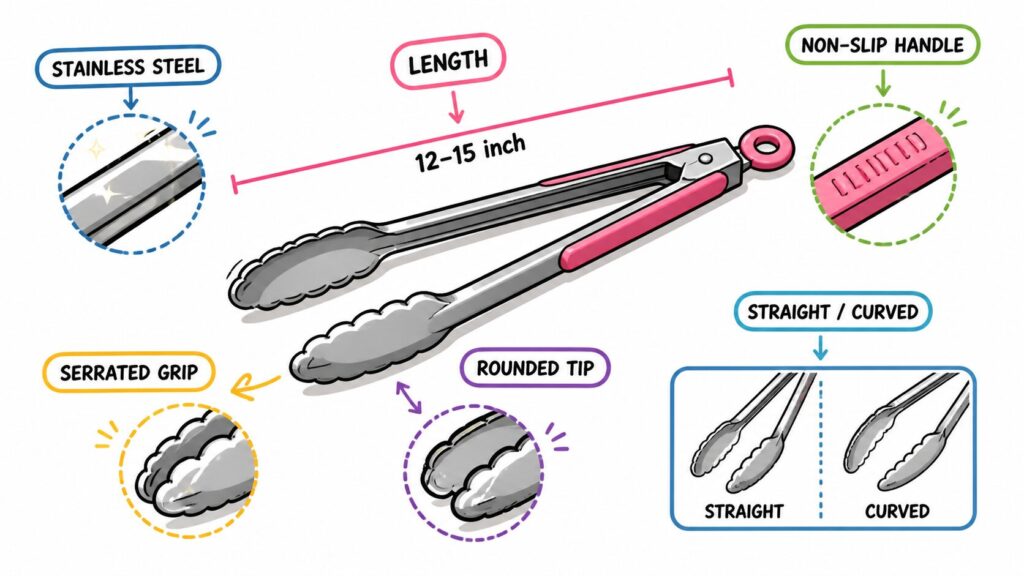
Long enough to reach the tank floor without submerging your arm. The Aqueon 40-gallon breeder — our recommended tank in the best axolotl tank article — has a 16-inch depth. Tongs of 10–11 inches require you to submerge your arm to the elbow to reach the floor. Tongs of 12–15 inches allow you to reach the full tank depth comfortably without getting your arm wet beyond the wrist. For the 40-gallon breeder, 12–15 inches is the ideal range. For deeper tanks, go longer.
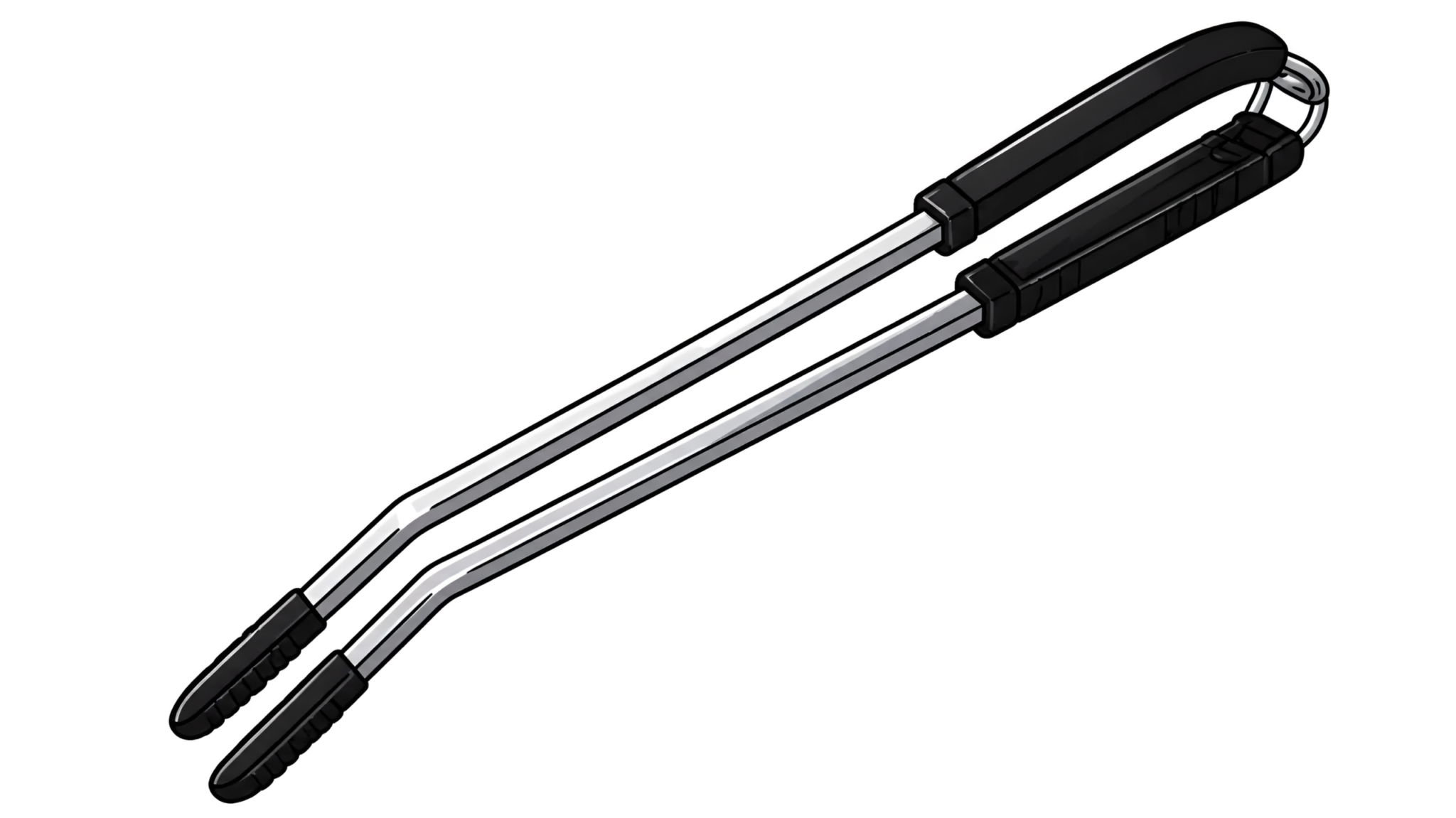
Stainless steel, not plastic. Plastic feeding tongs flex and warp underwater, losing their spring and making precise grip control difficult. Stainless steel tongs hold their shape, provide consistent spring tension, and last for years without degradation. They should be made from food-grade or marine-grade stainless steel — ideally SUS 304 stainless or better — that will not rust or corrode during regular submersion in freshwater.
Serrated or textured tips for secure grip. Smooth-tipped tongs allow food items — particularly worm pieces — to slip out during transfer to the tank. Serrated tips provide the grip needed to securely hold cut nightcrawler pieces, pellets, and bloodworm clusters through the water column without dropping them. The serrations should be fine enough not to damage food items, just coarse enough to grip them reliably.
Appropriate tip profile — straight or curved. Straight tongs are the most versatile for general feeding use, allowing food delivery from directly above and to the front of the axolotl. Curved tongs are useful for reaching into corners, under overhanging decorations, and around hides and caves where an axolotl has retreated. Many products come as a straight-curved pair, which is ideal.
Smooth rounded tips that will not injure your axolotl. If your axolotl strikes at the tongs themselves during feeding — which many will, particularly new, enthusiastic feeders — the tip of the tong must be smooth and rounded enough not to injure the axolotl’s mouth or skin. Sharp, pointed tips are not appropriate for axolotl feeding tongs. Most reputable aquarium tong products use smooth, rounded serrated tips specifically to avoid injury to sensitive animals.
Non-slip handle. You will be using these tongs with wet hands in an underwater environment. A textured, non-slip handle design prevents the tongs from twisting or slipping during use, giving you precise control of food placement.
Our Top Axolotl Feeding Tong Picks
Best Overall (Straight and Curved Set): Fri4Free 2PCS Long Aquarium Tweezers — 10.6-Inch Stainless Steel Straight and Curved
The Fri4Free 2PCS Long Aquarium Tweezers (10.6-Inch Straight and Curved Set) are our top overall pick for axolotl feeding tongs. The product page explicitly names axolotls as a target species alongside reptiles, fish, and amphibians — one of the few tong products with that specific confirmation. The set includes both a straight and a curved pair, giving you the flexibility to reach food on open tank floor with the straight pair and into corners or around hides and caves with the curved pair. Both are made from stainless steel with serrated tips for secure worm and pellet grip, and have smooth curved edges to minimise the risk of mouth injury during feeding strikes. At 10.6 inches they comfortably reach the floor of the Aqueon 40-gallon breeder without submerging your arm past the wrist. The ergonomic handles provide confident non-slip control even with wet hands.
Best for Deeper Tanks: AAProTools 24-Inch Stainless Steel Aquarium Tweezers (Straight)
For keepers with deeper tanks — particularly 55-gallon or 75-gallon setups housing two axolotls as we recommended in our best axolotl tank article — the AAProTools 24-Inch Stainless Steel Aquarium Tweezers (Straight) provide the extra reach needed for a more comfortable, dry-handed feeding experience. At 24 inches, these are long enough to reach the floor of virtually any home aquarium without any arm submersion. The product listing specifically mentions salamanders as a target species, and the forged stainless steel construction with anti-slip handle design provides confident control at full extension. These are the tongs to use when you want to maintain completely dry hands throughout the feeding session.
Best Purpose-Built Axolotl Set: Weewooday 3-Piece Axolotl Tank Accessories with Extra Long Tweezers
The Weewooday 3-Piece Axolotl Tank Accessories Set includes an extra-long tweezers pair, a curved pair, and a coral feeder syringe (which doubles as a small precision turkey baster) in a bundle that is specifically marketed for axolotl tank use. The stainless steel tongs with black coating provide durability and rust resistance, and the serrated tips grip worm pieces and pellets securely. For a new axolotl keeper who wants to assemble their core feeding and spot-cleaning toolkit in one purchase — tongs plus a precision syringe for targeted water removal — this three-piece set is excellent value and purpose-built for the axolotl-specific use case.
Best for Heavy-Duty Use: Dxobay 18.9-Inch Heavy Duty Curved SUS 304 Stainless Steel Aquascape Tweezers
For keepers who want a single robust pair of curved tongs rather than a straight-curved combo set, the Dxobay 18.9-Inch Heavy Duty Extra Long Tweezers (Curved, SUS 304 Stainless Steel) are an excellent standalone option. SUS 304 stainless steel is marine-grade and will not rust even with daily submersion. The 18.9-inch length provides comfortable reach for 40-gallon and larger tanks. The curved tip is particularly useful for feeding an axolotl that has retreated partway into its hide — the curve allows food delivery at an angle that straight tongs cannot achieve. Heavy-duty construction means these will last for the entire lifespan of your axolotl — potentially 10–15 years — without degradation.
Best Value Set: ACEONE 15-Inch Extra Long Aquarium Tweezers (Straight and Curved, 2-Pack)
The ACEONE 15-Inch Aquarium Tweezers Straight and Curved 2-Pack is an excellent mid-length, mid-price option that hits the sweet spot for most standard 40-gallon axolotl setups. At 15 inches both pairs comfortably reach the Aqueon breeder floor with minimal arm submersion. Anti-rust stainless steel construction with non-slip handles, serrated tip grip, and smooth rounded edges make these safe and effective for regular axolotl feeding. The 2-pack pricing makes this one of the better value-for-money tong options on Amazon, and having both straight and curved pairs immediately available means you are equipped for every feeding scenario.
Best Dedicated Axolotl Kit: 4-Piece Axolotl Tank Starter Kit with Hammock, Feeder Bowl, and Tongs
For new axolotl keepers who want to start with a curated set of axolotl-specific accessories, the 4-Piece Axolotl Tank Accessories Set with Hammock, Feeder Bowl, Feeding Tongs, and Tweezers includes a pair of straight and curved feeding tongs (10.6 inches, black-coated stainless steel), a ceramic feeding bowl that can be placed on the tank floor as a designated feeding area, and an axolotl hammock. The ceramic feeding bowl is a particularly useful inclusion — placing food in the bowl rather than directly on substrate keeps food in one easily monitored location, makes retrieval of uneaten food faster, and prevents pellets or worm pieces from disappearing into sand where they degrade unseen. The tongs deliver food into the bowl, your axolotl eats from the bowl, and any uneaten pieces are easily retrieved from the bowl with tongs or a turkey baster.
How to Feed Axolotls Correctly with Feeding Tongs
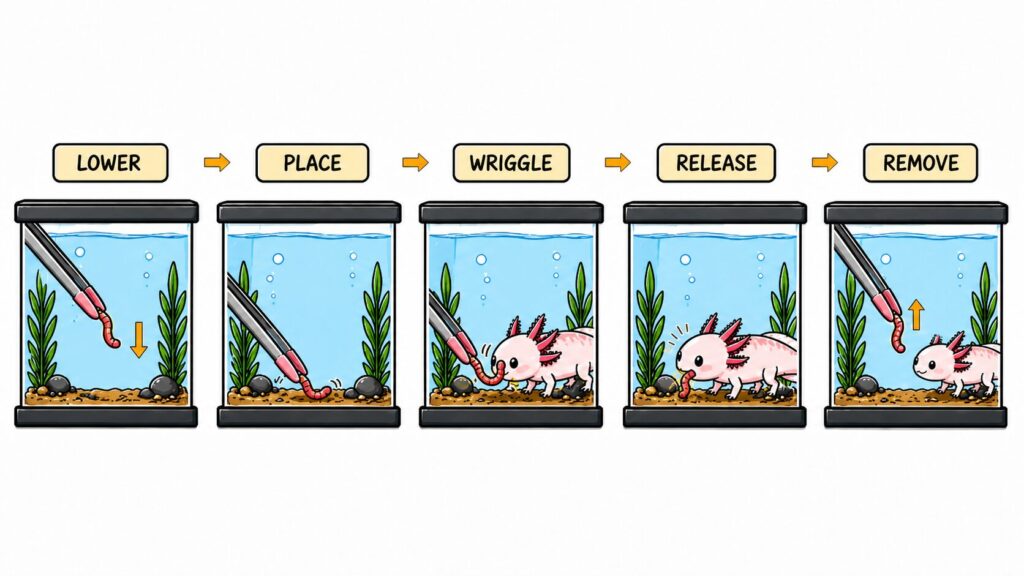
Lower food to floor level, don’t drop from above. The most common beginner mistake is dropping food into the tank from above and expecting the axolotl to find it. Axolotls hunt by smell and ground vibration — they detect prey that is already near them far more reliably than food that falls from a distance and lands in an unpredictable location. Use your tongs to lower the food slowly to tank floor level, bringing it to rest directly in front of your axolotl’s nostrils. You will see the axolotl’s head turn toward the food as it detects the scent.
Wriggle gently to trigger the feeding response. Once food is within detection range, a very gentle wriggling motion — moving the tong tips slightly back and forth — mimics the movement of live prey and triggers the instinctive suction strike. Do not wave the food aggressively at the axolotl’s face — a slow, subtle movement is more effective and less startling. Most axolotls strike within seconds of the food being correctly presented.
Release the food just before the strike. As your axolotl opens its mouth for the strike, release the tong grip very slightly so the food comes free easily when inhaled. Holding too tightly means the axolotl’s suction pulls against your grip, which can cause it to miss the food entirely or to receive only part of the piece.
Remove uneaten food promptly. After allowing 20–30 minutes for feeding to complete, retrieve any uneaten pellets or food pieces with your tongs. Lift them cleanly out of the water and dispose of them — do not drop them on the tank floor where they continue to degrade. For pieces that have partially dissolved or that your tongs cannot grip, switch to a turkey baster to suction them up.
Rinse tongs after every use. Rinse your feeding tongs under clean running water after each feeding session to remove organic residue from the tips. Never use soap or cleaning products — residual detergent introduced to your tank harms your beneficial filter bacteria and your axolotl. Dry fully before storing to prevent any rust spots on lower-grade stainless steel products.
Using Feeding Tongs for Different Axolotl Food Types
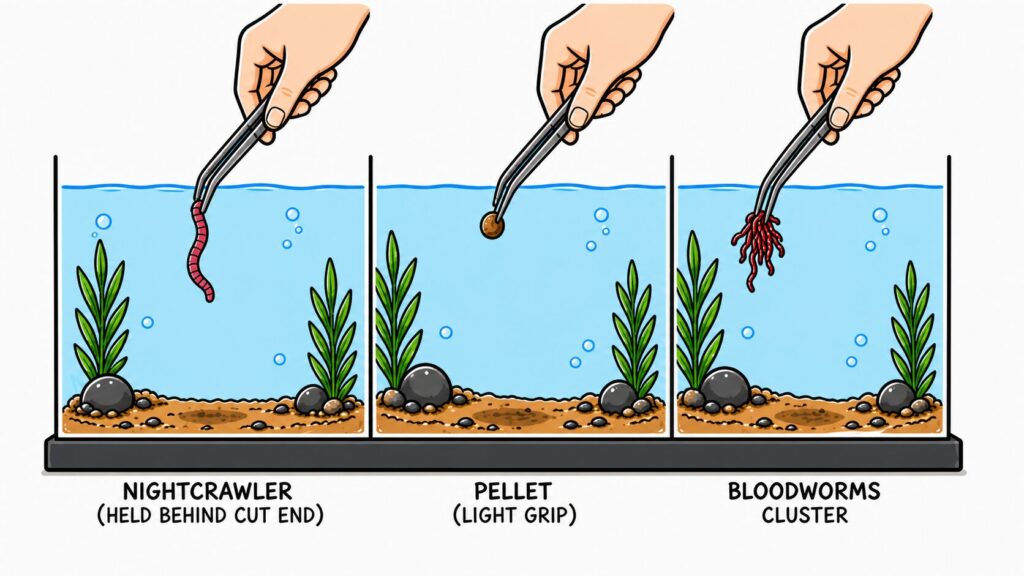
For nightcrawlers. Cut nightcrawler pieces should be held just behind the cut end so they are not bisected by the tong grip. Lower to tank floor level and wriggle gently. Nightcrawlers are the most enthusiastically accepted food by most axolotls — see our best axolotl nightcrawlers guide for preparation and portioning guidance.
For pellets. Hold the pellet very gently between the tips — enough to grip but not so much that you crush it. Wet pellets soften quickly and require a lighter grip than worm pieces. Lower to floor level in front of the axolotl, then wriggle slightly. If the axolotl does not strike, hold still for a moment while the pellet scent diffuses — most axolotls will strike at a stationary pellet once they detect it. See our best axolotl pellets guide for product recommendations.
For bloodworms. A small cluster of thawed frozen bloodworms or re-hydrated freeze-dried bloodworms can be gathered on the tong tips and lowered to floor level. Bloodworms are small enough that the wriggling motion you create with the tongs disperses them slightly into the water near your axolotl, which is ideal. See our best axolotl bloodworms guide for product picks and feeding frequency guidance.
Maintaining Healthy Water Quality Around Feeding
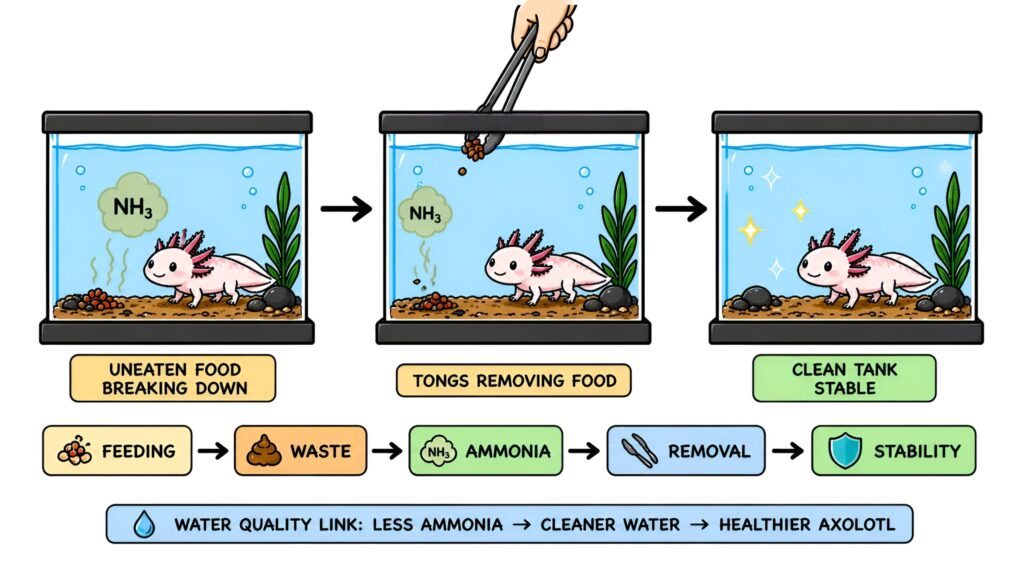
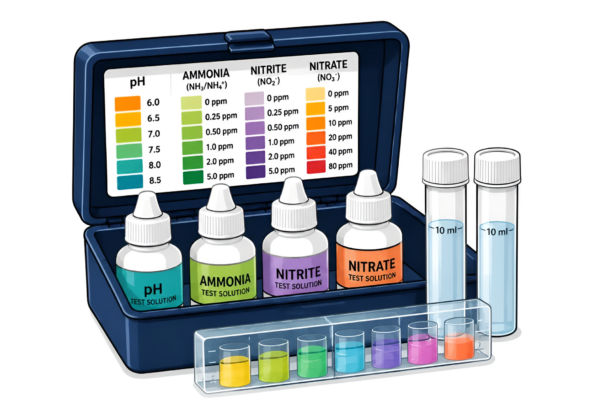
Feeding is the biggest regular driver of water quality changes in an axolotl tank. Every piece of food left uneaten produces ammonia as it decays. Every feeding session requires monitoring and cleanup to keep your water test kit readings stable. Good tong technique — precise delivery, accurate portion monitoring, and prompt retrieval of uneaten food — is the most effective single habit for keeping ammonia under control between weekly water changes.
Pair your feeding routine with regular water conditioner use during water changes and consistent parameter testing, and you give your axolotl the best chance at a long, healthy life. Axolotls can live 10–15 years in captivity with excellent care — and feeding correctly with the right tools is one of the most fundamental ways to support that longevity.
Frequently Asked Questions
Can I feed my axolotl by hand instead of using tongs? Technically yes, but it is not recommended. Axolotls bite at anything near their mouths during a feeding response — including fingers — with a powerful suction strike. While not dangerous to adult humans, hand feeding increases the risk of startling the axolotl, injuring it accidentally during the reaction, and creating a learned feeding association with human hands that causes biting during routine maintenance.
What length feeding tongs do I need for a 40-gallon breeder? 12–15 inches is the ideal range for the Aqueon 40-gallon breeder (16-inch depth). This allows comfortable floor access without submerging your arm past the wrist. For a 55-gallon or larger setup, 18–24 inches is more comfortable.
Do I need both straight and curved feeding tongs? Not strictly — many keepers use only straight tongs for all feeding sessions. Curved tongs are useful for feeding axolotls that have retreated into hides and cannot be reached comfortably with straight tongs. A straight-curved pair covers all scenarios and is worth the minor additional cost if buying a 2-pack set.
How do I clean feeding tongs properly? Rinse with clean running water after each use. Never use soap, detergent, or antibacterial cleaners — any residue introduced to your tank is harmful. Dry fully before storage to prevent rust spots on any exposed steel surfaces.
Can feeding tongs also be used for tank maintenance? Yes — good aquarium tongs are versatile. You can use them to reposition tank decor, adjust plants, retrieve fallen hides, and remove larger debris from the tank floor. Keeping a designated pair for feeding and a separate pair for maintenance prevents cross-contamination from tank surfaces to food.
The Tool That Makes Every Feeding Better
Good feeding tongs are one of those small investments that improve axolotl keeping in ways you feel every single day — cleaner feeding, less water quality stress, safer interaction with your animal, and a more predictable, enjoyable routine. Paired with the right food choices, a reliable turkey baster for cleanup, and a well-maintained tank, they complete the feeding system that keeps your axolotl thriving. For the complete, keeper-tested guide to every product your axolotl needs — from filtration and substrate to health supplies and enrichment — Best Axolotl Products is your one-stop resource for the best gear in every category of axolotl care.